


Creativity Solutions
Part of the Oxford Maths Admissions Test Livestream 2026
These are the solutions for the Creativity worksheet
Warm-up
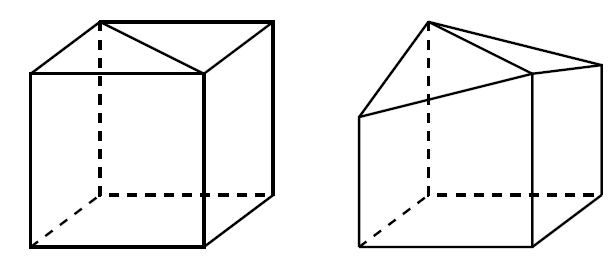
- I decided to start with a cube, because I know that has 8 vertices and 12 edges, which is almost what we're asked for.
- I want to add an edge.
- We can just do that; take one of the square faces and draw an extra edge across the diagonal to make that into two triangular faces.
You might want to move the corners around a little bit, if you don't like the idea of having two triangular faces that line up like that.
Alternatively, you might have decided to start with a pentagon-based pyramid (perhaps working backwards from what's about to happen!), and you might chop off one of the corners around the base. Chopping off one of these corners increases the number of vertices by two and increases the number of edges by three. So the shape goes from having 6 vertices to 8, and from having 10 edges to 13.
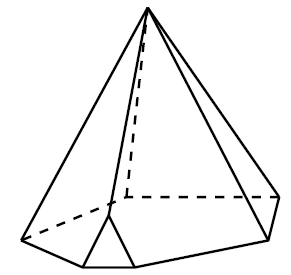
- So the answer is "Yes"!
Extension
- The Extension asks for other combinations of $E$ and $V$. We might also keep track of $F$, the number of faces of the shape.
- Maybe we want to generalise the "add an edge" idea; what happens in general if we draw an extra edge across a face (and maybe move the vertices around a little bit)?
- Maybe we want to generalise the "cut off a corner" idea; if $d$ edges met at a vertex, what happens to $E$ and $V$?
- You might notice that these involve a sort of balancing or trade-off; you can't just change $E$ on its own, you have to change something else too. You might even be able to find some combination of $E$ and $V$ and $F$ that does not change.
Questions
TMUA 2021 Paper 2 Question 4 (modified)
- I started by thinking about $a=2$ because that's a nice small even number.
- There's a problem though; the claim appears to be true! With $a=2$ it reads "if $bc$ is even then $b$ is even or $c$ is even". That's true; if $b$ and $c$ were both odd, then $bc$ would be odd.
- So perhaps I'll try $a=4$ instead. Now I can find a counterexample like $a=4$, $b=2$, $c=2$, where $bc$ is a multiple of $4$ but neither $b$ nor $c$ is.
- What was it about my previous counterexample that made it a success? Can I repeat that with odd numbers like $3$?
- Yes, I could have $a=9$ and $b=3$ and $c=3$. There wasn't anything special about the number 2, despite all the thinking about even and odd numbers I've done so far!
- For a counterexample with square numbers, perhaps I could start with $b$ and $c$ and then look for factors. I'd like $bc$ to have lots of factors, so I'm going to choose $b=36$ and $c=36$. Maybe this is a mistake, because $b$ and $c$ also have lots of factors, but let's give it a try.
- Then $bc=6^4$. So I could take $a=6^4$ and that would be a counterexample, because that is not a factor of $b$ or $c$.
- All my counterexamples so far have had $b=c$ and $a=bc$. Maybe yours are more varied than that. The last pair of exercises is going to make me think a bit more, but maybe you've already discovered counterexamples with $a\lt b\lt c$ or $a\gt b\gt c$.
- The key idea for me is that I can take my counterexamples from before and multiply $b$ and $c$ by "random" prime numbers without changing $a$. Then $a$ will still be a factor of $bc$, but will not be a factor of $b$ or $c$. What do I mean by "random"? Probably just a prime that hasn't appeared in the prime factorisations of $a$ or $b$ or $c$... let's give that a go.
- If I want $b$ and $c$ to be large numbers, I could start with my $(a,b,c)=(4,2,2)$ counterexample and multiply $b$ by $5$ and $c$ by $7$. Then I have $(a,b,c)=(4,10,14)$ and it's still true that $bc$ is a multiple of $4$, but neither $b$ nor $c$ is a multiple of $4$.
- If I want $b$ and $c$ to be small compared with $a$, I could start with my $(a,b,c)=(6^4,6^2,6^2)$ counterexample and multiply $b$ by $7$ and $c$ by $5$. Then I have $(a,b,c)=(6^4,7\times 6^2, 5\times 6^2)$ so $a\gt b\gt c$.
Extension
- Thinking about prime factorisations can help you solve this problem in the sense that you might be able to understand exactly which triples $(a,b,c)$ satisfy the claim and which do not.
TMUA 2020 Paper 2 Question 4 (modified)
- Our counterexample has to satisfy $N\gt 6$. The claim doesn't make any statement about numbers smaller than this, so there's no point in thinking about (for example) whether 4 can be written as the sum of two non-prime integers that are each greater than 1 (it can't, but that's not relevant).
- The number after 6 is 7, so that seems like a good place to start.
- There aren't many ways to write $7$ as the sum of two integers that are greater than 1; working systematically from $2$ upwards for the first number, these are $7=2+5$ and $7=3+4$ and $7=4+3$ and $7=5+2$.
- Each of these involves at least one prime number, so we conclude that it is not possible to write $7$ as the sum of two non-prime integers that are greater than 1.
Extension
- The Extension asks for all counterexamples. What other counterexamples can we find?
- Let's look at the next number. The number $8$ is not a counterexample because $8=4+4$, so $8$ can be written as the sum of two non-prime integers that are each greater than 1 (the claim doesn't say that the non-prime integers have to be different from each other).
- More generally, I think that I can do this for all even numbers greater than $8$. I could write $N = 4 + (N-4)$ and those are both even numbers greater than $2$, so they won't be primes. So I can't find any even counterexamples to this claim.
- Said differently, the claim is true if you add the word "even" near the start; "Every even positive integer $N$ that is greater than 6 can be...".
- What about odd numbers? I'd like to reuse that trick, which involves subtracting a number to leave something that's not prime (perhaps because I know it to be even). I need an odd number that's not prime, and $9$ works nicely. So I can write $N = 9+(N-9)$. When does this work? Well, I'm relying on the idea that $N-9$ is even but not prime, so it had better be greater than 2. So I need $N$ greater than 11.
- That leaves question marks over $N=9$ and $N=11$. Are these counterexamples?
- Yes, it turns out to be impossible to write $9$ or $11$ as the sum of two non-prime integers that are each greater than 1 (just like above, I checked all the ways to write $9$ and $11$ as the sum of two integers that are greater than 1).
- So the statement is true if "$6$" is replaced with "$11$", and that's the smallest number that could replace "$6$" for a true statement.
TMUA 2022 Paper 2 Question 3 (modified)
- A counterexample to the claim would need to be a prime number $n$ for which $n^2+2$ is not prime.
- The converse of the claim is
if $n^2+2$ is prime, then $n$ is prime - A counterexample to the converse of the claim would be a number $n$ for which $n^2+2$ is prime but $n$ is not a prime number.
I think I'll need a table of whether $n$ is prime, and whether $n^2+2$ is prime.
$n$ Is $n$ prime? $n^2+2$ Is $n^2+2$ prime? 1 No 3 Yes 2 Yes 6 No 3 Yes 11 Yes 4 No 18 No 5 Yes 27 No 6 No 38 No 7 Yes 51 No 8 No 66 No 9 No 83 Yes 10 No 102 No - For a counterexample to the claim, I would need Yes in the second column and No in the fourth.
- Those are the values 2 and 5 and 7.
- For a counterexample to the converse of the claim, I would need a No in the second column and Yes in the fourth.
- Those are the values 1 and 9.
Extension
- The question "for which integers $n$ is $n^2+2$ prime?" is difficult. In fact, it is an open problem; at the time of writing nobody even knows whether there are infinitely many such $n$ or only finitely many. Make a start on that question by finding a condition on $n$ such that $n^2+2$ is definitely not prime. You might look at the fourth column of the table above for inspiration.
TMUA 2020 Paper 2 Question 20 (modified)
- The claim "$x \ge 0$ only if $\mathrm{f}(x) \lt 0$" means "if $x \ge 0 $ then $\mathrm{f}(x) \lt 0$".
- The converse of this claim is "if $\mathrm{f}(x) \lt 0$ then $x \ge 0 $".
- I'll choose the function $\mathrm{f}(x) = -x^2-1$. Alternatively, just $\mathrm{f}(x) = -1$ would work.
- The claim "$x \lt 0$ if $\mathrm{f}(x) \ge 0$" means "if $\mathrm{f}(x) \ge 0$ then $x \lt 0$".
- The converse of this claim is "if $x\lt 0$ then $\mathrm{f}(x) \ge 0$".
- This claim is the contrapositive of the previous claim (and the converse of this claim is the contrapositive of the previous claim), so any function that worked for the previous one works here too.
- The claim "$x \ge 0$ only if $\mathrm{f}(x) \ge 0$" means "if $x \ge 0$ then $\mathrm{f}(x) \ge 0$".
- The converse of this claim is "if $\mathrm{f}(x) \ge 0$ then $x \ge 0$".
- I'll choose $\mathrm{f}(x) = 0$.
- The claim "$\mathrm{f}(x) \lt 0$ if $x \lt 0$" means "if $x \lt 0$ then $\mathrm{f}(x) \lt 0$".
- The converse of this claim is "if $\mathrm{f}(x) \lt 0$ then $x \lt 0$".
- I'll choose $\mathrm{f}(x) = -1$.
- The claim "$\mathrm{f}(x) \ge 0$ only if $x \ge 0$" means "if $\mathrm{f}(x) \ge 0$ then $x \ge 0$".
- The converse of this claim is "if $x \ge 0$ then $\mathrm{f}(x) \ge 0$".
- This claim is the contrapositive of the previous claim (and the converse of this claim is the contrapositive of the previous claim), so any function that worked for the previous claim works here too.
Extension
- Suppose that you know that exactly one of these five claims is true for a particular function. Which claim would it have to be? Give an example of such a function.
- The original TMUA question asks you to consider a sixth claim:
$\mathrm{f}(x)\geq 0$ if and only if $x\lt 0$. - Find a function that satisfies this new claim. [Hint: your function can have a "jump".] Suppose that a function satisfies this new claim. For each of the other five claims, decide whether it must be true, or must be false, or could be either true or false.
TMUA 2020 Paper 2 Question 10
- At first sight, we are given just four inequalities $$ 0\lt a+b, \quad \text{and}\quad a+b\lt c+d, \quad \text{and}\quad 0\lt a+c, \quad \text{and}\quad a+c\lt b+d. $$
- But we can derive more inequalities from these. For example, the first two together imply that $0\lt c+d$.
- The key is going to be working out how to combine these inequalities to produce the ones in claims I, II, and III, or finding counterexamples to show that the claims do not always hold.
- The last claim looks the most approachable, because I've already noticed that $c+d\gt 0$. I also know that $a+b\gt 0$. So I can be sure that $a+b+c+d$ will be positive, as it's the sum of $a+b$ (positive) with $c+d$ (positive).
- For the others, I think that some cancellation would need to happen in order to produce an inequality so simple. Something else might have been on both sides of the inequality. I wonder what?
- That thought didn't get me very far, so I played around with the given inequalities instead. If I add $a+b\gt 0$ and $a+c\gt 0$ I get $2a+b+c\gt 0$. That's not very helpful!
- If I add $c+d\gt a+b$ and $b+d\gt a+c$ then I get $c+b+2d \gt 2a+b+c$. That's helpful, because that's claim I, after I subtract $b+c$ from each side and divide by 2.
- What about claim II? After some more messing around, I haven't produced anything that leads to $b\lt c$. So I think it's worth trying to find a counterexample instead.
- I'll use positive numbers so that I don't have to think about $a+b\gt 0$ and $a+c\gt 0$.
- Is it possible to have $a+b\lt c+d$ and also $a+c\lt b+d$ while having $b\geq c$? I notice that the "while having" does not involve $a$ or $d$, and in both "is it possible" inequalities, I want something involving $a$ to be less than something involving $d$.
- So perhaps I can make $a$ much less than $d$, so much that $b$ and $c$ don't really matter.
- My counterexample is $a=100$, $b=2$, $c=1$, and $d=1000$. Then $102\lt 1001$ and $101\lt 1002$, while having $2\geq 1$.
- Alternatively, I could try something simple like $b=c=0$ and then any $a$ and $d$ with $0\lt a\lt d$.
- The answer is F.
Extension
- Find a counterexample to claim II where $a$ and $b$ and $c$ and $d$ are all prime numbers.
- Find a counterexample to claim II where $a$ and $b$ and $c$ and $d$ are all square numbers.
TMUA 2020 Paper 2 Question 18
- Let's think about each claim one by one.
- The first claim looked tempting to me at first, because I thought that if $a\gt p$ then I would have $ax^3 \gt px^3$.
- But that's not true, because $x$ might be negative! More importantly, I should be thinking about the converse of that; I'm being asked whether, given $\mathrm{f}(x)\gt\mathrm{g}(x)$ for all real $x$, can I always say that $a\gt p$?
- It would help if I had some pairs of cubic polynomials such that $\mathrm{f}(x)\gt\mathrm{g}(x)$. I like to keep my examples simple, so I started with $\mathrm{f}(x)=x^3$ and then tried to think of a cubic polynomial with $\mathrm{f}(x)\gt\mathrm{g}(x)$ for all real $x$.
- The easiest way to do this is to subtract $1$ everywhere, so I set $\mathrm{g}(x)=x^3-1$. This is a counterexample for claim I, because $a=p$ (they're both 1).
- Claim II looked tricky to me, so I thought about claim III next. The pair of functions above does satisfy $d\gt s$, so I can't use them as a counterexample again.
- Since I've made an attempt to find a counterexample and now I'm (already!) out of ideas, I'll try to prove that the claim is true instead.
- The breakthrough for me was when I remembered that $d$ is the $y$-intercept of $y=\mathrm{f}(x)$. If we have $\mathrm{f}(x)-\mathrm{g}(x)\gt 0$ for all real $x$, that includes $x=0$, so we must have $\mathrm{f}(0)-\mathrm{g}(0)\gt 0$. That is precisely $d-s\gt 0$. So claim III is true.
- Time to go back to claim II. Because I'd just had success thinking about $x=0$, I thought about the derivative and second derivative at $x=0$. This didn't get me anywhere, so I thought about writing out the statement $\mathrm{f}(x)\gt\mathrm{g}(x)$ in full.
- This is $(ax^3+bx^2+cx+d) - (px^3+qx^2+rx+s)\gt 0$ for all real $x$, and if $b=q$ then the $(b-q)x^2$ term is zero.
- So we have $(a-p)x^3+(c-r)x+(d-s)\gt 0$ for all real $x$.
- At this point, quite late on, I realised that if the difference is a cubic polynomial then it can't be positive for all real $x$.
- We must have $a=p$ so that this is not a cubic on the left. That would have made claim I easier to deal with!
- Then, thinking about claim II, our inequality becomes $(c-r)x+(d-s)\gt 0$ for all real $x$. That also looks impossible, because a line won't stay above the $x$-axis for all $x$, unless it's a horizontal line.
- That means that $c-r=0$. So claim II is true.
- The answer is G.
Extension
- Find a version of claim II for polynomials of degree 5 instead of degree 3.
Part of an Interview
- We're being asked to look for a "simple" function $y(x)$ with $$ x^3 \frac{\mathrm{d}^2y}{\mathrm{d}x^2}+x\frac{\mathrm{d}y}{\mathrm{d}x}-y=0. $$
- It's hard to see where to start; that first term $ \displaystyle x^3 \frac{\mathrm{d}^2y}{\mathrm{d}x^2}$ is really horrible to work with.
- What if that first term were zero?
- That happens if $y=Ax+B$. Can I make one of those functions work?
- I would need $$ x\frac{\mathrm{d}y}{\mathrm{d}x}-y=0. $$
- So I want $x\times(A)-(Ax+B)=0$.
- This is easy to achieve; I can just set $B=0$ and I can choose $A$ to be anything I like.
- I'm going to pick $A=1$, so my solution is $y=x$. You might choose a different multiple of this solution, in which case your calculations might have a factor of $A$ in them compared with mine.
- Now we're instructed to try $y=v(x)\times y_1(x)$, where $y_1$ is the solution that we already found. I'll rewrite this as $y=x v$ for simplicity, now that I know $y_1$.
- The differential equation involves $\dfrac{\mathrm{d}y}{\mathrm{d}x}$ and $\dfrac{\mathrm{d}^2y}{\mathrm{d}x^2}$, and I should work out what these are in terms of $v$. This needs the product rule; $$\frac{\mathrm{d}}{\mathrm{d}x}\left(xv\right)=v+x\frac{\mathrm{d}v}{\mathrm{d}x}\quad\text{and}\quad \frac{\mathrm{d}^2}{\mathrm{d}x^2}\left(xv\right)=2\frac{\mathrm{d}v}{\mathrm{d}x}+x\frac{\mathrm{d}^2v}{\mathrm{d}x^2} $$ (Just as a note, the product rule is not on the TMUA Content Specification. However, people have often met it by the time of the interview, and it doesn't take long for an interviewer to teach it on the spot if need be.)
- Then I can put these into the differential equation to see what happens. I get a horrible mess! $$ x^3 \left( 2\frac{\mathrm{d}v}{\mathrm{d}x}+x\frac{\mathrm{d}^2v}{\mathrm{d}x^2} \right)+x\left( v+x\frac{\mathrm{d}v}{\mathrm{d}x} \right)- \left(xv\right)=0. $$
- Perhaps the interviewer gives some encouragement to simplify this expression, grouping together terms that have the same number of derivatives.
- This becomes $$ x^4 \frac{\mathrm{d}^2v}{\mathrm{d}x^2} + (2x^3+x^2)\frac{\mathrm{d}v}{\mathrm{d}x} = 0 $$
- The term involving $v$ has cancelled!
- This looks like a second-order differential equation, but it's secretly a first-order differential equation for $\dfrac{\mathrm{d}v}{\mathrm{d}x}$. The interviewer might help the candidate to spot this.
- (I've chosen this differential equation because every step that follows, all the way to the final answer, is technically in A-level Mathematics or Further Mathematics. Of course, that doesn't mean that the people I'm interviewing midway through their academic year have seen it yet. So I might need to prompt people on various steps. I cannot stress this enough; I would not expect an A-level student to do the rest of the calculation unguided.)
- There's a general strategy for differential equations of the form $$ \frac{\mathrm{d}u}{\mathrm{d}x} +P(x) u = 0, $$ using an "integrating factor". We multiply both sides by $\operatorname{exp}\left(\int P(x)\,\mathrm{d}x\right)$ to turn the two terms into the sort of thing that you get from the product rule. Our differential equation would be in that form if we divided both sides by $x^4$ and wrote $u=\dfrac{\mathrm{d}v}{\mathrm{d}x}$ and $P(x)=\dfrac{2x+1}{x^2}$.
- The fiddly bit is working out $$ \operatorname{exp}\left(\int \frac{2x+1}{x^2}\,\mathrm{d}x\right) = \operatorname{exp}\left(\int \frac{2}{x}+\frac{1}{x^2}\,\mathrm{d}x\right)=\operatorname{exp}\left(2\ln |x| -\frac{1}{x}\right)=x^{2}\operatorname{exp}\left(-\frac{1}{x}\right) $$ Several of the steps here might need help from the interviewer. The differential equation becomes $$ \frac{\mathrm{d}}{\mathrm{d}x}\left(x^{2}\operatorname{exp}\left(-\frac{1}{x}\right)u\right) = 0 $$ so $$ x^{2}\operatorname{exp}\left(-\frac{1}{x}\right) u= c $$ for some constant $c$.
- We're almost done. We have found that $$ \frac{\mathrm{d}v}{\mathrm{d}x} = c x^{-2}\operatorname{exp}\left(\frac{1}{x}\right). $$ One more integral (by substitution, perhaps) will give us $$ v(x)= -c \operatorname{exp}\left(\frac{1}{x}\right)+d, $$ where $d$ is a constant of integration that just replicates the $y_1$ solution we had before.
- After all of that, we have a second solution to the original differential equation, so (setting $A=d$ and $B=-c$ to tidy up) our general solution can be written as $$y(x)= Ax+Bx \operatorname{exp}\left(\frac{1}{x}\right).$$