


Geometry
Part of the Oxford Maths Admissions Test Livestream 2026
TMUA Specification (April 2025, Section 1 §MM3)
- Equation of a straight line, including:
- $y - y_1 = m(x - x_1)$
- $ax + by + c = 0$
- Conditions for two straight lines to be parallel or perpendicular to each other.
- Finding equations of straight lines given information in various forms.
- Coordinate geometry of the circle, using the equation of a circle in the forms:
- $(x - a)^2 + (y - b)^2 = r^2$
- $x^2 + y^2 + cx + dy + e = 0$
- Use of the following circle properties:
- The perpendicular from the centre to a chord bisects the chord.
- The tangent at any point on a circle is perpendicular to the radius at that point.
- The angle subtended by an arc at the centre of a circle is twice the angle subtended by the arc at any point on the circumference.
- The angle in a semicircle is a right angle.
- Angles in the same segment are equal.
- The opposite angles in a cyclic quadrilateral add to $180^\circ$.
- The angle between the tangent and chord at the point of contact is equal to the angle in the alternate segment.
There is also a part of the TMUA Specification listing content that test-takers are expected to recall from GCSE or equivalent. For most of these worksheets, we haven't felt the need to include this content, but for geometry in particular, here is a list of selected items that you might find it useful to revise.
TMUA Specification (April 2025, Section 1 §M5) -- selected items
- Recall and use the properties of angles at a point, angles on a straight line, perpendicular lines and opposite angles at a vertex.
- Understand and use the angle properties of parallel lines, intersecting lines, triangles and quadrilaterals.
- Derive and apply the properties and definitions of special types of quadrilaterals, including square, rectangle, parallelogram, trapezium, kite and rhombus.
- Identify and use conventional circle terms: centre, radius, chord, diameter, circumference, tangent, arc, sector and segment (including the use of the terms minor and major for arcs, sectors and segments).
- Calculate arc lengths, angles and areas of sectors of circles.
- Describe translations as 2-dimensional vectors.
- Apply addition and subtraction of vectors, multiplication of vectors by a scalar, and diagrammatic and column representations of vectors.
Revision
- Points in the plane can be described with two coordinates $(x,y)$. The $x$-axis is the line $y=0$, and the $y$-axis is the line $x=0$.
- A straight line has equation $y=mx+c$, where $m$ is the gradient and $c$ is the $y$-intercept. Other ways to write the equation of a line are $ax+by+c=0$ (where that's a different $c$ to the one in the previous expression) or $y-y_1=m(x-x_1)$. The last expression is useful because that line goes through the point $(x_1,y_1)$ and has gradient $m$, which might be information that we've been given.
- Two lines are parallel if and only if they have the same gradient. Two lines are perpendicular if and only if their gradients multiply to give $-1$.
- The equation of the circle with centre $(a,b)$ and radius $r$ is $(x-a)^2+(y-b)^2=r^2$.
- If we expand the brackets in that equation, then we would get $x^2+y^2-2ax-2bx+a^2+b^2-r^2$. So if we see an equation of the form $x^2+y^2+cx+dy+e=0$ then that would represent a circle with centre $\displaystyle \left(-\frac{c}{2},-\frac{d}{2}\right)$ and radius $\displaystyle \sqrt{\frac{c^2}{4}+\frac{d^2}{4}-e}$, if the term inside the square root is positive. If that term is zero, this equation describes a single point, and if it's negative then the equation does not describe any points in the $(x,y)$-plane.
- A circle with radius $r$ has area $\pi r^2$ and circumference $2\pi r$.
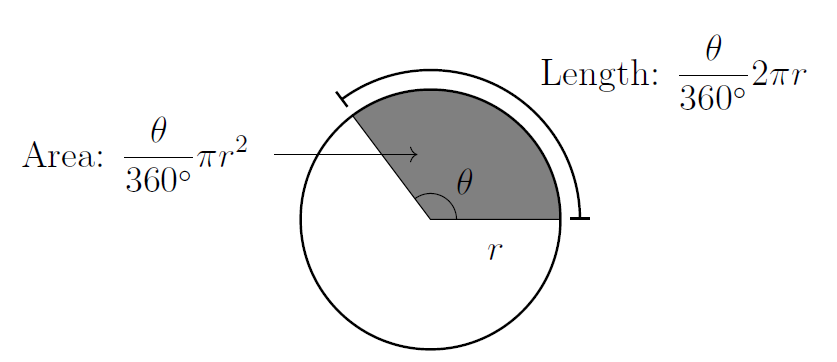
For a circle with radius $r$, suppose that two radii make an angle $\theta$. The arc subtended by $\theta$ has length $\displaystyle\frac{\theta}{360^\circ}2\pi r$ if you measure $\theta$ in degrees, or $\displaystyle \theta r$ if you measure $\theta$ in radians.
The area of the sector enclosed by that arc and the radii is $\displaystyle\frac{\theta}{360^\circ}\pi r^2$ if you measure $\theta$ in degrees, or $\displaystyle \frac{1}{2}\theta r^2$ if you measure $\theta$ in radians.
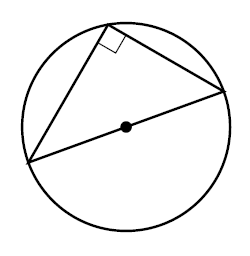
Circle Theorems.
The angle in a semicircle is a right angle; if $AB$ is the diameter of a circle, and $C$ is on the circle, then $\angle ACB=90^\circ$. Conversely, if triangle $ABC$ is right-angled at $C$, then the centre of the circle passing through $A$, $B$, and $C$ is the midpoint of the hypotenuse $AB$.
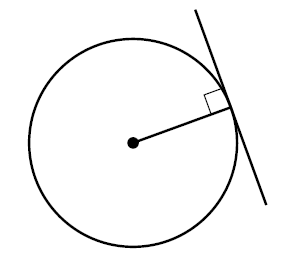
The tangent is at right angles to the radius at any point on a circle's circumference. Conversely, if a line passes through a point on the circle's circumference and is at right angles to the radius, then it is a tangent.
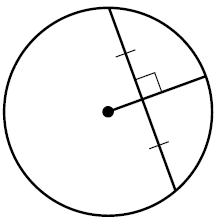
The perpendicular from the centre to a chord bisects the chord. You can check that this is true by drawing radii that connect the centre to each point on the circumference, and then using Pythagoras to find the lengths.
The angle subtended by an arc at the centre of a circle is twice the angle subtended by the arc at any point on the circumference.
You can check this by drawing in one more radius, and then naming the angles in the isosceles triangles that you've formed.
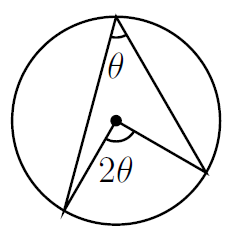
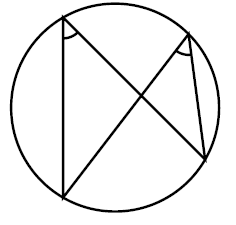
Angles in the same segment are equal. This follows from the previous fact, because these angles subtend the same arc, so the angle at the centre is equal.
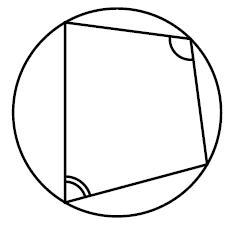
The opposite angles in a cyclic quadrilateral add to $180^\circ$. You can check that this is true by drawing radii that connect the centre to each point, and then naming the angles in the isosceles triangles that you've formed.
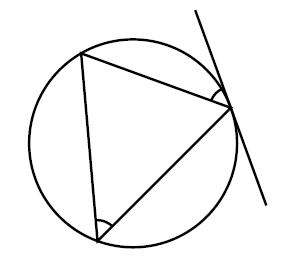
If you draw a tangent to a circle at point $A$, and draw a triangle $ABC$ with points on the circle, then the angle between $AB$ and the tangent is equal to the angle $BCA$. You can check this by drawing in the radii that connect the centre to $A$ and $B$ and chasing angles around, using the above facts.
- The angles at a point sum to $360^\circ$. Angles on a straight line sum to $180^\circ$. Opposite angles where two lines cross are equal. If a line crosses two parallel lines then the corresponding angles it makes with each of the parallel lines are equal.
- A parallelogram is a quadrilateral where both pairs of opposite sides are parallel. Each pair of opposite sides is therefore equal in length, but the four sides might not all be the same length as each other. The diagonals of a parallelogram bisect one another.
- A trapezium is a quadrilateral with one pair of opposite sides that are parallel.
- A kite is a quadrilateral with reflectional symmetry along one of its diagonals. Therefore it has two pairs of sides that are equal length. The diagonals of a kite cross at right angles.
- A rhombus is a parallelogram with all four sides the same length. Equivalently, a rhombus is a kite with all four sides the same length. The diagonals of a rhombus bisect one another at right angles.
- Triangles are similar if they have the same angles (they might be different sizes, and they might be translated / rotated / reflected / all of the above when compared with one another).
- More generally, two shapes are similar if one can be obtained from the other by some sequence of translations, rotations, and reflections. Note that these transformations all preserve angles and all preserve ratios of lengths (but not necessarily actual lengths).
- Triangles are congruent if they have the same side lengths and the same angles (they might be translated / rotated / reflected / all of the above). On the trigonometry worksheet, we will see several sufficient conditions that tell us that two triangles are congruent.
- A vector $\displaystyle \binom{x}{y}$ can store the same information as a pair of coordinates. Used in that sense, the vector is called a position vector.
- A vector can also describe the displacement from one point to another, so that $\displaystyle\binom{2}{1}$ could represent the displacement from $(1,1)$ to $(3,2)$ for example.
- Vectors can be added by adding the components separately. To show that in a diagram, we might interpret the first vector as a position vector (drawing an arrow starting from the origin) and then interpret the second as a displacement (drawing an arrow starting from the end of the first vector).
- The magnitude of the vector $\displaystyle\binom{x}{y}$ is $\sqrt{x^2+y^2}$.
- The distance from $A$ to $B$ is the magnitude of the vector displacement from $A$ to $B$. The distance from $(x_1,y_1)$ to $(x_2,y_2)$ is $\sqrt{(x_2-x_1)^2+(y_2-y_1)^2}$.
- A vector can be multiplied by a number by multiplying each component by that number. The result is a vector in the same direction but with scaled magnitude.
Revision Questions
- Find the equation of the line through the points $(1,5)$ and $(3,-1)$.
- Find the equation of the line through the point $(3,5)$ with gradient 2.
- A circle has centre $(-1,2)$ and radius 3. Write down an equation for the circle. What's the area of this circle? Where does this circle cross the axes?
- A circle is given by $x^2+9x+y^2-3y=10$. Find the centre and radius of the circle.
- Points $A$ and $B$ lie on a circle with centre $O$ and radius 2. The angle $\angle AOB$ is 120$^\circ$. Find the length of the arc between $A$ and $B$. Find the area enclosed by that arc and the radii $OA$ and $OB$.
- Two circles are given by $x^2+y^2=4$ and $(x-2)^2+y^2=4$. Find the area of the region that's inside both circles.
- A circle has centre $(c,0)$ and radius $1$. The area in the region $x>0$ which is inside the circle depends on $c$, and we'll call it $A(c)$. Sketch a graph of $A(c)$ against $c$.
- The points $(0,0)$ and $(1,a)$ and $(0,a+a^{-1})$ all lie on the same circle. Find the centre of the circle in terms of $a$.
- Twelve equally-spaced points are marked on the circumference of a circle. Three of them are selected and labelled $A$ and $B$ and $C$. What are the possible values for angle $ABC$?
- Show that the points $(0,5)$, $(1,3)$, $(2,6)$, and $(3,4)$ lie on the corners of a square.
- Show that the points $(0,0)$, $(0,4)$, $(3,2)$, $(3,1)$ form a trapezium. Find its area.
- Use similar triangles to prove that the diagonals of a kite cross at right angles.
- Find equations of three lines such that the finite region bounded by the three lines is an equilateral triangle.
- Draw a diagram to show the three separate position vectors $\displaystyle \binom{3}{2}$ and $\displaystyle\binom{-4}{1}$ and $\displaystyle\binom{1}{-2}$.
- Add the vectors $\displaystyle \binom{3}{2}$ and $\displaystyle \binom{-4}{1}$. Show the resulting vector on your diagram from the previous question.
TMUA Questions
TMUA 2020 Paper 1 Question 16
The circle $C_1$ has equation $(x+2)^2 + (y-1)^2 = 3$
The circle $C_2$ has equation $(x-4)^2 + (y-1)^2 = 3$
The straight line $l$ is a tangent to both $C_1$ and $C_2$ and has positive gradient.
The acute angle between $l$ and the $x$-axis is $\theta$
Find the value of $\tan\theta$.
(A) $\dfrac{1}{2}$
(B) $2$
(C) $\dfrac{\sqrt{2}}{2}$
(D) $\sqrt{2}$
(E) $\dfrac{\sqrt{6}}{2}$
(F) $\dfrac{\sqrt{6}}{3}$
(G) $\dfrac{\sqrt{3}}{3}$
(H) $\sqrt{3}$
[Scroll down for hints]
TMUA 2021 Paper 1 Question 20
Find the length of the curve with equation
$$2\log_{10}(x - y) = \log_{10}(2 - 2x) + \log_{10}(y + 5)$$
(A) $5$
(B) $10$
(C) $15$
(D) $3\pi$
(E) $9\pi$
(F) $12\pi$
[Scroll down for hints]
TMUA 2021 Paper 2 Question 7
A circle has equation $(x-9)^2 + (y+2)^2 = 4$
A square has vertices at $(1,0)$, $(1,2)$, $(-1,2)$ and $(-1,0)$.
A straight line bisects both the area of the circle and the area of the square.
What is the $x$-coordinate of the point where this straight line meets the $x$-axis?
(A) $2$
(B) $3$
(C) $4$
(D) $4.5$
(E) $5$
(F) $6$
(G) The straight line is not uniquely determined by the information given, so there is more than one possible point of intersection.
(H) There is no straight line that bisects both the area of the circle and the area of the square.
[Scroll down for hints]
TMUA 2022 Paper 1 Question 4
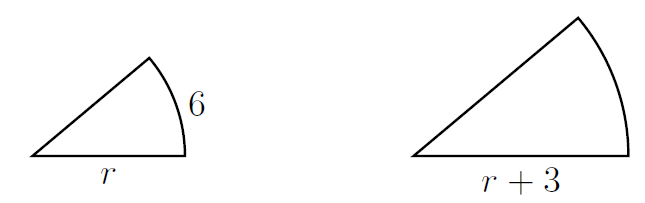
These sectors of circles are similar.
The arc length of the smaller sector is 6.
The difference between the areas of the sectors is 21.
Find the positive difference between the perimeters of the sectors.
(A) $4.5$
(B) $7$
(C) $8$
(D) $9$
(E) $10.5$
(F) $14$
(G) $15$
[Scroll down for hints]
TMUA 2022 Paper 1 Question 14
A circle has centre $O$ and radius 6.
$P$, $Q$ and $R$ are points on the circumference with angle $POQ \ge \dfrac{\pi}{2}$
The area of the triangle $POQ$ is $9\sqrt{3}$
What is the greatest possible area of triangle $PRQ$?
(A) $18 + 9\sqrt{3}$
(B) $18\sqrt{3}$
(C) $27 + 9\sqrt{3}$
(D) $27\sqrt{3}$
(E) $36 + 9\sqrt{3}$
(F) $36\sqrt{3}$
[Scroll down for hints]
TMUA 2022 Paper 2 Question 11
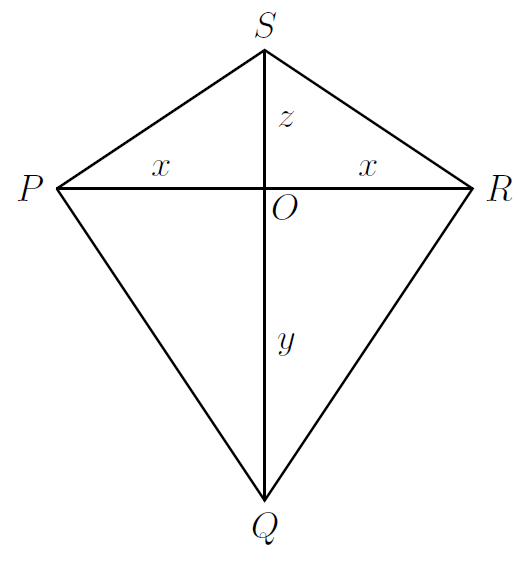
The diagram shows a kite $PQRS$ whose diagonals meet at $O$, with $OP = x$, $OQ = y$, $OR = x$, and $OS = z$.
Which of the following is necessary and sufficient for angle $SPQ$ to be a right angle?
(A) $x = y = z$
(B) $2x = y + z$
(C) $x^2 = yz$
(D) $y = z$
(E) $y^2 = x^2 + z^2$
[Scroll down for hints]
Hints
TMUA 2020 Paper 1 Question 16
- Draw a diagram! This will force you to think about things like the locations of the centres of the circles, and whether they overlap or intersect anywhere.
- What's the radius of each circle? What do you notice?
- Add a line to your diagram that's tangent to both circles and has positive gradient. This line is uniquely determined, which is maybe a bit of a surprise. If you draw in other tangents, convince yourself that they don't have positive gradient.
- Symmetry is powerful. If you can guess a point that lies on the line "by symmetry", that can save you work. You might like to think carefully about whether the point definitely lies on the line.
- If you spot a right-angled triangle, draw a separate diagram of that triangle, labelling what you know. You can probably deduce something, using all the many things you know about right-angled triangles.
- Try to avoid solving for the equation of the line, unless you really want to. There's an angle that you want. Mark it in on your diagram(s).
- Although the question says "the acute angle between $l$ and the $x$-axis", we can replace "the $x$-axis" in that phrase with any line that's parallel to the $x$-axis. Check your understanding; why can we do this?
TMUA 2021 Paper 1 Question 20
- If you haven't met logarithms yet, come back to this question after you have.
- The left-hand side is only defined if $x-y>0$. Similarly, the terms on the right-hand side might not be defined for all values of $x$ and $y$.
- I don't know the lengths of many curves. Something to do with circles, perhaps? I can see factors of $\pi$ in half the options for this question.
- We'll need to manipulate the logarithms to get an equation we can work with, but we should remember where we started.
- Draw a diagram!
TMUA 2021 Paper 2 Question 7
- Draw a diagram!
- What can you say about "a straight line that bisects the area of the circle"? Why?
- What can you say about "a straight line that bisects the area of the square"? Why?
- You'll probably want to solve for the equation of the line for this question, before you find the $x$-intercept.
- Some of the options suggest that there might be no such line, or too many such lines. Focus on trying to solve for the line, and only consider one of these options if you're really having trouble finding the equation of the line (is there some reason why you cannot find the equation of the line?)
TMUA 2022 Paper 1 Question 4
- We could write down the arc length for the larger sector, using the fact that these shapes are similar (ratios between lengths are the same in each diagram). But do we want to do this? Not yet, perhaps.
- The question asks about the "difference between areas", so we should be careful to take the larger area and subtract the smaller area. Luckily, it's pretty clear which sector is larger.
- All the formulas that I know for the area or the arc length of a sector involve an angle. I should give that angle a name.
- The perimeter of a sector is not something I've particularly thought about before, but I assume that it means that I should add all the side lengths together, like I would for a square or rectangle or triangle.
TMUA 2022 Paper 1 Question 14
- Draw a diagram!
- You know several things about triangle $POQ$; the area is directly mentioned in the question, you're told a fact about an angle, and it's clearly related to the circle somehow. It's probably related to the triangle $PRQ$ too, but that's less clear so let's ignore that for now. Can you deduce any facts about the side lengths or angles of triangle $POQ$?
- Don't worry about the precise locations of $P$ and $Q$ and $R$. There's definitely not enough information for us to actually work out where these points are, because the circle can be rotated! That rotation doesn't change the areas in the question, so it just doesn't matter.
- Because it's only the relative positions of $P$ and $Q$ and $R$ that matter, you can draw your diagram so that $PQ$ has a particularly convenient orientation, such as being horizontal or vertical. When you use the convenience of making an arbitrary choice like this, you might say that you are making your choice "without loss of generality".
- With your choice, and your knowledge of triangle $POQ$, you might have $PQ$ (relatively) fixed. The only thing about triangle $PRQ$ left to set is the position of $R$. How can you position this point to maximise the area of the triangle?
TMUA 2022 Paper 2 Question 11
- Recall that the diagonals of a kite meet at right angles.
- Once you've remembered that fact about kites, you can ignore the point $R$ entirely.
- There is an approach for this question that uses right-angled triangles.
- There is an approach for this question that uses similar triangles.
- There is an approach for this question that uses the angle in a semi-circle.