


Integration Solutions
Part of the Oxford Maths Admissions Test Livestream 2026
These are the solutions for the Integration worksheet
Revision Questions
- First find the points where $y=0$. We have $(x+3)(x+1)=0$ so these points are at $x=-1$ or $x=-3$. In between, we have $y<0$ (by considering the graph).
So we want $-\displaystyle \int_{-3}^{-1} x^2+4x+3\,\mathrm{d}x$. That minus sign out the front is because the function is negative in this region. This works out to be $\frac{4}{3}$. -
- $\displaystyle \int \frac{x+3}{x^3}\,\mathrm{d}x=\int \frac{1}{x^2}+\frac{3}{x^3}\,\mathrm{d}x=-\frac{1}{x}-\frac{3}{2x^2}+c$ where $c$ is a constant.
- $\displaystyle \int \sqrt[3]{x}\,\mathrm{d}x=\int x^{1/3}\,\mathrm{d}x=\frac{3}{4}x^{4/3}+c$ where $c$ is a constant.
- $\displaystyle \int \left(\left(x^2\right)^3\right)^5\,\mathrm{d}x=\int x^{30}\,\mathrm{d}x=\frac{x^{31}}{31}+c$ where $c$ is a constant.
- $\displaystyle \int \left(x^2+1\right)^3\,\mathrm{d}x=\int x^6+3x^4+3x^2+1\,\mathrm{d}x=\frac{x^7}{7}+\frac{3x^5}{5}+x^3+x+c$ where $c$ is a constant.
- The graph of $f(-x)$ is the graph of $f(x)$ reflected in $y$-axis. Also, note that if we reflect the interval $-1\leq x \leq 1$ in the $y$-axis then we get the same interval back. On the left-hand side, we're finding the area under $f(x)$ (or maybe negative the area in any regions where $f$ is negative). On the right-hand side, we're calculating exactly the same area, but with the shape of the graph reflected.
- First consider the graph $\displaystyle y=\frac{1}{x}$. The area under the graph between $x=1$ and $x=10$ is $I_1$. Now consider stretching that region by a factor of 10 parallel to the $x$-axis, and squashing it by a factor of 10 parallel to the $y$-axis. The area will be the same, and (amazingly!) any point that was on the curve $\displaystyle y=\frac{1}{x}$ is still on the graph after these transformations. So $I_2$, the area under the graph between $10$ and $100$, is equal to $I_1$.
This means that \[\int_1^{100}\frac{1}{x}\,\mathrm{d}x=\int_1^{10}\frac{1}{x}\,\mathrm{d}x+\int_{10}^{100}\frac{1}{x}\,\mathrm{d}x=I_1+I_2=2I_1.\] But similarly, if we think about stretching the graph again in the same way, we find that $\displaystyle \int_{100}^{1000}\frac{1}{x}\,\mathrm{d}x$ is also equal to $I_1$. By setting $N$ to be a large power of ten, we can make $\displaystyle \int_1^{N}\frac{1}{x}\,\mathrm{d}x$ arbitrarily large. - (i) $\displaystyle \int_0^3 f(x)\,\mathrm{d}x = \int_0^1 f(x)\,\mathrm{d}x+\int_1^2 f(x)\,\mathrm{d}x+\int_2^3 f(x)\,\mathrm{d}x= a+b+c$
(ii) $\displaystyle \int_3^1 f(x)\,\mathrm{d}x = \int_3^2 f(x)\,\mathrm{d}x + \int_2^1 f(x)\,\mathrm{d}x = -\int_2^3 f(x)\,\mathrm{d}x - \int_1^2 f(x)\,\mathrm{d}x = -c-b$
(iii) $\displaystyle \int_0^2 3 f(x)\,\mathrm{d}x = 3\int_0^2 f(x)\,\mathrm{d}x = 3\left(\int_0^1 f(x)\,\mathrm{d}x + \int_1^2 f(x)\,\mathrm{d}x\right) = 3\left(a+b\right)$
(iv) $\displaystyle \int_0^2 f(x)\,\mathrm{d}x + \int_2^1 f(x)\,\mathrm{d}x = (a+b) + (-b) =a$.
(v) The graph of $y=f(x)$ has been reflected. Instead of thinking about $y=f(-x)$ between $-2$ and $0$, we can think about $y=f(x)$ between $0$ and $2$. The integral is $a+b$.
(vi) The graph of $y=f(x)$ between $x=0$ and $x=2$ has been squashed by a factor of 2 to give the graph of $y=f(2x)$ between $x=0$ and $x=1$. Before the squash, the integral would have been $a+b$, but the squash divides the area by 2, for a final answer of $\displaystyle\frac{a+b}{2}$. - Note that $\displaystyle \frac{x^2}{1+x^2}+\frac{1}{1+x^2}=1$ so if we add $I_3$ to the first integral, we will get $\displaystyle \int_1^3 1 \,\mathrm{d}x=2$. So the first integral is $2-I_3$.
Now note that $\displaystyle \frac{x^4}{1+x^2}=x^2-\frac{x^2}{1+x^2}$ so the last integral is $\displaystyle \int_1^3 x^2\,\mathrm{d}x-(2-I_3)=\frac{20}{3}+I_3$. - With $f(t)=t^2$, the Fundamental Theorem of Calculus tells us that this should be $x^2$. Now note that \[\int_0^x t^2\,\mathrm{d}t = \left[\frac{t^3}{3}\right]_0^x=\frac{x^3}{3}\] and then \[\frac{\mathrm{d}}{\mathrm{d}x} \left(\frac{x^3}{3}\right) = \frac{3x^2}{3}=x^2.\]
- This is not quite in the right format to use the Fundamental Theorem of Calculus. But note that we can swap the limits if we introduce a minus sign. So \[\frac{\mathrm{d}}{\mathrm{d}x} \left(\int_x^{10} \sqrt{t^3+8}\,\mathrm{d}t\right) = \frac{\mathrm{d}}{\mathrm{d}x} \left(-\int_{10}^{x} \sqrt{t^3+8}\,\mathrm{d}t\right)=-\frac{\mathrm{d}}{\mathrm{d}x} \left(\int_{10}^{x} \sqrt{t^3+8}\,\mathrm{d}t\right) = - \sqrt{x^3+8}\] where the final equality follows from the Fundamental Theorem of Calculus.
- This is just zero, either by arguing that it represents an area with no width, or by splitting it up as \[\int_x^{x} f(t)\,\mathrm{d}t = \int_a^{x} f(t)\,\mathrm{d}t + \int_x^{a} f(t)\,\mathrm{d}t = \int_a^{x} f(t)\,\mathrm{d}t - \int_a^{x} f(t)\,\mathrm{d}t=0.\]
- To estimate $\displaystyle \int_0^1 4^x \,\mathrm{d}x$ with the trapezium rule with 4 strips, take $x_0=0$, $x_1=\frac{1}{4}$, $x_2=\frac{1}{2}$, $x_3=\frac{3}{4}$, and $x_4=1$. Then the trapezium rule gives \[\frac{1}{2}\times \frac{1}{4} \times \left(1+2\times \left(\sqrt{2}+ 2 + 2\sqrt{2} \right) + 4\right)\] which simplifies to $\dfrac{9 + 6\sqrt{2}}{8}$.
The graph curves upwards (convex) so this is an overestimate of the integral.
In case you care (and to be clear, this is not on the TMUA Content Specification) the exact value of this integral is $\frac{3\log_2 (e)}{2}$, where $e=2.718...$ is the base of natural logarithms. - To estimate $\displaystyle \int_0^1 \sqrt{1-x^2} \,\mathrm{d}x$ with the trapezium rule with 3 strips, take $x_0=0$, $x_1=\frac{1}{3}$, $x_2=\frac{2}{3}$, and $x_3=1$. Then the trapezium rule gives \[\frac{1}{2} \times \frac{1}{3} \times \left( 1 + 2 \times \left( \sqrt{\frac{8}{9}} + \sqrt{\frac{5}{9}} \right) + 0 \right)\] which simplifies to $\dfrac{3+4\sqrt{2}+2\sqrt{5}}{18}$.
The graph curves downwards (concave) so this is an underestimate of the integral.
For the exact value, note that the function is positive and consider the area under the graph. That's precisely the area bounded by the $x$-axis, the $y$-axis, and the curve $x^2+y^2=1$. That's a quarter of the unit circle, and the integral is $\frac{\pi}{4}$.
You can check with a calculator that, indeed, $\dfrac{3+4\sqrt{2}+2\sqrt{5}}{18} < \dfrac{\pi}{4}$. It's not obvious what you might do with this fact. - To solve $\displaystyle \frac{\mathrm{d}y}{\mathrm{d}x}=\frac{1}{x^2}$, we calculate the indefinite integral $\displaystyle \int \frac{1}{x^2}\,\mathrm{d}x$. Our solution will only be determined up to a constant. The indefinite integral is $\displaystyle -\frac{1}{x}+c$ (recalling that $\frac{1}{x^2}$ is $x^{-2}$ and applying the rule).
We want the solution that has $y\approx 3$ when $x$ is large. If $x$ is large then $\displaystyle -\frac{1}{x}$ is small, and so we choose the solution with $c=3$ to make sure that $y\approx 3$. Our solution is $y=3-\frac{1}{x}$.
TMUA Questions
TMUA 2020 Paper 2 Question 13
- I know that $\left(\mathrm{f}(x)\right)^2$ is positive, so the integral $\displaystyle \int_0^3\bigl(\mathrm{f}(x)\bigr)^2\,\mathrm{d}x$ is positive. It represents an area, but I don't know $\mathrm{f}(x)$ so I can't really sketch that area.
- To use the fact that the first integral is positive, I think that I want to move everything else to the right-hand side.
- Then I have $\displaystyle \int_0^1 \mathrm{f}(x)\,\mathrm{d}x \;-\;\int_0^3 \mathrm{f}(x)\,\mathrm{d}x$ on the right-hand side, and that simplifies to $\displaystyle -\int_1^3 \mathrm{f}(x)\,\mathrm{d}x$. I want to simplify like this because I can see that it's going to involve the range $1\leq x\leq 3$ that's in one of the claims.
- Here's what we know now; $\displaystyle -\int_1^3 \mathrm{f}(x)\,\mathrm{d}x$ is positive. This means that, without the minus sign, $\displaystyle \int_1^3 \mathrm{f}(x)\,\mathrm{d}x$ is negative.
- That can't happen if $\mathrm{f}(x)>0$ for all values in $1\leq x \leq 3$, because if that were the case then the integral would represent a positive area. But the value of the integral is negative! So claim I is necessarily true.
- Time to look at claim II. I've seen these integrals already! Let's rearrange this inequality like we did with the equation earlier, by moving the $\displaystyle \int_0^3 \mathrm{f}(x)\,\mathrm{d}x$ to the right-hand side.
- This simplifies in the same way as before. We're asked whether $\displaystyle 0 \leq -\int_1^3 \mathrm{f}(x)\,\mathrm{d}x$.
- Yes, that's what we had before. So claim II is necessarily true.
- The answer is D.
Extension
- Let's find a function $\mathrm{f}(x)$ that satisfies the equation in the question. We'll start small and build up.
For example, the function with $\mathrm{f}(x) = 0$ for all $x$ works (but is a boring example).
Is there a constant $c$ such that $\mathrm{f}(x)=c$ works? We already know that $c=0$ would work, and maybe we'll find more solutions. - If that works, then next we could look for a linear function $\mathrm{f}(x)=mx+c$ and keep going from there. Or we could try other functions entirely!
TMUA 2020 Paper 2 Question 16
- The student has been asked to calculate a $\dfrac{\mathrm{d}}{\mathrm{d}x}\!\left(\displaystyle\int_x^{2x} t^2\,\mathrm{d}t\right)$. I read that quite carefully because I wanted to make sure that the student hadn't copied it down wrong. I reckon I could calculate that if I had to, but let's read the student's work first.
- I also looked at the split of the integral in line (I) carefully although, in hindsight, it would have been quite a boring question if the error happened straight away.
- Line (II) is just FTC, nothing to see here.
- Line (III) has $2x$ as the upper limit. That doesn't match the statement of FTC in the question (where the upper limit is $x$, matching the variable that we will differentiate with respect to). That's suspicious to me.
- Just in case, let's do a little sanity check by calculating the expression on each side of the equation in line (III). This is easier than calculating the whole expression at the top of the question.
- On the left, the integral is \[\displaystyle \int_0^{2x} t^2\,\mathrm{d}t = \left[ \frac{t^3}{3}\right]_0^{2x}=\frac{(2x)^3}{3}-\frac{0}{3}=\frac{8x^3}{3}.\]
- This has derivative $8x^2$. The student's work in line (III) has $4x^2$. This is the first line with an error.
- As it happens, the rest of the student's work are fine, except for the error carried forwards from this mistake.
- The answer is D.
Extension
- The student could learn from this; they should only use the theorem as written! If you need a more general version then you'll need to be careful.
If I were using this as the start of an interview question, then next I might tell you this general version of FTC; \[\frac{\mathrm{d}}{\mathrm{d}x} \left(\int_{a(x)}^{b(x)}\mathrm{f}(t)\,\mathrm{d}t \right) = b'(x)\mathrm{f}(b(x)) - a'(x)\mathrm{f}(a(x)).\] We might work together to work out why this is true. We might check that in the special case where $a(x)$ is constant and $b(x)=x$, we get back to the version of FTC that you've seen.
TMUA 2021 Paper 1 Question 7
- The condition $x\mathrm{f}(x)>0$ looks a bit unusual to me. To understand it, I'll split it into cases where $x>0$ and where $x<0$ (because I want to divide by $x$, and I'm worried about the effect on the inequality sign). This shows me that $\mathrm{f}(x)>0$ for $x>0$ and $\mathrm{f}(x)<0$ for $x<0$.
- I can use this observation to understand $\displaystyle \int_{-2}^{2} |\mathrm{f}(x)|\,\mathrm{d}x$.
- Let's split up the integral into two integrals, one with $x\leq 0$ and one with $x\geq 0 $; \[\int_{-2}^{2} |\mathrm{f}(x)|\,\mathrm{d}x = \int_{-2}^{0} |\mathrm{f}(x)|\,\mathrm{d}x \;+\; \int_{0}^{2} |\mathrm{f}(x)|\,\mathrm{d}x.\]
- For the first integral, $\mathrm{f}(x)<0$, so we could write $\displaystyle \int_{-2}^{0} |\mathrm{f}(x)|\,\mathrm{d}x = - \int_{-2}^{0} \mathrm{f}(x)\,\mathrm{d}x $. For the second integral, $\mathrm{f}(x)>0$ so we don't get a minus sign.
- So (splitting up the other integral similarly) we have \[\int_{-2}^{0} \mathrm{f}(x)\,\mathrm{d}x \;+\; \int_{0}^{2} \mathrm{f}(x)\,\mathrm{d}x=4 \quad \text{and} \quad -\int_{-2}^{0} \mathrm{f}(x)\,\mathrm{d}x \;+\; \int_{0}^{2} \mathrm{f}(x)\,\mathrm{d}x=8\]
- These look like simultaneous equations to me. I'll write for $A=\int_{-2}^{0} \mathrm{f}(x)\,\mathrm{d}x$ and $B$ for $\int_0^2 \mathrm{f}(x)\,\mathrm{d}x$.
- I have $A+B = 4$ and $-A+B=8$, with solution $A=-2$ and $B=6$.
- At this point, I misread the question and thought that I was done, because at first I didn't see $|x|$ in the integral that we're asked for, $\displaystyle \int_{-2}^0 \mathrm{f}(|x|)\,\mathrm{d}x$. When I was checking my work, I saw that we're not just being asked for $A$ here!
- What is $\mathrm{f}(|x|)$ when $-2\leq x \leq 0$? It's $\mathrm{f}(-x)$, and that is positive.
- So this integral represents an area. Which area?
- It's the area under the graph $y=\mathrm{f}(x)$ between 0 and 2. That's been reflected in the $y$-axis to give the area under the graph $y=\mathrm{f}(-x)$. But that reflection doesn't change the area.
- So we don't want the value of $A$, we want the value of $B$.
- The answer is G.
Extension
- I've reasoned with areas above, but in fact it is a true fact about integrals that \[\int_a^b \mathrm{f}(x)\,\mathrm{d}x = \int_{-b}^{-a} \mathrm{f}(-x)\,\mathrm{d}x.\] Check this fact in the case $\mathrm{f}(x)=x^n$ with $n$ a positive integer.
TMUA 2021 Paper 1 Question 15
- I wrote out the sum $\mathrm{g}(x)= \mathrm{f}(x)+\mathrm{f}(2x)+\dots + \mathrm{f}(2^9 x)$
- We want to integrate this, and we can integrate term-by-term and then add.
- We're only interested in values of $x$ between 0 and 1.
- So to integrate $\mathrm{f}(x)$ from 0 to 1, I just have to calculate the area below the first straight-line segment of gradient 1. That's a triangle with area $\frac{1}{2}$.
- For $\mathrm{f}(2x)$, the graph of $\mathrm{f}(x)$ between 0 and 2 will be squashed down to give a triangular graph from 0 to 1. That's got area $\frac{1}{2}$.
- You'd be forgiven for skipping to the conclusion that all of these integrals are going to be $\frac{1}{2}$, and that is in fact true!
I wanted to do one more, so I sketched $\mathrm{f}(4x)$, for which the area is not just a triangle but is instead a pair of triangles.
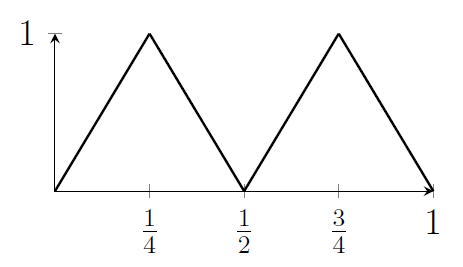
- These triangles have the same height, and equal bases that sum to 1. So their areas will sum to $\frac{1}{2}$.
- Because $2^k$ is always a whole number, the graph will always be a bunch of triangles, with total area $\frac{1}{2}$.
- The sum of 10 of these will be 5.
- The answer is C.
Extension
- If I were using this as the start of an interview question, then next I might ask you about $\displaystyle \int_0^1 \mathrm{f}(kx)\,\mathrm{d}x$ if $k>0$ is not a whole number. Now we probably have to do some integration!
- (Hard) Sketch the graph of $y=\left|x-\left\lfloor x \right\rfloor - \frac{1}{2}\right|$, where $\left\lfloor x \right\rfloor$ means the largest integer that's less than or equal to $x$. Describe a sequence of graph transformations that would transform your sketch to the graph of $y=\mathrm{f}(x)$.
TMUA 2021 Paper 2 Question 20
- I wanted to start by sketching $\mathrm{f}_2(x)= \left| |x|+x \right|$.
- Let's split into separate cases where $x \geq 0$ and $x\leq 0$, to see what happens with the inner $|x|$.
- In the first case, when $x\geq 0$, the inner $|x|$ is just $x$, so we have $\mathrm{f}_2(x) =|2x|$
- In the second case, when $x\leq 0$, the inner $|x|$ is $-x$. This cancels with the "$+x$" and we have $\mathrm{f}_2(x) = 0$. Interesting!
- Then I wanted to see what would happen next, so I worked out that $\mathrm{f}_3(x) = 3x$ for $x \geq 0$ and $\mathrm{f}_3(x) = -x$ for $x \leq 0$. So it's not zero this time for $x \leq 0$. Interesting!
- The next one would be $\mathrm{f}_4(x)$. I worked out that $\mathrm{f}_4 (x) = 4x$ for $x\geq 0$ and $\mathrm{f}_4 (x) = 0$ for $x \leq 0$. Zero again. Interesting!
- I can see some patterns, and it seems pretty clear from the way the algebra has been going that these patterns will keep happening;
- For $x \geq 0$, the gradient just keeps increasing by 1 each time.
- For $x \leq 0$, $\mathrm{f}_n(x)$ is 0 if $n$ is even, or $-x$ if $n$ is odd.
- So I expect $\mathrm{f}_{99}(x)$ to be $-x$ from $-1$ to 0 and then $99x$ from 0 to 1
- $ \displaystyle \int_{-1}^0 (-x)\,\mathrm{d}x = -\left[ \frac{x^2}{2}\right]_{-1}^0 = -\left(\frac{0}{2}-\frac{1}{2}\right)= \frac{1}{2}$.
- $ \displaystyle \int_{0}^1 (99x)\,\mathrm{d}x = 99\left[ \frac{x^2}{2}\right]_{0}^1 = 99\left(\frac{1}{2}-\frac{0}{2}\right)=\frac{99}{2}$.
- The total of those integrals is 50.
- The answer is E.
Extension
- Here's another sequence of functions.
Let $\mathrm{g}_1(x)=x-2\sqrt{x}+1$ and then for integer $n>1$, let $\mathrm{g}_n(x)=\mathrm{g}\left(\mathrm{g}_{n-1}(x)\right)$.
Sketch $y=\mathrm{g}_1(x)$.
Sketch $y=\mathrm{g}_2(x)$.
Find $\mathrm{g}_{1729}(100)$.
Check your sketch of $y=\mathrm{g}_2(x)$ with Desmos; define $g(x)$ in Desmos and plot $y=g(g(x))$. Does this match your sketch? If not, would you like to change your answer for $\mathrm{g}_{1729}(100)$?
TMUA 2022 Paper 1 Question 7
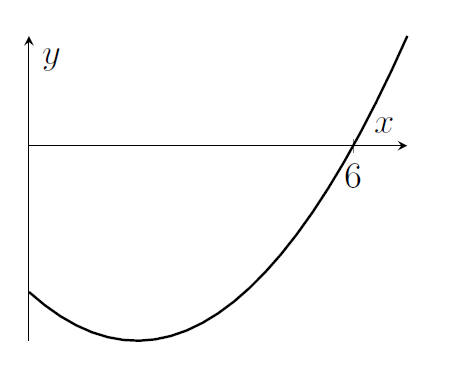
- I started with a sketch for $x>0$, because in that region we just have $y=x^2-4x-12$.
That factorises as $(x-6)(x+2)$. The $y$-intercept is negative. There's a turning point at $x=2$. The graph is negative for $0<x<6$.
- The graph $y=x^2-4|x|-12$ has reflectional symmetry in the $y$-axis, because if $(x,y)$ is a point on the graph then so is $(-x,y)$ and vice versa. So we'll get the same area in the region $x\leq 0$ as we get in the region $x\geq 0$.
- My plan here is "integrate, remember the minus sign, double". The minus sign is there because the function is negative, so integrating will give $-1$ times the area.
- For the limits of the integral, I should integrate from 0 to 6 so that I get all of this finite region between the curve and the x-axis.
- $\displaystyle \int_0^6 \left(x^2-4x-12\right)\,\mathrm{d}x = \left[ \frac{x^3}{3} - 2x^2 - 12x\right]_0^6 = 72-72-72=-72$
- According to my plan, I want to double this and multiply by $-1$ (sanity check; this will give a positive value for the area, phew)
- I get 144.
- The answer is E.
Extension
- If I were using this as the start of an interview question, then next I might ask you to describe the key features of the graph $y=x^2-4|x|-12$ and discuss how these might change if we instead sketched $y=ax^2+b|x|+c$ for some other values of $a$ and $b$ and $c$.
- For the graph in the question we could draw two tangents near $x=0$, one that's tangent to the curve for very small positive $x$ and one that's tangent to the curve for very small negative $x$. How could you calculate the angle between these tangents? (don't actually do this for the curve in the question). Are there values of $a$ and $b$ and $c$ such that this angle is $60^\circ$?