

Networks seminar
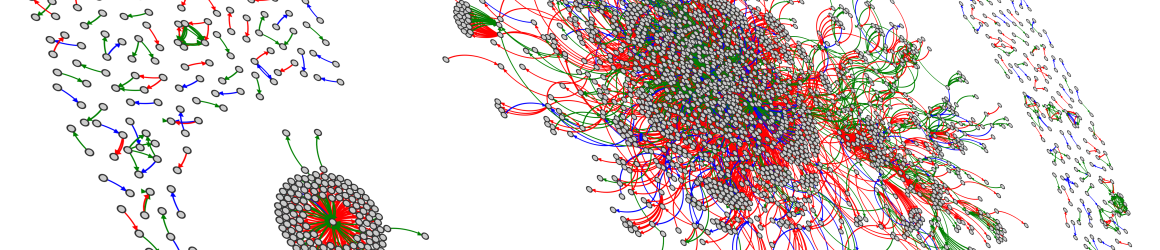
Welcome to the homepage of the Networks seminars, a weekly seminar series on networks, complex systems, and related topics held in the Mathematical Institute. In this year's series, we will alternate between regular talks and "fresh from the arXiv" talks (FFTA) in which we invite the author of a recently published (pre)print to discuss their work. Suggestions are always welcome!
The Networks seminar usually takes place on Tuesdays at 14:00-15:00. In line with current regulation, we are excited to announce that the seminars will now run with a new hybrid format that will allow attendees to choose whether to join our group in person in room C1 at the Mathematical Institute, or to attend remotely on Zoom. A link to the event will be made available in the schedule of upcoming talks below (for logged-in users) and via the mailing list.
To sign up to our mailing list simply send an empty email to the following address:
@email
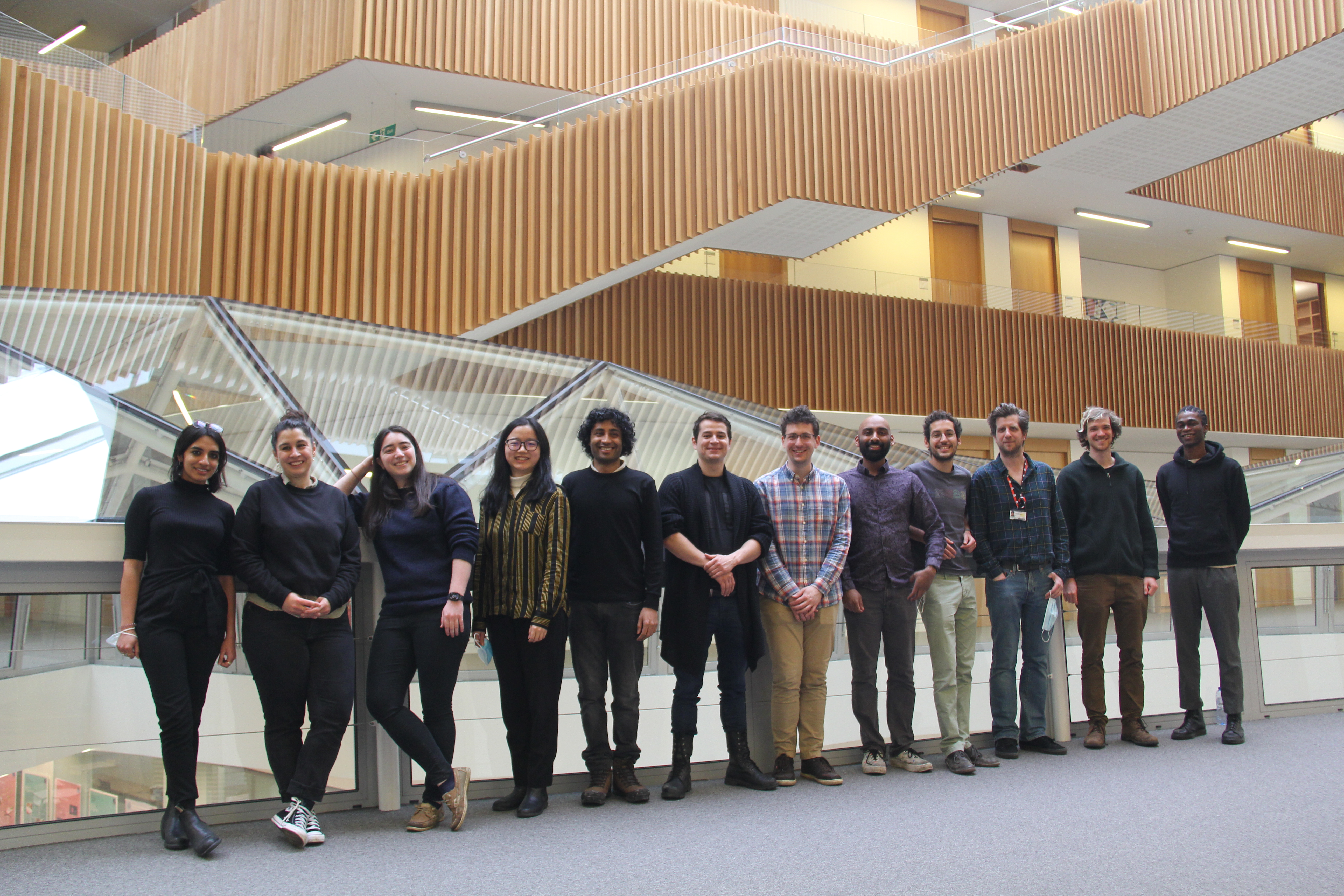
If you would like to give a presentation at our seminar, please do not hesitate to contact the organisers Erik Hörmann and Yu Tian. The presentation can be either about your own work or on some (recent) interesting article on networks or on complex systems in general.
In case you missed any of the talks, we will also make recordings of the talks available on our youtube channel.
Upcoming Seminars
Topology shapes dynamics of higher-order networks
Abstract
Permutation-Invariant Spectral Learning via Dyson Diffusion
Abstract
Diffusion models are central to generative modeling and have been adapted to graphs by diffusing adjacency matrix representations. The challenge of having up to $n!$ such representations for graphs with $n$ nodes is only partially mitigated by using permutation-equivariant learning architectures. Despite their computational efficiency, existing graph diffusion models struggle to distinguish certain graph families and their spectra, unless graph data are augmented with ad hoc features.
This shortcoming stems from enforcing the inductive bias within the learning architecture.
In this work, we leverage random matrix theory to analytically extract the spectral properties of the diffusion process, allowing us to push most of the inductive bias from the architecture into the dynamics. Building on this, we introduce the Dyson Diffusion Model, which employs Dyson's Brownian motion to capture the spectral dynamics of an Ornstein-Uhlenbeck process on the adjacency matrix.
Furthermore, conditioned on the spectral dynamics, we formulate a Lie group diffusion, appropriately modeling the remaining degrees of freedom. Strikingly, the resulting learning problem becomes permutation invariant at the Lie algebra level.
We demonstrate that the Dyson Diffusion Model learns graph spectra accurately and outperforms existing graph diffusion models.
This is joint work with Cai Dieball, Constantin Kogler, Renaud Lambiotte, Arnaud Doucet, Aljaz Godec, and George Deligiannidis.
Paper: Schwarz, T., Dieball, C., Kogler, C., Lambiotte, R., Doucet, A., Godec, A., Deligiannidis, G., 2026, Permutation-Invariant Spectral Learning via Dyson Diffusion, Accepted at NeurIPS 2026
You can also find a list of all talks (with abstracts) prior to 2018 here, and the former website
of the Networks journal club at the Oxford complexity center (CABDyN) here.
Unsubscribing?
Simply send an empty email to
@email