Ruth Baker awarded a Whitehead Prize by the LMS
Professor Ruth Baker has been awarded a Whitehead Prize by the London Mathematical Society for her outstanding contributions to the field of Mathematical Biology.


Ruth Baker awarded a Whitehead Prize by the LMSProfessor Ruth Baker has been awarded a Whitehead Prize by the London Mathematical Society for her outstanding contributions to the field of Mathematical Biology. |
|
Kishan Patel wins 2014 Hansjoerg Wacker PrizeCongratulations to Kishan Patel who has won the 2014 Hansjoerg Wacker Prize of the European Consortium for Mathematics in Industry. This prize is awarded for a Masters thesis on Industrial Mathematics. Kishan completed the MSc in Scientific Computing and Mathematical Modelling in 2012 at the University of Oxford and his dissertation on 'Imaging with X-Ray Emitter Arrays' was supervised by Raphael Hauser and sponsored by Radius Health. The chairman of the Prize Committee wrote: 'This year’s winner stands out due to a very impressive combination of different areas of mathematics, excellent algorithmic and programming skills together with a significant impact for an industrial imaging process.'
|
|
Mathematical Institute receives a Green Impact Award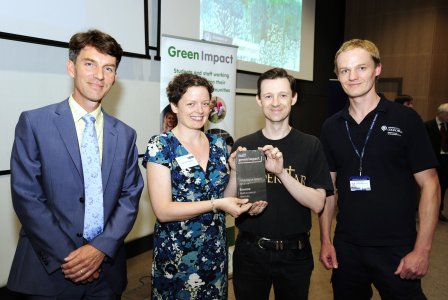
The Mathematical Institute was one of 12 departments who scooped a Bronze Award at the Universitys first ever Green Impact Awards Ceremony held on 18th June 2014 hosted at the Andrew Wiles Building, Mathematical Institute. This award is in recognition for our achievements in a number of areas, including promoting green IT, recycling methods, sustainable energy efficient buildings, travel and cycling schemes and encouraging staff to reduce their energy usage. The University signed up to Green Impact last year - an environmental accreditation and award scheme which helps departments improve their working environments for all, whilst gaining recognition for their efforts. During this first successful year, 199 members of staff have formed 23 departmental teams across the University. These teams help deliver a range of sustainable initiatives - impacting over 5000 members of staff. Vice Chancellor, Professor Andrew Hamilton attended to present awards alongside other representatives from across the University. Many thanks to everyone who has contributed to our success. For more information about the scheme please contact a member of our building operations team. Quotes from the Vice-Chancellor"environmental sustainability is the responsibility of us all
|
|
Oxford Mathematics Public Lectures: "Love and Math", Edward Frenkel, 07 JulyWe are delighted to announce our latest Public lecture featuring the recently published book "Love and Math" by Edward Frenkel. Presentation and discussion in the Andrew Wiles Building, Mathematical Institute, University of Oxford Moderator: Marcus du Sautoy, Simonyi Professor for the Public Understanding of Science, University of Oxford Questions can be submitted by Twitter using the hashtag #loveandmath. The presentation will be followed by a book signing. "Love and Math" tells two intertwined stories: the wonders of mathematics and one young man's journey learning and living it. The book shows that mathematics - far from occupying a specialist niche - goes to the heart of all matter, uniting us across cultures. Edward works on the Langlands correspondences. Considered by many to be a Grand Unified Theory of mathematics, the Langlands Programme enables researchers to translate findings from one field to another so that they can solve hard problems that had seemed intractable before. "Love and Math" is an invitation to discover the hidden magic universe of mathematics. For more information, visit http://loveandmathbook.com/ |
|
Miguel Walsh wins the Ramanujan PrizeThe 2014 Ramanujan Prize has been awarded to Miguel Walsh of the Mathematical Institute in the University of Oxford for his outstanding contributions to Ergodic Theory and Number Theory, including a proof of the norm convergence of multiple polynomial or nilpotent ergodic averages, a long-standing problem in ergodic theory, and important results in inverse sieve problems leading to a sharp bound on the number of rational points on curves. In March Dr Walsh was awarded a Clay Research Fellowship, which he takes up on July 1. He will hold the fellowship in Oxford. The Ramanujan Prize is awarded jointly by the International Centre for Theoretical Physics (ICTP) in Trieste, the Department of Science and Technology (Government of India) and the International Mathematical Union. More details can be seen on the ICTP website. |
|
Mathematical Institute Teaching Awards announcedCongratulations and thanks to the following winners of the Mathematical Institute Teaching Awards: Lifetime Teaching Awards: Prof. Karin Erdmann, Dr Jackie Stedall and Prof. David Stirzaker. Individual Teaching Awards: Prof. Peter Howell, Prof. Colin Macdonald, Prof. Michael Monoyios, Prof. Oliver Riordan and Prof. Paul Tod. The awards will be presented at the Undergraduate Welcome Party in the Michaelmas Term. |
|
Oxford Mathematics Interviews: 'Extra Time: Professor Sir Roger Penrose in conversation with Andrew Hodges.'These two films explore the development of Sir Roger Penrose’s thought over more than 60 years, ending with his most recent theories and predictions. In the first film, Roger Penrose explains the impact of his time at Cambridge in the 1950s. The interview brings out his highly unconventional choice of subjects for deep study, which completely ignored the boundary between ‘pure’ and ‘applied’ mathematics. Those familiar with his world-leading development of relativity theory in the 1960s may be surprised to learn how much he was influenced by quantum theory in the 1950s, and also by the early origin of his new ideas. Roger also explains the influence of Dirac, Sciama and other leading figures of the 1950s, and goes on to characterise the emergence of twistor theory. Non-experts will be interested to hear how the ideas of his best-known work, The Emperor’s New Mind, also had an origin in this early period. He also adds fascinating detail about the psychology of mathematical discovery, explaining how he was very slow at school, needing extra time to think issues through for himself. The mystery of time, in physics and human consciousness, runs through the entire conversation, and lights up even the most technical aspects of the discussion. In the second film, the emphasis shifts to the recent developments in Roger Penrose’s thought. He gives a very clear outline of his argument for Conformal Cyclic Cosmology as the correct description of the Big Bang. However, the conversation turns once again to the precursors of these ideas in the 1950s, with new anecdotes about Dirac and the origin of Roger Penrose’s geometrical innovations. Bringing the discussion up to the present moment, Roger describes the impact of recent observations of primordial magnetic fields and also addresses the significance of his own predictions for the form of ‘dark matter’. And in a closing segment, the discussion turns to the current discoveries in neurology and biophysics relevant to Roger Penrose’s theory of microtubules as advanced in Shadows of the Mind. The discussion ends tantalisingly with renewed speculation on the foundations of quantum mechanics and its relation to general relativity. Roger concludes: "to me eternity is not such a long time." |
|
Mason Porter wins 2014 Erdős–Rényi PrizeAssociate Professor Mason Porter has won the 2014 Erdős–Rényi Prize. The prize is awarded to a selected young scientist (under 40 years old on the day of the nomination deadline) for their achievements in research activities in the area of network science, broadly construed. While the achievements can be both theoretical and experimental, the prize is aimed at emphasizing outstanding contributions relevant to the interdisciplinary progress of network science. The prize awarding ceremony and lecture took take place in a special session at the conference portion of NetSci 2014 on Jun 2-6, 2014 in Berkeley California, at the Claremont Hotel and the Clark Kerr Campus of the University of California. |
|
Fernando Alday wins most acclaimed lecturer awardCongratulations to Professor Fernando Alday who won the Oxford University Student Union (OUSU) Teaching Award in the “Most Acclaimed Lecturer” category for the Mathematical, Physical & Life Sciences Division. |
|
Endre Süli and Fernando Alday recognised by their studentsCongratulations to Professors Endre Süli and Fernando Alday who have been nominated for Oxford University Student Union (OUSU) Teaching Awards in the “Most Acclaimed Lecturer” category. |