What if you need to search through months of video files
to identify a red car that was in shot for just a few seconds. Or how long do you have to scrub
something before it can be considered clean? No big deal if it is the washing-up but what if there are hazardous chemicals in your
workplace?
The answer to both problems is mathematics. Demonstrating this fact was the driving force
for the 100th European Study Group with Industry which took place in
Oxford from 7-11 April. Nine companies from sectors as diverse as chemicals,
logistics, data processing, government and retail presented problems to a range
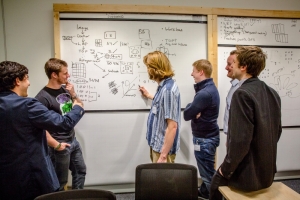
of the world’s best mathematicians in an intensive week of brainstorming. The
mathematicians’ brief was simple. Prove that mathematics can work in the real
world and have a commercial application and value.
 The result? The video search group came up with brand new
algorithms for decompressing jpeg files to make objects recognisable by
sharpening the edges in the image and reducing the computer-generated
artefacts. Glynn Wright, CEO of Aralia, the company involved, said "we now have a clear insight
into how we may advance the state-of-the-art in automated scene analysis. The
range of skills brought to bear by graduates and professors alike forms a
solid basis for our R&D that will keep Aralia busy for many months to come.
Some of the results promise to be of considerable significance to virtually
everyone who uses digital images."
The result? The video search group came up with brand new
algorithms for decompressing jpeg files to make objects recognisable by
sharpening the edges in the image and reducing the computer-generated
artefacts. Glynn Wright, CEO of Aralia, the company involved, said "we now have a clear insight
into how we may advance the state-of-the-art in automated scene analysis. The
range of skills brought to bear by graduates and professors alike forms a
solid basis for our R&D that will keep Aralia busy for many months to come.
Some of the results promise to be of considerable significance to virtually
everyone who uses digital images."
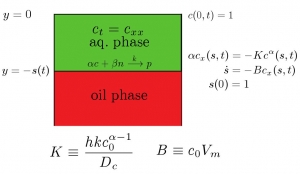 In parallel the cleansing group modelled the movement of hazardous
materials and decontaminants through carpets and concrete. The key new insight
was that cleansing is better if the reaction produces products that are soluble
in the decontaminant rather than the hazardous material. "The week was a
great success" said Anthony Arkell and Hasmitta Stewart of the Government
Decontamination Service. "The range of chemicals and types of surfaces
proved to be an impossible task to prioritise and investigate within a
laboratory but the outcomes from ESGI 100 will allow us to target further
research and development and provide better advice in the interim. It was also
a great pleasure to be involved with such a range of talented and enthusiastic
people". These successes were repeated across the week as mathematicians and industrialists worked side by side on shared interests and goals.
In parallel the cleansing group modelled the movement of hazardous
materials and decontaminants through carpets and concrete. The key new insight
was that cleansing is better if the reaction produces products that are soluble
in the decontaminant rather than the hazardous material. "The week was a
great success" said Anthony Arkell and Hasmitta Stewart of the Government
Decontamination Service. "The range of chemicals and types of surfaces
proved to be an impossible task to prioritise and investigate within a
laboratory but the outcomes from ESGI 100 will allow us to target further
research and development and provide better advice in the interim. It was also
a great pleasure to be involved with such a range of talented and enthusiastic
people". These successes were repeated across the week as mathematicians and industrialists worked side by side on shared interests and goals.
We often hear that mathematics underpins science. We hear
less how it underpins industry. The 100th Study Group and its predecessors
demonstrate that mathematics is a crucial industrial resource and that
industrial R&D can provide fantastic challenges for mathematicians. For more information please contact Chris Breward (@email).








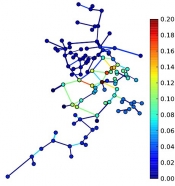 Perhaps Bugs Bunny would not have taken a wrong turn at
Albuquerque if he'd only known some more network analysis? In a paper published in
Perhaps Bugs Bunny would not have taken a wrong turn at
Albuquerque if he'd only known some more network analysis? In a paper published in