


Geometry Solutions
Part of the Oxford Maths Admissions Test Livestream 2026
These are the solutions for the Geometry worksheet
Revision Questions
- This line has gradient $(-1-5)/(3-1)=-3$ and goes through $(1,5)$ so it's $y-5=-3(x-1)$ which can also be written as $y=8-3x$.
- This must be $y=2x+c$ for some constant $c$, and the line goes through $(3,5)$ so $5=6+c$ and so the line is $y=2x-1$.
$(x+1)^2+(y-2)^2=3^2$
The area is $\pi r^2$ and $r=3$ so the area is $9\pi$.
The circle meets the $x$-axis where $(x+1)^2+(0-2)^2=3^2$. That's $x=-1\pm \sqrt{5}$.
The circle meets the $y$-axis where $(0+1)^2+(y-2)^2=3^2$. That's $y=2\pm\sqrt{8}$.
- $x^2+9x+y^2-3y=\left(x+\frac{9}{2}\right)^2+\left(y-\frac{3}{2}\right)^2-\frac{81}{4}-\frac{9}{4}$. The equation of the circle is $\left(x+\frac{9}{2}\right)^2+\left(y-\frac{3}{2}\right)^2=10+\frac{90}{4}$. So the centre is $\left(-\frac{9}{2},\frac{3}{2}\right)$ and the radius is $\sqrt{\frac{65}{2}}$.
Draw a diagram.
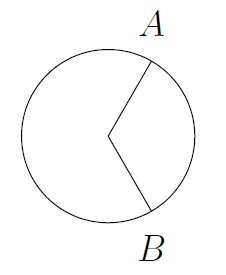
Since $120^\circ$ is one-third of $360^\circ$, the length of the arc is one-third of the length of the circumference $2\pi r$ with $r=2$. So the length of the arc is $\frac{4}{3}\pi$. The area is one-third of $\pi r^2$, which works out to be $\frac{4}{3}\pi$ (coincidentally the same value as the length of the arc).
Draw a diagram.
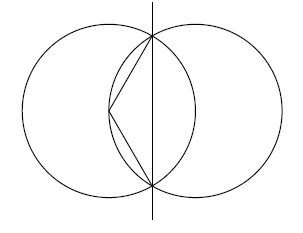
Find the points of intersection. Taking the difference between the two equations gives $x^2=(x-2)^2$, so $x=2-x$ or $x=x-2$, which only has $x=1$ as a solution. The $y$-coordinates are $\pm \sqrt{3}$, and the angle at the centre is $120^\circ$. Let's aim to find the area to the right of $x=1$ that's inside both circles. That's the area of the sector from the previous question, minus the area of a triangle. We can use $\frac{1}{2}ab \sin\theta$ to work out the area of the triangle, $\sqrt{3}$.
Then we'll need to double the area to get our final answer of $\frac{8}{3}\pi -2\sqrt{3}$.
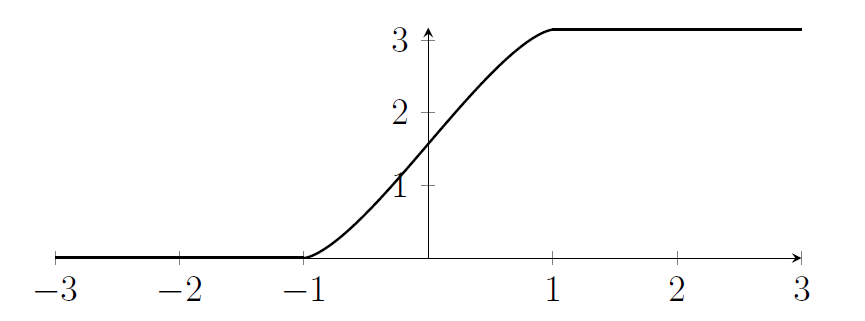
The area $A(c)$ is zero if $c<-1$ and it's $\pi$ if $c>1$. In between, the area rises from 0 to $\pi$ in a nice symmetric manner; slow then fast then slow.
Draw a diagram.
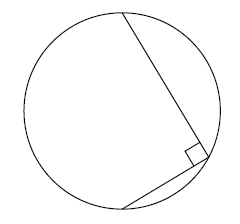
We could write down equations for the distance of a general point $(x,y)$ to each of these points and set them equal to each other, but that's a lot of work.
Instead, note that the gradient of the line from $(0,0)$ to $(1,a)$ is $a$ and the gradient of the line from $(1,a)$ to $(0,a+a^{-1})$ is $-a^{-1}$. These gradients multiply to $-1$, so the lines are at right-angles.
The angle in a semi-circle is a right-angle, so the line from the first point to the third point is the diameter of the circle.
The centre is at the midpoint of the diameter, so it's at $(0,\frac{1}{2}\left(a+a^{-1}\right))$.
Call the centre of the circle $O$. If $A$ and $C$ are fixed, then there are only two possibilities for the value of the angle $ABC$, because there are in general two arcs that $B$ might lie on, but within that arc the angle is constant (subtended arc). Then the angle $ABC$ is half the angle at the centre, and this is a multiple of $30^\circ$, controlled by the separation between $A$ and $C$. So the angle $ABC$ is a multiple of $15^\circ$.
However, there's an important exception; $B$ cannot be between $A$ and $C$ if those are consecutive points on the circumference of the circle. So there's no way for the angle $ABC$ to be $165^\circ$. Another way to notice this is to see that, just like $ABC$ is a multiple of $15^\circ$, so are the other two angles. Neither of those angles is zero degrees, so there's only $150^\circ$ of angle "left over" for angle $ABC$, once you've allowed for the other angles of the triangle.
A quick check reveals that you can in fact make triangles where angle $ABC$ takes the values $15^\circ$, $30^\circ$, $45^\circ$, ..., $150^\circ$. Those are the possibilities.
I might try to show that all the sides are the same length, and that all the corners are right angles. First I need to draw a diagram to get the points in the right order.
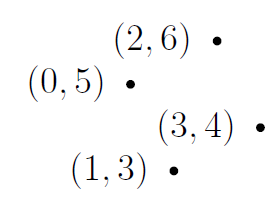
Now I can check that the distances from $(1,3)$ to $(3,4)$, from $(3,4)$ to $(2,6)$, from $(2,6)$ to $(0,5)$, and from $(0,5)$ to $(1,3)$ are all $\sqrt{5}$.
To check the corners are right angles, I could check that the gradients of the lines for each side multiply to $-1$. Those gradients are all either $\frac{1}{2}$ or $-2$, so all the corners are right angles.
- The shape has a side that lies on the line $x=0$ and a side that lies on the line $x=3$. These sides are parallel, so the shape is a trapezium. To find the area, we could split the shape into triangles and rectangles, or we could use the formula $\frac{1}{2}(a+b)h$, where $a$ and $b$ are the lengths of the parallel sides and $h$ is the perpendicular distance between those sides. Here, that gives an area of $\frac{15}{2}$.
- Call the kite $PQRS$ and the point where the diagonals meet $O$. Suppose that the kite has reflectional symmetry in the diagonal $SQ$. Then triangles $SOR$ and $SOP$ are similar, because they're related by a reflection. The angles $SOR$ and $SOP$ are therefore equal. But they lie on the line $PR$ so together they sum to $180^\circ$. They must each be $90^\circ$.
There are lots of examples that work! I decided to use the $x$-axis as one of my lines (that's $y=0$), and then use something like $y=\sqrt{3}-ax$ and $y=\sqrt{3}+bx$ for some $a$ and $b$; I've chosen those $y$-intercepts so that $(0,\sqrt{3})$ is a corner of the triangle.
I need those two lines to go through $(\pm 1,0)$. I can do that by choosing $a$ and $b$ carefully, and I end up with the three lines $y=0$ and $y=\sqrt{3}\,(1-x)$ and $y=\sqrt{3}\,(1+x)$.
Something like this;
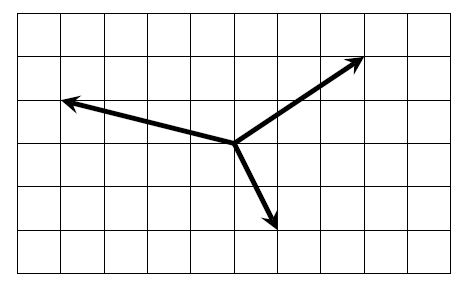
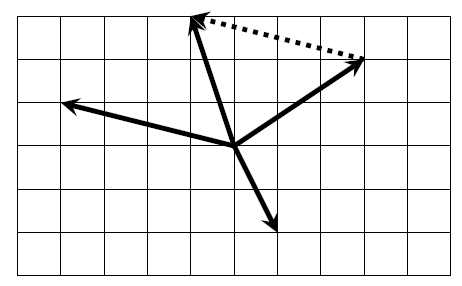
We add the components separately, so $\displaystyle \binom{3}{2}+\binom{-4}{1}=\binom{-1}{3}$. My updated diagram is shown below. The dotted arrow has the direction and magnitude of $\displaystyle \binom{-4}{1}$.
TMUA Questions
TMUA 2020 Paper 1 Question 16
I drew a diagram like this
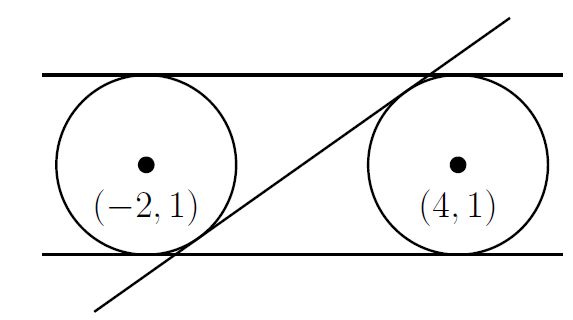
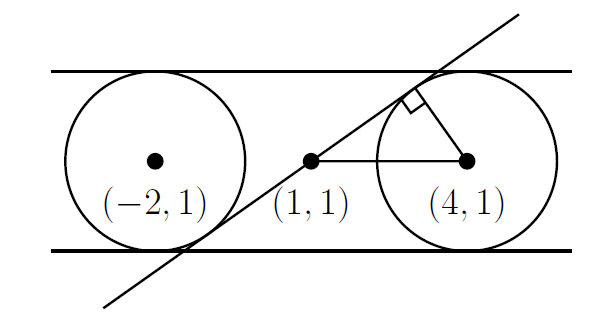
- Several things to say about that diagram; I've noticed that the circles have the same radius, and that their centres have the same $y$-coordinate. I've drawn a couple of extra lines that are tangent to both circles, but those lines both have zero gradient, because of those observations about the circles.
- I'm thinking about rotational symmetry, because the circles are the same. I think that the midpoint between the centres of the circles, $(1,1)$, lies on the line.
Next, I'd like to use the fact that the line is tangent to the circle, so I've drawn in the radius. My diagram now looks like this.
When I spot a right-angled triangle, I like to draw a separate little diagram, labelled with everything I know and want. Here I know the angle in this triangle is $\theta$, because my horizontal line is parallel to the $x$-axis.
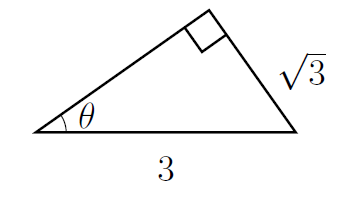
- From here, I can use Pythagoras to find out the other side length (it's $\sqrt{6}$) and then I can work out that $\tan\theta$ is $\displaystyle \frac{1}{\sqrt{2}}$.
- The answer is C.
Extension
- In general, given two circles with the same radius, how many lines do you expect there to be that are tangent to both circles? MAT 2022 Q1J explored this idea.
TMUA 2021 Paper 1 Question 20
- Raising 10 to the power of each side should help. But I'll make a note that I need $x-y$ and $2-2x$ and $y+5$ to be positive, for these logarithms to make sense (be defined) in the first place.
Using various laws of logarithms, I have
$$(x-y)^2 = (2-2x)(y+5)$$
- I don't love this equation, and I'm a bit worried that if I expand the brackets I'll get a mess. But I can see that if I multiply out the right-hand side I'll get $-2xy$, which is also a term that I'll get on the left-hand side. That's enough of a sign for me to try it.
- I get $x^2-2xy+y^2 = 2y+10-2xy-10y$ and then I have $x^2+y^2 = 2y+10-10x$. This is one of the forms of the equation of a circle (possibly). I should try to complete the square to find out what's going on.
- I have $(x+5)^2+(y-1)^2=36$. That's the equation of a circle with radius 6 and centre $(-5,1)$. Brilliant!
- But wait, I made a note to check about whether $x-y$ and $2-2x$ and $y+5$ are all positive.
I drew a sketch at this point.
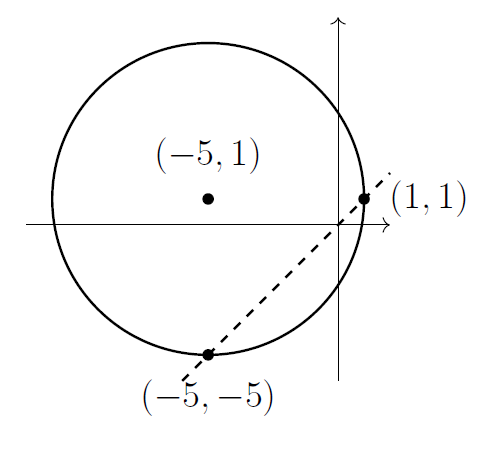
- The good news is that $2-2x\geq 0$ and $y+5\geq 0$ (because $x\leq 1$ and $y\geq -5$; I marked the extreme points on my sketch). The bad news is that only part of this circle satisfies $x-y>0$.
- The line $x-y=0$ goes through those extreme points that I marked, and so I can see that there's a quarter of the circle where $x>y$. That arc of the circle has length $\frac{1}{4}\times (2\times 6\times \pi)$.
- The answer is D.
Extension
- This is an example of a necessary and sufficient condition; being on the circle is necessary for the point $(x,y)$ to satisfy the original equation, but not sufficient. The problem comes if we want to replace $2\log u$ with $\log u^2$; we can only reverse this step if $u>0$. Can you make a small change to the original equation, so that being on the circle is necessary and sufficient for the point $(x,y)$ to satisfy the original equation?
TMUA 2021 Paper 2 Question 7
I drew a diagram like this to think about the square
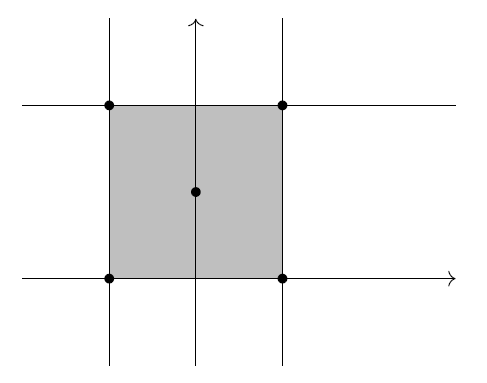
- I drew a circle off to one side of my diagram, but if I'm honest I didn't think about it too much, because the condition "a straight line bisects the area of the circle" tells me that the line goes through the centre of the circle, nothing more and nothing less (it's a necessary and sufficient condition!).
- I'm not worried about getting the centre of the circle $(9,-2)$ in the right place on my diagram, and I'm not interested in the radius of the circle.
- I would like to think about the square though. With the circle, I'm very confident that we just need the line to go through the centre of the circle. Is the same true for the square?
- Yes, any line that goes through the centre clearly bisects the area of the square, and therefore any line that misses the centre can't bisect the square.
- The line goes through the points $(0,1)$ and $(9,-2)$.
- The equation of the line is $\displaystyle y=1-\frac{x}{3}$.
- This crosses the $x$-axis at $x=3$.
- The answer is B.
Extension
- If I were using this as the start of an interview question, then next I would ask you about other regular polygons. Is it always true that a line that bisects the area must go through the centre of the polygon? We might have a discussion about what the "centre" of a regular polygon means (perhaps we'd agree to look equally-spaced points on the unit circle, with the centre of the circle standing in for the centre of the polygon). You might find other shapes where you're convinced that any line through the centre bisects the area of the shape. Is that enough? We would try to avoid calculating any areas in detail (but we might discuss ways we might calculate those areas if we needed them).
- If you'd like to think more about the areas formed by a line crossing a square, there's a past MAT question about areas formed by a line crossing a square. That's MAT 2012 Q1D.
TMUA 2022 Paper 1 Question 4
- I've decided to call the angle $\theta$. It's the same angle in each sector, because the sectors are similar.
- This means that I can write down lots of equations, like $r \theta = 6$, using this angle $\theta$.
- I could even write down expressions for the perimeters straight away. But I don't want to do this yet, because I want to see if I can interpret the information in the question, before I calculate the thing they're asking about. This is a time-saving tactic; I think that the perimeter calculation will come at the end of the question, and if I get stuck in the middle, then I would like to move on without having spent any time thinking about perimeters.
- The areas are $\frac{1}{2} r^2 \,\theta$ and $\frac{1}{2} (r+3)^2\, \theta$. I am more than happy to write down the difference between these areas, because I can see that I'll get to use the difference of two squares.
- I have $\displaystyle \frac{1}{2} \left((r+3)^2-r^2\right) \theta= 21$, so $\displaystyle \frac{1}{2}\times 3 \times (2r+3)\theta = 21$.
- This is a good moment to think about what I'm aiming for. I have two equations involving $r$ and $\theta$. I can perhaps solve those for $r$ and $\theta$, at which point surely the question is basically over.
- Substituting $\displaystyle \frac{6}{r}$ for $\theta$ and multiplying up by $r$, I have $\displaystyle \frac{1}{2}\times 3 \times (2r+3)\times 6 = 21 r$. Simplifying and rearranging, I can get this down to $r=9$.
- Then from $r\theta=6$, I have $\displaystyle \theta=\frac{2}{3}$.
- What did we want? The positive difference between the perimeters! Time to work out the perimeter of a sector; it's $r+r+r\theta$ for the sector on the left, which is $24$. For the sector on the right, it's $32$. So the difference is 8.
- The answer is C.
Extension
- Without using the fact about the difference between the areas, find an expression for the positive difference between the perimeters, in terms of $r$ and/or $\theta$. What do you notice?
- Here's a related popular maths question. Imagine a rope around the equator of the Earth. We'd like to increase the length of the rope so that we can lift it one metre off the ground everywhere, all around the equator. How much longer does the rope need to be?
TMUA 2022 Paper 1 Question 14
I drew a diagram like this
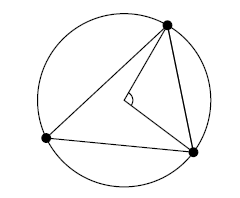
- I labelled angle $POQ$ first with the fact $\geq \frac{\pi}{2}$ and then with a name $\theta$. But then I realised that I could solve for that angle, because I'm told the area of the triangle.
- That calculation looks like this; $\frac{1}{2}\times 6 \times 6 \times \sin \theta = 9\sqrt{3}$. I can solve that for $\displaystyle \sin\theta=\frac{\sqrt{3}}{2}$.
- Since $\theta\geq \frac{\pi}{2}$, we can solve this uniquely for $\displaystyle \theta=\frac{2\pi}{3}$.
- Now I'm thinking about the triangle $PRQ$. If I hold $P$ and $Q$ fixed (their relative locations are fixed by our knowledge of the unique value of $\theta$), then the angle $PRQ$ is fixed. It's $\frac{\pi}{3}$.
- I could use that angle to work out the area. But that looks like hard work, because I don't know the other side lengths of triangle $PRQ$. Are there any cases where I could imagine calculating the side lengths? Sort of, if $R$ is directly opposite the midpoint of $PQ$.
- Better, that's actually what the question wants me to do, because if I think of $PQ$ as the "base" of the triangle $PRQ$, then I should maximise the "height" of the triangle to maximise the area.
- I drew a second sketch with the points arranged like that.
- At this point, I changed my mind about the area calculation. I don't want to find the side lengths of triangle $PRQ$. I can split the area into three parts and find the areas.
- There are some similar triangles, and in fact all the angles at $O$ are $\displaystyle \frac{2\pi}{3}$. So the area of $PRQ$ turns out to be precisely three times the area of triangle $POQ$. The area is $27\sqrt{3}$.
- The answer is D.
Extension
- There's a past MAT question with a similar idea; see MAT 2012 Q1J.
- Suppose that you have a regular pentagon with side-length 1. Out of all the triangles with three vertices on the perimeter of the pentagon, describe which ones have the largest area. It's a bit fiddly to actually calculate the value of this largest area, but if you want some trigonometry practice you could give it a go.
- I've used the following investigation as the start of an interview question; suppose that $A$ and $B$ and $C$ are points on the curve $y=x^2$, with $A$ and $C$ fixed, and $B$ somewhere in between them. In terms of the locations of $A$ and $C$, where should we put the point $B$ to maximise the area of triangle $ABC$?
TMUA 2022 Paper 2 Question 11
- We're asked whether angle $SPQ$ is a right angle. This reminds me of Pythagoras; if I knew the lengths of the sides of triangle $SPQ$ then I could write down a statement that's true if and only if the angle is a right-angle.
- How could I find the side-lengths of triangle $SPQ$? One of them is given to me, it's $y+z$. For the other sides, I would need to know an angle in the triangle.
- I have used the fact that it's a kite yet, and I'd like a fact about angles. The diagonals of a kite cross at right angles. So now I get to use Pythagoras two more times to write down the side lengths of $PS$ and $SQ$.
- I have $$\left(\sqrt{x^2+z^2}\right)^2 + \left(\sqrt{x^2+y^2}\right)^2=(y+z)^2.$$
- This is fine to simplify (the terms inside the square roots are positive, so I've got no concerns). I get $$2x^2+y^2+z^2 = y^2 +2yz + z^2$$ and that simplifies really nicely to $x^2 = yz$.
- Alternatively, I could have spotted that triangles $OSP$ and $OPQ$ are similar if and only if the angle $SPQ$ is a right angle (because in that case, the angles in the two triangles $OSP$ and $OPQ$ match). If they're similar then the side lengths are in the same ratio, so $\frac{x}{z} = \frac{y}{x}$. That gives the same equation $x^2=yz$.
- Alternatively, I could have spotted that the angle $SPQ$ is a right angle if and only if the point $P$ lies on a semi-circle with $SQ$ as the diameter. Then the midpoint $M$ of $SQ$ would be the centre of the circle, the radius would be $\frac{1}{2}(y+z)$ and the distance from the centre to $O$ would be $\left|\frac{1}{2} (y-z) \right|$. Pythagoras on the triangle $OPM$ would give $x^2+\frac{1}{4}(y-z)^2=\frac{1}{4}(y+z)^2$ which again simplifies down to $x^2=yz$.
- The answer is C.
Extension
Keep $S$ and $Q$ fixed and consider moving point $P$ around the semi-circle with diameter $SQ$. By considering the radius of the circle and the possible locations for $P$, prove the following claim.
(AM-GM inequality) For any positive numbers $y$ and $z$, $$\frac{y+z}{2}\geq \sqrt{yz}.$$
- If I were using this as the start of an interview question, then next I might ask you to apply this AM-GM inequality to show things like $x+\frac{1}{x}\geq 2$ for all $x>0$, or $(a+b)\left(\frac{1}{a}+\frac{1}{b}\right)\geq 4$ for all $a$, $b>0$, or to find the largest area of a rectangle with fixed perimeter $L$.