


Logarithms Solutions
Part of the Oxford Maths Admissions Test Livestream 2026
These are the solutions for the Logarithms worksheet
Revision Questions
- $(2^3)^4=2^{12}$. $(2^4)^3=2^{12}$. $2^4 2^3=2^7$. $2^3 2^4=2^7$.
- This is a quadratic for $\frac{1}{x}$ with solutions $\frac{1}{x}=-1$ or $\frac{1}{x}=-3$. So $x=-1$ or $x=-\frac{1}{3}$. Alternatively, we could multiply both sides by $x^2$ and solve the quadratic that we get.
- This is $\log_{10} 12$.
- The quadratic inside the brackets factorises, and this is $\log_3(x+2)+\log_3(x+1)$. Other answers are possible, such as $\log_3 (2(x+2))+\log_3((x+1)/2)$.
- The left-hand side is just $2$ so we want $2=x^3$. So $x=\sqrt[3]{2}$.
- The left-hand side is $1+\log_x 2$ so we want $\log_x 2=2$. So $x^2=2$ and $x=\sqrt{2}$ (not $-\sqrt{2}$ because we're told that $x>0$).
- Take $(x+5)$ to the power of each side to get $6x+22=(x+5)^2$. Expand the square and rearrange for $x^2+4x+3=0$. The solutions are $x=-1$ or $x=-3$. Check these solutions; $\log_4(16)=2$ and $\log_2(4)=2$.
- $\log_{3} 1024=\log_{3}\left(2^{10}\right)=10\log_{3} 2=10a$.
- $\log_{3} 40=\log_{3} 8+\log_{3} 5=3a+b$.
- $\log_{3} \sqrt{\frac{2}{5}}=\frac{1}{2}\log_{3} \left(\frac{2}{5}\right)=\frac{1}{2}\left(a-b\right)$.
- $\log_{3} \left(\frac{1}{10}\right)=-\log_{3} 10=-\log_{3}2-\log_{3} 5=-a-b$.
- $\log_{3} 1.024=\log_{3} 1024+\log_{3} \left(\frac{1}{1000}\right)=10a +3(-a-b)=7a-3b$.
There are other solutions, partly because $b=a\times\log_2 5$ (see the change of base formula below).
$2^{x+y}+2^{y-x}-2^{x-y}-2^{-x-y}+2^{x+y}-2^{y-x}+2^{x-y}-2^{-x-y}$. That's $2^{x+y+1}-2^{-x-y+1}$.
$2^{x+y}+2^{y-x}+2^{x-y}+2^{-x-y}+2^{x+y}-2^{y-x}-2^{x-y}+2^{-x-y}$. That's $2^{x+y+1}+2^{-x-y+1}$.
$2^x=3$ is what it means for $x$ to be $\log_2 3$.
If $0.5^x=3$ then $2^{-x}=3$ so $x=-\log_2 3$. Alternatively, just write down $x=\log_{0.5}3$.
If $4^x=3$ then $2^{2x}=3$ so $x=\frac{1}{2}\log_2 3$. Alternatively, just write down $x=\log_4 3$.
- By definition, $\log_a b = 0$ if and only if $a^0 = b$. Since $a$ is positive, we have $a^0=1$ and so $b=1$.
- We have $\log_{10}x=10^6$, which is a million. So $x$ is ten to the power of a million. That's got a million zeros at the end.
- We have $\displaystyle \log_a \left(\frac{x}{y}\right)=\log_a \left(xy^{-1}\right)=\log_a x +\log_a y^{-1}$ using the product rule, and then $\log_a y^{-1}=- \log_a y$ using the power rule.
Multiply both sides by $2^x$ and rearrange to get $2^{2x}-4\times 2^x+1=0$. This is a quadratic for $2^x$. Solve it for $2^x=2\pm \sqrt{3}$. So $x=\log_2 (2\pm \sqrt{3})$.
Following the previous working, we can see that we'll get two roots for $2^x$ if $c^2-4>0$. But we need these to be positive roots, so we need $c>2$. If $c=2$ there's a repeated root. If $c<2$ there are no roots.
Move both terms onto the left-hand side and use the fact that $(N+\sqrt{N^2-1})(N-\sqrt{N^2-1})=N^2-(N^2-1)=1$; that's the difference of two squares. Remember that $\log_a 1 =0$.
As a result, our solutions to the previous question, $\log_2 (2\pm \sqrt{3})$, are actually $\pm \log_2 (2+\sqrt{3})$, revealing a lovely symmetry. But you could have spotted that from the equation, of course!
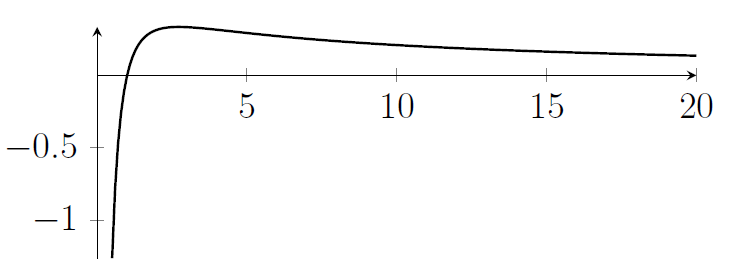
I've taken logarithms base 3 on each side to get $\log_{3}(x^y)=\log_{3}(y^x)$. You probably picked a different base for your logarithms, it doesn't make much difference (see the last question below). I can simplify my equation to $y\log_{3} x=x\log_{3} y$ and rearrange to get $\displaystyle \frac{\log_{3} x}{x}=\frac{\log_{3} y}{y}$. You might choose to put this fraction the other way up, or to square both sides or something, so your $f(x)$ might not be the same as mine. Here's a sketch of $\displaystyle y=\frac{\log_{3}(x)}{x}$.
$a^{k\log_a b}$ is the same as $(a^{\log_a b})^k$ which is just $b^k$.
We can use a similar bit of algebra with $k=\log_b c$. \[ a^x=a^{\log_a b \log_b c}=\left(a^{\log_a b}\right)^{\log_b c}=\left(b\right)^{\log_b c}=c. \] So $a^x=c$ and therefore $x=\log_a c$. We have proved that $\left(\log_a b\right) \left(\log_b c\right) = \log_a c$.
We can divide by $\log_a b$ to get \[ \log_b c = \frac{\log_a c}{\log_a b} \]
- We can use the result in the previous question to change the base to 3, and then we can rewrite the numerator and denominator separately; \[ \log_6(45)=\frac{\log_3 (45)}{\log_3 6} =\frac{\log_3 5+\log_3 9}{\log_3 2+\log_3 3} = \frac{b+2}{a+1}.\]
If $a<1$ then $\log_a x$ is a decreasing function of $x$. You can deduce this from the corresponding equation $x=a^y$. Since $a^y$ is a decreasing function of $y$ for $a<1$, large values of $y$ correspond to small values of $x$, and vice versa.
You might also note that $\log_a x = - \log_{(1/a)} x$ using the change of base formula.
TMUA Questions
TMUA 2020 Paper 1 Question 7
- The question includes powers of numbers like 2 and 4 and 8 and 16. These are all powers of 2, so we can re-write everything in terms of powers of 2.
- The equation $2^{3x}=8^{(y+3)}$ can be re-written as $2^{3x}=2^{3(y+3)}$.
- The equation \[4^{(x+1)} = \frac{16^{(y+1)}}{8^{(y+3)}}\] can be re-written as \[2^{2(x+1)}=2^{4(y+1)-3(y+3)}\]
- Since $2^x$ is an increasing function of $x$, we can just compare exponents.
- So we have the simultaneous equations \begin{align*} 3x &= 3(y+3)\\ 2(x+1) &= 4(y+1)-3(y+3) \end{align*}
- The first equation simplifies to $x=y+3$, and that's in a convenient form to substitute into the second equation. This gives $2y+8 = y-5$.
- The solution I get has $x=-10$ and $y=-13$, so $x+y=-23$.
- The answer is A.
Extension
- Is the function \[ \left(\frac{1}{2}\right)^{-x/2}\times 8^{3x} \times \left(2\sqrt{2}\right)^{3x/2}\] an increasing function of $x$, or a decreasing function of $x$?
- Find the minimum value of $\displaystyle \mathrm{f}(x)=\frac{2^{\left(x^2\right)}}{\left(2^x\right)^2}.$
TMUA 2021 Paper 1 Question 10
I drew a sketch of the function. The sketch made me think about the fact that the difference between $2$ and $\frac{1}{2}$ is $\frac{3}{2}$, so if we use 3 strips then each will have width $\frac{1}{2}$. I thought about the sign of the function, but I'm not sure if that's going to be relevant.
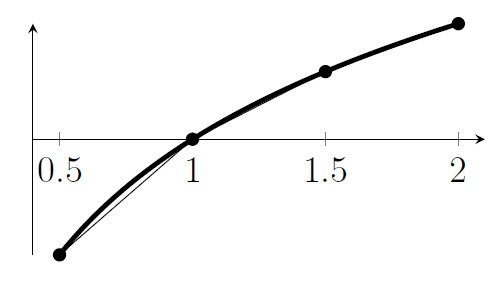
- For the trapezium rule, we need the value of the function at various points. Writing $\mathrm{f}(x)$ for the function $2\log_{10}x$, the trapezium rule calls for \[ \frac{1}{2} \times \frac{1}{2} \times \left( \mathrm{f}\left(\frac{1}{2}\right) + 2\cdot \mathrm{f}\left(1 \right)+ 2\cdot \mathrm{f}\left(\frac{3}{2}\right)+\mathrm{f}\left(2\right) \right) \]
- Those values of $\mathrm{f}$ are, in order, $2\log_{10} \frac{1}{2}$, $0$, $2\log_{10} \frac{3}{2}$, and $\log_{10} 4$.
- So we have \[ \frac{1}{4}\left(2\log_{10} \frac{1}{2} + 0 + 4\log_{10} \frac{3}{2} + \log_{10} 4\right), \] and the $2\log_{10} \frac{1}{2}$ cancels out the $\log_{10} 4$.
- So the answer is just $\log_{10} \frac{3}{2}$.
- The answer is B.
Extension
- Is this an overestimate or an underestimate?
- If I were using this as the start of an interview question, then next I might try to find out whether you know enough about integration and logarithms to work out the exact value of that integral. If not then I might use the interview to teach you that \[\int \ln x \,\mathrm{d}x = x\ln x - x + c,\] where $\ln x$ means $\log_e x$ with $e$ a particular irrational number that's about 2.7, and where $c$ is the constant of integration. Or perhaps we might work that out together.
- Use the trapezium rule with 101 strips to estimate \[ \int_0^{101} \log_{10}\! \left(3^{1-x}\right)\,\mathrm{d}x.\]
TMUA 2022 Paper 1 Question 11
- I wrote out a few terms and the last term, like this \[ \log_{10} \left(3^0\right) + \log_{10} \left(3^1\right) + \log_{10} \left(3^2\right) + ... + \log_{10} \left(3^{-99}\right), \] where I had to think really hard about whether the last term would involve $3^{-99}$ or $3^{-100}$.
- Each term looks like it can be simplified with a law of logarithms to bring down the exponent (from the options, I can see that we want everything to be in terms of $\log_{10} 3$).
- I now have \[ -\left(0+1+2+...+ 99\right)\log_{10} 3 \] where I've pulled the minus sign out the front, the $\log_{10}3$ out the end, and I've kept the $0$ at the front of the sum so that it's still clear that I've got 100 terms.
- In the brackets I can see the sum of the numbers from 1 to 99. That's $\frac{1}{2}\times99\times 100$, using the rule for the sum of the terms of an arithmetic progression, or the formula for triangle numbers $\binom{n}{2}$, whichever you prefer.
- That's $-4950 \log_{10}3$.
- The answer is A.
Extension
- Check your understanding: suppose that $a_n$ is a geometric progression with $a_1=a$ and $a_{n+1}=r a_n$ for $n\geq 1$, where $a$ and $r$ are positive constants. Find an expression for \[ \sum_{n=1}^{100} \log_{10} a_n.\]
- This sum is related to the last bullet point in the Extension section of the previous question. Noting that the function $\log_{10}\! \left(3^{1-x}\right)$ is linear, can you comment on whether the trapezium rule gives an overestimate or an underestimate?
- MAT 2016 Q1A asked for the product of the first 15 terms of the geometric progression with first term $a_1=1$ and subsequent terms defined by $a_{n+1}=l a_n$ for $n\geq 1$, in terms of $l$. That question also involved careful manipulation of powers.
TMUA 2021 Paper 2 Question 14
- I would quite like to solve these equations, if I can.
- I see that $x$ only appears as part of $2^x$, and $y$ only appears as part of $\log_2 y$. I'd like to solve for $2^x$ and $\log_2 y$, treating those as the variables, if I can.
- In my rough work I've underlined $2^x$ and written "problem!" because I can see that a solution for $2^x$ might not correspond to a solution for $x$.
- Taking the difference between the equations in the question will eliminate the bit that depends on $y$, whatever we're calling it. I'm left with $(p-1)2^x =1$
- I've rearranged this for $p=1+2^{-x}$. I know that $2^{-x}$ is positive, so I really want $p>1$.
- Then $x=-\log_2 \left(p-1\right)$, which would be fine.
- And $y$ would be... something else. If I'm honest, I didn't write down what $y$ would be, because it seems pretty clear that the equation $2^x + \log_2 y = 1$ could be rearranged for $\log_2 y$ in terms of this solution we've just found for $x$, and then $y$ would be 2 to the power of whatever we get. That's all well-defined, and the question doesn't ask me to find $y$.
- If I'm being less lazy, then the solution is \[ x=-\log_2 \left(p-1\right), \qquad y= 2^{\left(\frac{p-2}{p-1}\right)}. \]
- Anyway, the solution exists if and only if $p>1$.
- The answer is C.
Extension
- Check your understanding: what is the complete range of $p$ for which the simultaneous equations \begin{align*} p \cos x + \sin y &= 2\\ \cos x + \sin y &= 1 \end{align*} have at least one real solution $(x,y)$?
- What is the complete range of $p$ for which the simultaneous equations \begin{align*} p \cdot\sqrt{x} + y^2 &= 2\\ \sqrt{x} + y^2 &= 1\\ \end{align*} have at least one real solution $(x,y)$?
- What is the complete range of $p$ for which the simultaneous equations \begin{align*} p 2^x + \log_2 y &= 2\\ 2^x + \log_2 y &= 2 \end{align*} have at least one real solution $(x,y)$?
TMUA 2021 Paper 2 Question 17
- The options are quite confusing to me. They each seem to involve one case where $\mathrm{f}(x)<\mathrm{g}(x)$ and one case where $\mathrm{g}(x)<\mathrm{f}(x)$. So perhaps I should start by working out which values of $x$ give each of those behaviours.
- I rewrote $\mathrm{f}(x)=\log_2 \left(\frac{1}{2}\log_2 x\right)$ to make the two functions look more similar.
- Both functions end with an application of the function $\log_2 x$. I know that $\log_2 x$ is an increasing function of $x$, so \[ \log_2 \left(\frac{1}{2}\log_2 x\right) < \log_2 \left(\sqrt{\log_2 x}\right) \quad\text{if and only if}\quad \frac{1}{2}\log_2 x < \sqrt{\log_2 x}. \]
- To get to grips with that, I'm going to write $u=\log_2 x$. So now I'm looking at $\frac{1}{2}u < \sqrt{u}$.
I know that $\frac{1}{2}u<\sqrt{u}$ if and only if $0 < u < 4$. I drew a little sketch to remind myself which way around that inequality goes. $\sqrt{u}$ starts fast but $\frac{1}{2}u$ eventually catches up.
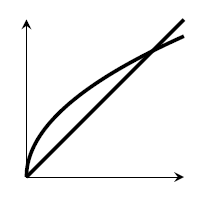
- So $\mathrm{f}(x)<\mathrm{g}(x)$ if and only if $\log_2 x <4$, and $\mathrm{f}(x)>\mathrm{g}(x)$ if and only if $\log_2 x>4$. I'm not including the fact that $u>0$ because this is guaranteed by the range of $x$ in the question.
- For each of the possible answers, we need to know about the values in each case. It's not immediately clear whether I should look at $\mathrm{f}(x)$ or $\mathrm{g}(x)$, so I'll look at both.
If $\log_2 x<4$ then what can I say about $\mathrm{f}(x)$? I could say $\mathrm{f}(x)<\log_2\left(\frac{1}{2}\times 4\right) = 1$.
If I had to say something about $\mathrm{g}(x)$ it would be $\mathrm{g}(x)<\log_2\left(\sqrt{4}\right) =1$.
- In the other case, if $\log_2 x >4$, then all the inequality signs flip, and so $\mathrm{g}(x)>1$ and $\mathrm{f}(x)>1$.
- I've missed the case where $\log_2 x = 4$ and both $\mathrm{f}(x)$ and $\mathrm{g}(x)$ are equal to 1.
- The answer is F.
Extension
If I were using this as the start of an interview question, then next I might introduce a third function: \[ \mathrm{h}(x)=\sqrt{\log_2\left(\log_2 x\right)}. \] Where is this function defined? For what value or values of $x$ does $\mathrm{h}(x)=\mathrm{f}(x)$? For what value or values of $x$ does $\mathrm{h}(x)=\mathrm{g}(x)$?
[If your answers involve massive powers of 2, leave them as massive powers of 2.]
- These functions involve the three permutations of two "$\log_2$"s and one "$\sqrt{\phantom{x}}$". You could invent your own extension, using the six possible permutations of two of each function!
TMUA 2022 Paper 2 Question 15
- I think that the following approach is unintended, but it's what I did, so I'll start by showing you how it goes.
- I know that the logarithms in the question, $\log_x y$ and $\log_y z$ and $\log_z x$, are related via the identity $\left(\log_x y\right) \left(\log_y z\right) \left(\log_z x\right)=1$
- We're told that the first two are equal to $z$ and $x$ respectively.
- Therefore the third must be $\dfrac{1}{xz}$ to make the identity work. That's one of the options.
- I think that the intended route is more like this: start by writing out what the given information tells us in terms of exponentials.
- We have $y=x^z$ and $z=y^x$.
- So, substituting the first into the second to eliminate $y$, we have $z= x^{zx}$.
- I want to say something about $\log_z x$, so I want a statement where some power of $z$ is equal to $x$.
- I can take each side to the power of $\dfrac{1}{xz}$ to get $z^{(1/xz)}=x$.
- Therefore $\displaystyle \log_z x = \frac{1}{xz}$.
- Either way, the answer is F.
Extension
- Use the change of base formula to prove that \[ \log_x y = \left(\log_y x\right)^{-1}\] for all positive $x$ and $y$, with neither equal to 1.
- Use the change of base formula to prove that \[\log_{\frac{1}{b}}c = \log_b \frac{1}{c}\] for all positive $b$ and $c$, with $b$ not equal to 1.
- Use the change of base formula to prove that \[\left(\log_x y\right) \left(\log_y z\right) \left(\log_z x\right)=1\] for all positive $x$, $y$, and $z$, with none of them equal to 1.
- Use the change of base formula to prove that \[\left(\log_a b\right) \left(\log_b c\right) \left(\log_c d\right) \left(\log_d a\right)=1\] for all positive $a$, $b$, $c$, and $d$, with none of them equal to 1.
- If I were using this as the start of an interview question, then next I might ask you to continue the pattern that I've set up with the previous two bullet points.