


Integration
Part of the Oxford Maths Admissions Test Livestream 2026
TMUA Specification (April 2025, Section 1 § MM7)
- Definite integration as related to the "area between a curve and an axis". The difference between finding a definite integral and finding the area between a curve and an axis is expected to be understood.
- Finding definite and indefinite integrals of $x^n$ for $n$ rational, $n \neq -1$, and related sums and differences, including expressions which require simplification prior to integrating.
- An understanding of the Fundamental Theorem of Calculus and its significance to integration. Simple examples of its use may be required in the forms:
- $\displaystyle \int_a^b f(x)\,\mathrm{d}x = F(b)-F(a)$ where $F'(x)=f(x)$.
- $\displaystyle \frac{\mathrm{d}}{\mathrm{d}x}\int_a^x f(t) \,\mathrm{d}t = f(x)$
- Combining integrals with either equal or contiguous ranges.
- Approximation of the area under a curve using the trapezium rule; determination of whether this constitutes an overestimate or an underestimate.
- Solving differential equations of the form $\displaystyle \frac{\mathrm{d} y}{\mathrm{d}x}=f(x)$.
Revision
- A definite integral is written as $\displaystyle \int_a^b f(x)\,\mathrm{d}x$ where $a$ and $b$ are real numbers sometimes called the two end-points of the integral, and where $f(x)$ is defined for $a\leq x \leq b$.
- The definite integral is a number (not, for instance, a function of $x$), and the value of that number depends on $a$ and $b$ and the function $f$. We sometimes say "dummy variable" to describe $x$ inside the integral, and it's a sort of placeholder. The letter $x$ is often used, but for the same function, same $a$, and same $b$, the integrals $\displaystyle \int_a^b f(t)\,\mathrm{d}t$ or $\displaystyle \int_a^b f(q)\,\mathrm{d}q$ would mean the same thing and have the same value. The "$\mathrm{d}x$" at the end indicates which letter is the dummy variable.
- To calculate definite integrals, we first introduce the idea of an indefinite integral, written $\displaystyle \int f(x)\,\mathrm{d}x$ without limits. In contrast to the definite integral, the indefinite integral is a function of $x$. It is only defined up to a constant.
- The indefinite integral of $x^n$ is $\displaystyle \frac{x^{n+1}}{n+1}+c$, provided that $n\neq -1$, where $c$ is an arbitrary constant.
- Note that differentiation is the reverse of indefinite integration in the sense that if you differentiate $\displaystyle \frac{x^{n+1}}{n+1}+c$ then you get back to $x^n$. So we might say that we've identified a function $F(x)$ with derivative $F'(x)=f(x)$.
- If we want to calculate $\displaystyle \int_a^b f(x)\,\mathrm{d}x$ and we know that the function $F(x)$ has $F'(x)=f(x)$, then the definite integral is just $F(b)-F(a)$. This is an example of something called the Fundamental Theorem of Calculus.
- Note that, if you find $F(x)$ with indefinite integration, then the arbitrary constant "$+c$" doesn't matter for your definite integral, because when you calculate $F(b)-F(a)$ that constant will cancel.
- The integral $\displaystyle \int_a^x f(t)\,\mathrm{d}t$ with constant $a$ is worth thinking about. For any particular value of $x$, it's a definite integral, so we just get a number. But that makes it a function of $x$. The Fundamental Theorem of Calculus states that, as a function of $x$, it has derivative $f(x)$.
- Integration can be used to find areas, but we have to be careful.
- If $a< b$ and $f(x)>0$ for $a<x<b$ then $\displaystyle \int_a^b f(x)\,\mathrm{d}x$ is the area of the region bounded by the curve $y=f(x)$, the $x$-axis, and the lines $x=a$ and $x=b$.
- If $a<b$ and $f(x)<0$ for $a<x<b$ then $\displaystyle \int_a^b f(x)\,\mathrm{d}x$ is $-1$ times the area of the region bounded by the curve $y=f(x)$, the $x$-axis, and the lines $x=a$ and $x=b$. Areas are supposed to be positive! The integral here is sometimes called the ``signed area" to reflect the fact that it's got a minus sign. This is a key difference between finding a definite integral and finding the area between a curve and the $x$-axis.
- If $f(x)$ is sometimes positive and sometimes negative in $a<x<b$ then we can identify separate regions where $f(x)$ is positive or negative before applying the above. The total area is the sum of the (positive!) areas of the separate parts.
- Some rules worth knowing;
- $\displaystyle \int_a^bf(x)\,\mathrm{d}x=-\int_{b}^{a}f(x)\,\mathrm{d}x$.
- $\displaystyle \int_a^b k f(x)\,\mathrm{d}x=k \int_{a}^{b}f(x)\,\mathrm{d}x$ for any constant $k$.
- (Contiguous ranges) $\displaystyle \int_a^bf(x)\,\mathrm{d}x+\int_{b}^{c}f(x)\,\mathrm{d}x=\int_{a}^{c}f(x)\,\mathrm{d}x$.
- (Equal ranges) $\displaystyle \int_a^b f(x)\,\mathrm{d}x + \int_a^b g(x)\,\mathrm{d}x = \int_a^b \left(\phantom{\frac{\!}{\!}} f(x)+g(x)\right)\,\mathrm{d}x$.
- The trapezium rule gives us a way to estimate a definite integral by representing the curve with a series of straight lines ("chords"), and the region between the curve and the $x$-axis with a series of trapeziums. To estimate the area between $x=a$ and $x=b$ and the $x$-axis and the curve $y=f(x)$, we split the interval from $a$ to $b$ into $n$ "strips" of equal width. This requires $n+1$ points, and we use an arithmetic sequence with $x_0=a$, $x_1=a+h$, $x_2=a+2h$, ..., $x_{n}=b$, where $h=\dfrac{b-a}{n}$.
The trapezium rule adds expressions for the signed areas of the trapeziums to get \[\int_a^b f(x)\,\mathrm{d}x \; \approx \; \frac{1}{2}\times h \times \left(f(x_0)+2\times\left( \phantom{\frac{\!}{\!}}f(x_1)+f(x_2)+\dots+f(x_{n-1})\right)+f(x_n)\right)\]
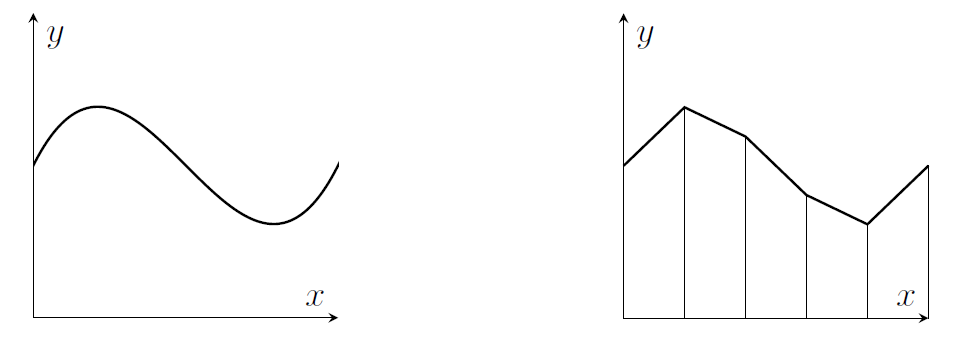
- The trapezium rule gives an underestimate of the integral if the graph $y=f(x)$ curves downward (concave). This happens if the second derivative $f''(x)$ is negative throughout $a<x<b$. The chords lie below the curve.
- The trapezium rule gives an overestimate of the integral if the graph $y=f(x)$ curves upward (convex). This happens if the second derivative $f''(x)$ is positive throughout $a<x<b$. The chords lie above the curve.
- If $f''(x)=0$ throughout $a<x<b$ then the graph $y=f(x)$ is a straight line and the trapezium rule is exactly correct. The chords lie on the curve.
- It's often the case that $f''(x)$ changes sign between $a$ and $b$. In that case, the trapezium rule might give an underestimate or an overestimate, or it might even be exactly correct.
- Note that if $f(x)<0$ then the area is $-1$ times the integral, so if the trapezium rule gives an underestimate for the (negative) integral, that will be an overestimate for the (positive) area.
- The solutions to $\displaystyle \frac{\mathrm{d} y}{\mathrm{d}x}=f(x)$ are the indefinite integrals $\displaystyle y=\int f(x)\,\mathrm{d}x$. Remember to include the arbitrary constant "$+c$".
Revision Questions
- Find the area enclosed between the polynomial $y=x^2+4x+3$ and the $x$-axis.
- Find \[\int \frac{x+3}{x^3}\,\mathrm{d}x, \qquad \int \sqrt[3]{x}\,\mathrm{d}x,\qquad \int \left(\left(x^2\right)^3\right)^5\,\mathrm{d}x,\qquad \int \left(x^2+1\right)^3\,\mathrm{d}x\]
- Suppose that $f(x)>0$ for $-1< x <1$. By thinking about the area that the integral represents, explain why \[\int_{-1}^1 f(x)\,\mathrm{d}x=\int_{-1}^1 f(-x)\,\mathrm{d}x.\]
- Let $\displaystyle I_1=\int_1^{10} \frac{1}{x}\,\mathrm{d}x$ and $\displaystyle I_2=\int_{10}^{100} \frac{1}{x}\,\mathrm{d}x$. You are not expected to calculate either of these integrals. By considering a transformation of the graph $\displaystyle y=\frac{1}{x}$, and areas under that graph, prove that $I_1=I_2$.
Deduce that $\displaystyle \int_1^N \frac{1}{x}\,\mathrm{d}x$ with $N>1$ can be made arbitrarily large by increasing $N$. - Suppose that $f(x)>0$ for $-3\leq x \leq 3$ and let \[a=\int_0^1 f(x)\,\mathrm{d}x, \quad b=\int_1^2 f(x)\,\mathrm{d}x,\quad c=\int_2^3 f(x)\,\mathrm{d}x.\] Find the following in terms of $a$ and $b$ and $c$. \[\displaystyle \text{(i)} \quad \int_0^3 f(x)\,\mathrm{d}x,\qquad \text{(ii)} \quad \int_3^1 f(x)\,\mathrm{d}x,\qquad \text{(iii)}\quad \int_0^2 3 f(x)\,\mathrm{d}x,\] \[\displaystyle \text{(iv)}\quad \int_0^2 f(x)\,\mathrm{d}x + \int_2^1 f(x)\,\mathrm{d}x,\qquad \text{(v)} \quad \int_{-2}^0 f(-x)\,\mathrm{d}x,\qquad \text{(vi)} \quad \int_{0}^1 f(2x)\,\mathrm{d}x.\] (For the last two, use graph transformations).
- Let $\displaystyle I_3=\int_1^3 \frac{1}{1+x^2}\,\mathrm{d}x$. Without calculating any of these integrals, find expressions for $\displaystyle \int_1^3 \frac{x^2}{1+x^2}\,\mathrm{d}x$ and $\displaystyle \int_1^3 \frac{x^4}{1+x^2}\,\mathrm{d}x$ in terms of $I_3$.
- Use the Fundamental Theorem of Calculus to simplify $\displaystyle \frac{\mathrm{d}}{\mathrm{d}x} \left(\int_0^{x} t^2\,\mathrm{d}t\right)$. Check your answer by calculating the integral.
- For $x>-2$, find an expression for $\displaystyle \frac{\mathrm{d}}{\mathrm{d}x} \left(\int_x^{10} \sqrt{t^3+8}\,\mathrm{d}t\right)$.
- Find an expression for $\displaystyle \int_x^{x} f(t)\,\mathrm{d}t$.
- Use the trapezium rule to estimate $\displaystyle \int_0^1 4^x \,\mathrm{d}x$ using 4 strips.
Is this an underestimate or an overestimate? - Use the trapezium rule to estimate $\displaystyle \int_0^1 \sqrt{1-x^2} \,\mathrm{d}x$ using 3 strips.
Is this an underestimate or an overestimate?
Without using integration, find the exact value of this integral. - Find the solution to $\displaystyle \frac{\mathrm{d}y}{\mathrm{d}x}=\frac{1}{x^2}$ that has $y\approx 3$ for large values of $x$.
TMUA Questions
TMUA 2020 Paper 2 Question 13
$\mathrm{f}(x)$ is a function for which \[\int_0^3 \bigl(\mathrm{f}(x)\bigr)^2\,\mathrm{d}x \;+\; \int_0^3 \mathrm{f}(x)\,\mathrm{d}x \;=\; \int_0^1 \mathrm{f}(x)\,\mathrm{d}x\] Which of the following claims about $\mathrm{f}(x)$ is/are necessarily true?
I $\mathrm{f}(x) \le 0$ for some $x$ with $1 \le x \le 3$
II $\displaystyle\int_0^3 \mathrm{f}(x)\,\mathrm{d}x \;\le\; \int_0^1 \mathrm{f}(x)\,\mathrm{d}x$
(A) neither of them
(B) I only
(C) II only
(D) I and II
[Scroll down for hints]
TMUA 2020 Paper 2 Question 16
The Fundamental Theorem of Calculus (FTC) tells us that for any polynomial $\mathrm{f}$: \[\frac{\mathrm{d}}{\mathrm{d}x} \!\left(\int_0^x \mathrm{f}(t)\,\mathrm{d}t\right) = \mathrm{f}(x)\] A student calculates $\dfrac{\mathrm{d}}{\mathrm{d}x}\!\left(\displaystyle\int_x^{2x} t^2\,\mathrm{d}t\right)$ as follows:
\begin{alignat}{2} \text{(I)}\quad && \int_x^{2x} t^2\,\mathrm{d}t &= \int_0^{2x} t^2\,\mathrm{d}t - \int_0^x t^2\,\mathrm{d}t \notag\\[4pt] \text{(II)}\quad && \text{By FTC,}\quad \frac{\mathrm{d}}{\mathrm{d}x}\!\left(\int_0^x t^2\,\mathrm{d}t\right) &= x^2 \notag\\[4pt] \text{(III)}\quad && \text{By FTC,}\quad \frac{\mathrm{d}}{\mathrm{d}x}\!\left(\int_0^{2x} t^2\,\mathrm{d}t\right) &= (2x)^2 = 4x^2 \notag\\[4pt] \text{(IV)}\quad && \text{So}\quad \frac{\mathrm{d}}{\mathrm{d}x}\!\left(\int_x^{2x} t^2\,\mathrm{d}t\right) &= 4x^2 - x^2 \notag\\[4pt] \text{(V)}\quad && \text{giving}\quad \frac{\mathrm{d}}{\mathrm{d}x}\!\left(\int_x^{2x} t^2\,\mathrm{d}t\right) &= 3x^2 \notag \end{alignat}
Which of the following best describes the student's calculation?
(A) The calculation is completely correct.
(B) The calculation is incorrect, and the first error occurs on line (I).
(C) The calculation is incorrect, and the first error occurs on line (II).
(D) The calculation is incorrect, and the first error occurs on line (III).
(E) The calculation is incorrect, and the first error occurs on line (IV).
(F) The calculation is incorrect, and the first error occurs on line (V).
[Scroll down for hints]
TMUA 2021 Paper 1 Question 7
The function $\mathrm{f}$ is such that $\mathrm{f}(0) = 0$, and $x\mathrm{f}(x) > 0$ for all non-zero values of $x$.
It is given that \[\int_{-2}^{2} \mathrm{f}(x)\,\mathrm{d}x = 4 \quad \text{and}\quad \int_{-2}^{2} |\mathrm{f}(x)|\,\mathrm{d}x = 8.\] Evaluate \[\int_{-2}^{0} \mathrm{f}(|x|)\,\mathrm{d}x\]
(A) $-8$
(B) $-6$
(C) $-4$
(D) $-2$
(E) $2$
(F) $4$
(G) $6$
(H) $8$
[Scroll down for hints]
TMUA 2021 Paper 1 Question 15
The diagram shows the graph of $y = \mathrm{f}(x)$.
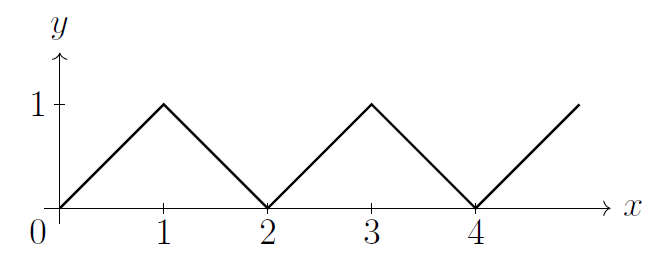
The graph consists of alternating straight-line segments of gradient 1 and $-1$ and continues in this way for all values of $x$.
The function $\mathrm{g}$ is defined as \[\mathrm{g}(x) = \sum_{r=1}^{10} \mathrm{f}\!\left(2^{r-1}x\right)\] Find the value of \[\int_{0}^{1} \mathrm{g}(x)\,\mathrm{d}x\]
(A) $\dfrac{1023}{1024}$
(B) $\dfrac{1023}{512}$
(C) $5$
(D) $10$
(E) $\dfrac{55}{2}$
(F) $55$
[Scroll down for hints]
TMUA 2021 Paper 2 Question 20
A sequence of functions $\mathrm{f}_1, \mathrm{f}_2, \mathrm{f}_3, \ldots$ is defined by \[\mathrm{f}_1(x) = |x|\] \[\mathrm{f}_{n+1}(x) = |\mathrm{f}_n(x) + x| \quad \text{for } n \ge 1\] Find the value of \[\int_{-1}^{1} \mathrm{f}_{99}(x)\,\mathrm{d}x\]
(A) $0$
(B) $0.5$
(C) $1$
(D) $49.5$
(E) $50$
(F) $99$
(G) $99.5$
(H) $100$
[Scroll down for hints]
TMUA 2022 Paper 1 Question 7
Find the finite area enclosed between the line $y = 0$ and the curve $y = x^2 - 4|x| - 12$
(A) $\dfrac{128}{3}$
(B) $\dfrac{176}{3}$
(C) $\dfrac{256}{3}$
(D) $108$
(E) $144$
(F) $288$
[Scroll down for hints]
Hints
TMUA 2020 Paper 2 Question 13
- This question includes an integral from 0 to 3, an integral from 0 to 1, and a reference to the range $1\leq x \leq 3$. What's the relationship between those things?
- Do not try to solve for $f(x)$.
- Note that we cannot assume that $\displaystyle\int (\mathrm{f}(x))^2\,\mathrm{d}x = \left(\int \mathrm{f}(x)\,\mathrm{d}x\right)^2$.
- Note that $(\mathrm{f}(x))^2\geq 0 $. What does that tell you about the integral $\displaystyle \int_0^3 (\mathrm{f}(x))^2\,\mathrm{d}x$?
TMUA 2020 Paper 2 Question 16
- You could always just do the integral yourself and then differentiate. This will reveal that the student's final answer is wrong. If need be, we could calculate the integrals on each line to see where things went wrong.
- Note that line (I) is fine for any function that's being integrated, using ideas from the Revision Notes.
- Line (II) is very much an application of the Fundamental Theorem of Calculus as written in the question.
- After line (III), the student's work is just substitution and tidying up, so those steps are easy to check.
TMUA 2021 Paper 1 Question 7
- The inequality $x\mathrm{f}(x)>0$ is an unusual condition. What does that tell you about $\mathrm{f}(x)$?
- If you know that $\mathrm{f}(x)$ is positive in some region(s) and negative in some region(s) then you can split up the integral of $|\mathrm{f}(x)|$ to think about those regions separately.
- Note that we're asked for the integral of $\mathrm{f}(|x|)$ not $\mathrm{f}(x)$, with $-2\leq x \leq 0$. What can you say about $|x|$ for this range of $x$?
- Note that reflections do not change the areas of regions of the $(x,y)$-plane (remembering that areas are always positive).
TMUA 2021 Paper 1 Question 15
- The function $\mathrm{g}(x)$ is a sum of functions. Write out a few of the terms of the sum, including the first and last terms.
- We're going to handle these ten functions separately.
- What is $\displaystyle \int_0^1 \mathrm{f}(x)\,\mathrm{d}x$?
- If you used integration for the previous hint, explain your answer to yourself in terms of an area.
- What does the graph of $y=\mathrm{f}(2x)$ look like for $0\leq x \leq 1$?
- What does the graph of $y=\mathrm{f}(4x)$ look like for $0\leq x \leq 1$?
TMUA 2021 Paper 2 Question 20
- 99 is a huge number. You're not expected to see what $\mathrm{f}_{99}(x)$ is just by looking at it.
- Do not "start at 99 and work down". It'll be many nested $|x|$ before you get back to anything that you can simplify.
- Instead, start small, and build up. What's $\mathrm{f}_2(x)$? Split into cases where $x\geq 0 $ and $x<0$ because that's how $|x|$ works.
TMUA 2022 Paper 1 Question 7
- Start by sketching the graph in the region $x\geq 0$, where $|x|$ is just $x$.
- For the region $x\leq 0$, simplify the expression $y=x^2-4|x|-12$.
- How is the graph in $x\leq 0$ related to the graph in $x\geq 0 $? Can we use that to save time with our integration?
- None of the options are negative. Why not?