


Versatility Solutions
Part of the Oxford Maths Admissions Test Livestream 2026
These are the solutions for the Versatility worksheet
Warm-up
- Let's see what happens if we continue the student's method. They've got to \[\frac{x-2}{\sqrt{(x-1)^2+(x-3)^2}}+\frac{x-4}{\sqrt{(x-2)^2+(x-6)^2}}=0.\]
- So now it would probably make sense to move a term to the right-hand side, square both sides, and multiply up. But let's be careful, because squaring both sides of an equation can introduce additional solutions.
- This gives \[ (x-2)^2\left((x-2)^2+(x-6)^2\right) = (x-4)^2\left((x-1)^2+(x-3)^2\right) \]
- This looks like a mess, but I can see that the $x^4$ term will cancel. Multiplying everything out and bringing the remaining terms to the left reveals that in fact the $x^3$ term cancels too, and it all simplifies to the quadratic $3x^2-8x=0$. The value $x=0$ isn't the one I want (it doesn't satisfy the equation that we had before we squared), so I'll take $x=\frac{8}{3}$. Then $y=\frac{5}{3}$ and the minimum value of the original function is $\sqrt{\frac{26}{9}} + \sqrt{\frac{4}{9}+\frac{100}{9}}=\sqrt{26}$.
Alternatively, we could interpret the question geometrically. The question wants the point on the line $y=x-1$ that minimises the sum of the distances to $(1,2)$ and $(2,5)$. Let's write $A$ for the point $(1,2)$, $B$ for the point $(2,5)$, and $P$ for the unknown point on the line.
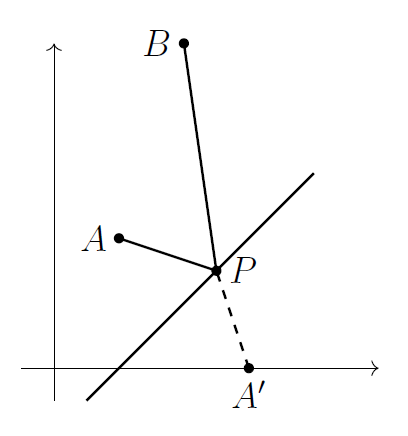
- This problem is not easy! Let's use an idea from geometry; imagine reflecting the point $A$ in the line $y=x-1$, as if the line $y=x-1$ is a mirror, to give a new point $A'$ on the other side of the line. Then the distance $|A'P|$ will be the same as the distance $|AP|$. Then the key idea is that the sum $|A'P|+|BP|$ will be minimised when the segments $A'P$ and $BP$ form a straight line; the quickest route from $A'$ to $B$ is a straight line.
- So we need to find the mirror image $A'$, and then we need to find the straight line through $A'$ and $B$. I find that $A'$ is at $(3,0)$ and the line is $y=15-5x$. This intersects $y=x-1$ at $x=\frac{8}{3}$, $y=\frac{5}{3}$. As above, the original function has value $\sqrt{26}$.
Questions
TMUA 2020 Paper 1 Question 19
- It's tempting to just evaluate the quadratic at each of the six values and find out whether it's positive.
- This is lots of work though;
- $26^2-52\times 26 - 52 = -728$
- $27^2-52\times 27 - 52 = -727$
- $51^2-52\times 51 - 52 = -103$
- $52^2-52\times 52 - 52 = -52$
- $53^2-52\times 53 - 52 = 1$
- I can stop now!
- Instead of persisting through all that, perhaps we should rewrite the quadratic to make it easier to evaluate.
- One way to do this is to complete the square for $(x-26)^2-26^2-52$.
- This is a bit of a pain, because I don't know $26^2$ and I don't want to work it out.
- Perhaps I should use the difference of two squares to simplify those first two terms. Said differently, I could have just factored the $x$ out of the first two terms of the original quadratic.
- The expression is $x(x-52)-52$.
- This is much easier to work with!
- I can see that the expression will definitely be negative for $0\leq x \leq 52$ because $x(x-52)$ will be less than or equal to zero. When $x=53$, the expression will be $53\times (1) -52=1$, which is positive.
- The answer is E.
Extension
- It's a good thing that we didn't try to find the roots of the quadratic $x^2-52x-52=0$, because they're not very nice numbers. As a challenge, find the exact value of the larger root of the quadratic and prove that it's between $x=52$ and $x=53$.
Suppose that we have some polynomial of degree $n$ and we would like to evaluate it at some horrible value of $x$. Explain how you can do this in a way that involves multiplying by $x$ exactly $n$ times (so you cannot work out $x^{n}$ and then $x^{n-1}$ and so on).
If you're interested in this, you can look up "Horner's method" online, but you've probably just invented it yourself.
TMUA 2021 Paper 1 Question 16
- We're told the third term in ascending powers is $105x^2$. That looks a little odd to me, because the exponent is $2$ not $3$, but this is just because the first term in ascending powers of $x$ would be the term that doesn't involve $x$ at all (or, said differently, the term involves $x^0$). Careful not to be out-by-one when counting!
- The third term would be $\binom{n}{2}a^{n-2}b^{2}x^2$.
- Similarly, the fourth term would be $\binom{n}{3}a^{n-3}b^3x^3$.
- Now we're told about the fourth term in descending powers of $x$. Before I write out an equation for this, I'm struck by the fact that it's $210x^3$ again. What's going on here?
- The fourth term in ascending powers of $x$ has the same coefficient as the fourth term in descending powers of $x$. But, more to the point, it has the same power of $x$.
- We must be looking at the middle term in the expansion.
- So there are, in total, seven different powers of $x$ in this expansion. So $n=6$... careful not to be out-by-one when counting!
- This is really helpful for my equations above. I need to know expressions for the binomial coefficients \[ \binom{n}{2}=\frac{n(n-1)}{2}\quad \text{and}\quad \binom{n}{3}=\frac{n(n-1)(n-2)}{6} \] so that I can work out $\binom{6}{2}=15$ and $\binom{6}{3}=20$.
- I have \[ a^4b^2=7\quad \text{and}\quad a^3b^3=\frac{21}{2} \]
- We're asked for $\left(\frac{a}{b}\right)^2$. That's a bit unusual, but we can work it out from the equations. We could try to solve for $a$ and $b$, but I don't think that we need to. Instead, let's divide the first by the second to get $\frac{a}{b}$ on the left, and then we'll be almost done. I have \[ \frac{a^4b^2}{a^3b^3}=\frac{7}{\frac{21}{2}},\quad\text{so}\quad \frac{a}{b}=\frac{2}{3} \]
- Then the square of this is $\frac{4}{9}$.
- The answer is B.
Extension
- Using your solution, find the third term, in descending powers of $x$, of the expansion.
- We have three unknowns ($a$ and $b$ and $n$) and we've been given three bits of information, so we might hope that we can solve any version of this question. Investigate this by choosing your own values of $a$ and $b$ and $n$ (not too large!), and calculating the expansion. Then select three terms from your expansion, try to forget $a$ and $b$ and $n$, and see if you can deduce them from your selected terms. Can you always do this? What might go wrong?
TMUA 2021 Paper 2 Question 19
- I could do some algebra, perhaps moving one term to the other side and squaring both sides. I know that's dangerous though, because an equation like $x=1-2x$ squares to the same thing as $x=2x-1$, even though they have totally different solutions.
- Instead, let's try to simplify first. It's odd that the question has two square-roots multiplied together. You don't see that very much. Why not? Well, because we can simplify it. If $a\geq 0$ and $b\geq 0$ then $\sqrt{a}\sqrt{b}=\sqrt{ab}$, and that's normally a nicer thing to write down.
- So I can simplify $\sqrt{1+\sin \theta}\sqrt{1-\sin \theta}$ to $\sqrt{1-\sin^2 \theta}$. The next step is where I might make a mistake.
- I might spot that $1-\sin^2\theta = \cos^2\theta$ and then I might want to write $\sqrt{1-\sin^2 \theta}$ as $\cos \theta$. Not so fast!
- Remember that $\sqrt{x^2}$ is not equal to $x$ if $x\lt 0$. Instead of writing $\cos \theta$, I must write $\left| \cos \theta \right|$.
- So, remembering this fact about square-roots, the equation simplifies to \[ \sin \theta \left| \cos\theta \right| + \cos\theta \left|\sin\theta\right| = 0 \]
- Whenever I have absolute value signs, I like to think about separate cases depending on whether the expression(s) inside are positive or negative.
- In this case, if $\sin \theta$ and $\cos \theta$ are both positive, then I'll have the sum of two positive terms. That can't be zero.
- Similarly, if $\sin \theta$ and $\cos \theta$ are both negative, then I'll have the sum of two negative terms. That can't be zero.
- I want exactly one of $\sin\theta$ and $\cos\theta$ to be positive, and the other to be negative. Or for one of them to be zero, I suppose (because then both terms will be zero).
Time to draw graphs of $\sin \theta$ and $\cos\theta$ to find out when this happens.
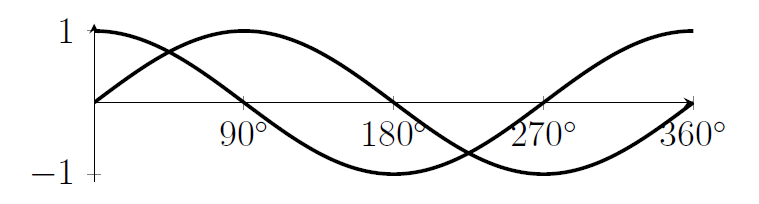
- I want the range $90^\circ$ to $180^\circ$ inclusive, and the range $270^\circ$ to $360^\circ$ inclusive. That's 182 integer values in total.
- The answer is F.
Extension
- Check your understanding; replace the $+$ in the question with a $-$. Which values of $\theta$ satisfy this new equation?
TMUA 2022 Paper 1 Question 16
- The quadratic equation gives \[x^2=\frac{3\pm \sqrt{2}}{7}\]
- If $x=\cos \theta$ then we're looking at $\cos^2\theta$, so $\sin^2\theta$ will be $1$ minus this. Similarly for $\beta$ instead of $\theta$.
- So we're looking for a new polynomial where the roots are \[x^2 = 1-\frac{3\pm\sqrt{2}}{7} = \frac{4\mp \sqrt{2}}{7}\]
- I've used the $\mp$ symbol there to keep track of the fact that the root with the $+$ sign corresponds to the root for $x^2$ with the $-$ sign in the original polynomial, but this is not very important.
- The key observation is that these would be the roots of some quadratic for $x^2$, and if we can work out the coefficients then we're done.
- All the options have leading coefficient $7$, so let's work with that. The denominator for the quadratic formula is supposed to be $2a$, so I'll multiply both numerator and denominator by $2$ to get $\frac{8\mp \sqrt{8}}{14}$. Can I just take $b=-8$ and then work out $c$?
- I'd need $b^2-4ac = 8$, with $b=-8$ and $a=7$. I can do this if I take $c=2$. So my quadratic for $x^2$ would be $7x^4-8x^2+2=0$.
- Alternatively, finish solving the original polynomial for $x=\pm \sqrt{\frac{3+\sqrt{2}}{7}}$, or $x=\pm \sqrt{\frac{3-\sqrt{2}}{7}}$, then calculate $\sin \theta$ and $\sin \beta$ from these values of $\cos\theta$ and $\cos\beta$, and then multiply out $(x-\sin \theta)(x+\sin\theta)(x-\sin \beta)(x+\sin \beta)=0$. You'll get $x^4-\frac{8}{7}x^2+\frac{2}{7}=0$.
- The answer is B.
Extension
Explain why a polynomial of degree four with roots $\pm\cos\theta$ and $\pm\cos\beta$ will never have an $x^3$ term or an $x^1$ term.
Explain why replacing $x^2$ with $1-x^2$ in such a polynomial will always give a new polynomial with roots $\pm \sin\theta$ and $\pm\sin\beta$.
Check that replacing $x^2$ with $1-x^2$ in $7x^4-6x^2+1=0$ gives $7x^4-8x^2+2=0$.
MAT 2019 Q1I
- I might try to rearrange this for \[\frac{x}{y}=2^{y-x}.\]
- I could even take logarithms of both sides for \[\log_2 x -\log_2 y = y-x.\]
- But now what?
- Instead, let's think about the function $f(x)=x2^x$. Perhaps that's not the best choice of variable, because I'd like to say that I'm evaluating that function at $x$ and at $y$, as two different inputs. If it helps, imagine rewriting the question to use $a$ and $b$ with $0\lt a\lt b$ and $a2^a = b2^b$. Then I'm looking at $f(a)=f(b)$.
Does this ever happen? I should probably try to sketch $f(x)$ and see if it repeats any values.
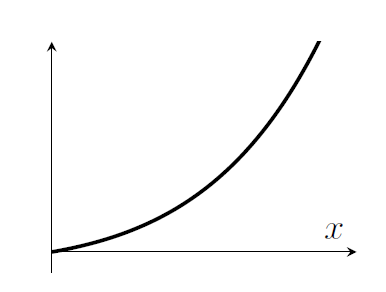
- Doing this, I realise that the function does not repeat any values, because $f(x)=x2^x$ is an increasing function for $x\gt 0$. It's the product of two positive increasing functions.
- Since we're told that $x\lt y$ (no possibility of $x=y$), we conclude that $x2^x = y2^y$ simply never happens.
- The answer is (a).
Extension
- True or false? "If $\mathrm{f}(x)$ is increasing and $\mathrm{g}(x)$ is increasing, then $\mathrm{f}(x)\mathrm{g}(x)$ is increasing."
- True or false? "If $\mathrm{f}(x)$ is decreasing and $\mathrm{g}(x)$ is decreasing, then $\mathrm{f}(x)\mathrm{g}(x)$ is decreasing."
- Compare and contrast with the similar Extension question on the Graphs worksheet following TMUA 2020 Paper 2 Question 5.
Part of an Interview
It's helpful to draw a diagram.
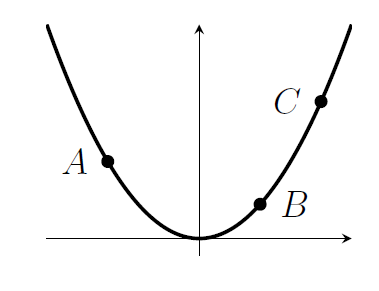
- It's tempting to write out an expression for the area in terms of $a$ and $b$ and $c$, perhaps with the hope of differentiating it with respect to $b$. This is really messy if you use Heron's formula, it's a bit of a pain if you use the shoelace formula, and it's more or less a non-starter if you want to work out any angles. If you want to check your answer, the area simplifies down to $\frac{1}{2}(b-a)(c-a)(c-b)$ provided $a\lt b\lt c$.
- Instead of doing all that, let's think about how moving the point $B$ changes the area of the triangle. The points $A$ and $C$ stay fixed, so it makes sense to think of that as the "base" of the triangle, with the different positions for $B$ changing the "perpendicular height" of the triangle. It's perhaps a little odd to call $AC$ the base, because it's the top of the triangle, but the formula $\frac{1}{2}bh$ still works!
- At this point, you might like to do some algebra to find the perpendicular distance from $B$ to the line $AC$, aiming to maximise this by differentiating. That's still a bit messy, so let's think more about where this will happen.
I'll draw on some lines that show the "height" of the triangle $ABC$, like a height chart. I'll draw dashed lines that are parallel to $AC$.
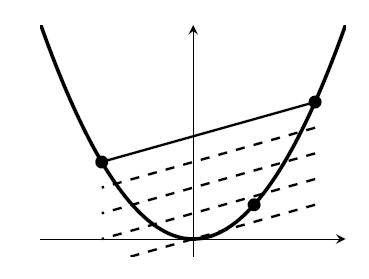
- I want to put $B$ as far from the line $AC$ as possible, so I should put it at a point where one of those dashed lines is tangent to the curve. So I should find the point where the gradient of the curve matches the gradient of the line $AC$.
- This algebra is easy, just set $b$ to be the value of $x$ where $2x = \frac{c^2-a^2}{c-a}$. This simplifies to \[b=\frac{a+c}{2}\]
- The answer turned out to be the arithmetic mean of $a$ and $c$; perhaps that's what you would have guessed!
- Depending on how the interview is going, we might repeat the calculation with $y=x^4$ instead of $y=x^2$. The general formula for the area is horrible in this case, so you should probably use this gradient method. The answer is not the arithmetic mean of $a$ and $c$ in this case. Perhaps we could say that this second example proves that we can't just guess (sadly).
- The approach we've used above is foreshadowing for the method of Lagrange multipliers, where you maximise a target function subject to some constraint function by choosing a point where the gradients align. This is something we teach to first-year students on the Oxford Mathematics degree, and I wouldn't expect people to have seen it before an interview.
- The first year of the Oxford Mathematics degree also contains something called the Mean Value Theorem, which guarantees that for any two points on a smooth curve, there's a point in between where the gradient of the curve matches the gradient of the chord between the two points. (Note: "smooth" has a technical definition that is a bit stronger than I need here, but I'm hoping that you'll read it simply as a condition on the sorts of curve that we're talking about. Curves like $y=|x|$ are not covered by the Mean Value Theorem).