

If you have ever watched the movie Transformers you may not have worried too much about whether it is realistic. Nevertheless, scientists have tried, and are still trying, to create objects that can transform their shape.
14:00
Multigrid for climate- and weather prediction
Abstract
Climate- and weather prediction centres such as the Met Office rely on efficient numerical methods for simulating large scale atmospheric flow. One computational bottleneck in many models is the repeated solution of a large sparse system of linear equations. Preconditioning this system is particularly challenging for state-of-the-art discretisations, such as (mimetic) finite elements or Discontinuous Galerkin (DG) methods. In this talk I will present recent work on developing efficient multigrid preconditioners for practically relevant modelling codes. As reported in a REF2021 Industrial Impact Case Study, multigrid has already led to runtime savings of around 10%-15% for operational global forecasts with the Unified Model. Multigrid also shows superior performance in the Met Office next-generation LFRic model, which is based on a non-trivial finite element discretisation.
12:00
Anomalous boundaries of topological matter
Abstract
A topological insulator has anomalous boundary spectrum which completely fills up gaps in the bulk spectrum. This ``topologically protected’’ spectral property is a physical manifestation of coarse geometry and index theory ideas. Special examples involve spectral flow and gerbes, related to Hamiltonian anomalies, and they arise experimentally in quantum Hall systems, time-reversal invariant mod-2 insulators, and shallow-water waves.
12:00
Symmetry protected topological (SPT) phases of quasifree gapped ground states and coarse geometry
Abstract
Symmetry protected topological (SPT) phases have recently attracted a lot of
attention from physicists and mathematicians as a topological classification
scheme for gapped ground states. In this talk I will briefly introduce the
operator algebraic approach to SPT phases in the infinite-volume limit. In
particular, I will focus on the quasifree (free-fermionic) setting, where we
can adapt tools from algebraic quantum field theory to describe phases of
gapped ground states using K-homology and the coarse index.
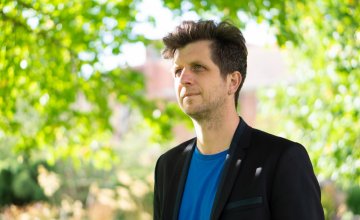
Network Science provides generic tools to model and analyse systems in a broad range of disciplines, including biology, computer science and sociology. Renaud Lambiotte (pictured) teaches a 4th year undergraduate course on Networks and we are making the whole course available via our YouTube Channel. The first lecture is below with seven more to follow over the next few weeks.
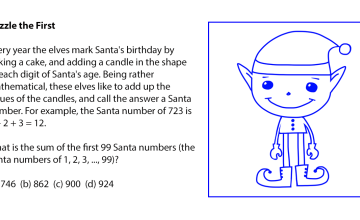
There is no doubt about it, Santa is a mathematician. He must be, having every year to calculate the best way to get presents to so many homes in such a short space of time.
So in homage to such genius, we have two Santa themed puzzles for you to solve. You can find the answers at the bottom of the page (but try not to look too quickly).