

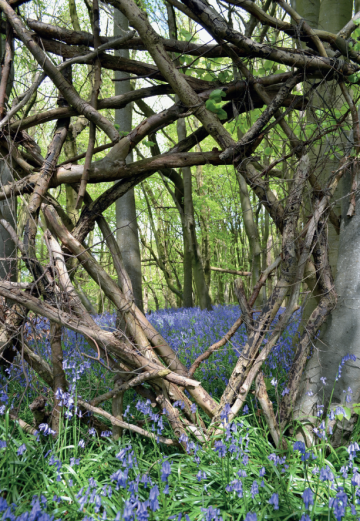

If you are ever in the centre of Oxford and are getting tired of the endless beautiful buildings, then make your way to Wytham Woods. Covering 1000 acres of ancient and beautiful woodland 3 miles NW of Oxford, Wytham is exceptionally rich in flora and fauna, with over 500 species of plants, a wealth of woodland habitats, and 800 species of butterflies and moths. And it is so wonderfully peaceful.
Lauren Williams - Combinatorics of the tree amplituhedron
Abstract
The tree amplituhedron A(n, k, m) is a geometric object generalizing the positive Grassmannian, which was introduced by Arkani-Hamed and Trnka in 2013 in order to give a geometric basis for the computation of scattering amplitudes in N=4 supersymmetric Yang-Mills theory. I will give a gentle introduction to the amplituhedron, and then describe what it looks like in various special cases. For example, one can use the theory of sign variation and matroids to show that the amplituhedron A(n, k, 1) can be identified with the complex of bounded faces of a cyclic hyperplane arrangement. I will also present some conjectures relating the amplituhedron A(n, k, m) to combinatorial objects such as non-intersecting lattice paths and plane partitions. This is joint work with Steven Karp, and part of it is additionally joint work with Yan Zhang.
Optimisation of a Steam Turbine Blade Path
Abstract
The vast majority of the world's electricity is generated by converting thermal energy into electric energy by use of a steam turbine. Siemens are one of the worlds leading manufacturers of such
turbines, and aim to design theirs to be as efficient as possible. Using an internally built software, Siemens can estimate the efficiency which would result from a turbine design. In this presentation, we present the approaches that have been taken to improve turbine design using mathematical optimisation software. In particular, we focus on the failings of the approach currently taken, the obstacles in place which make solving this problem difficult, and the approach we intend to take to find a locally optimal solution.
The pants graph
Abstract
In the 80s, Hatcher and Thurston introduced the pants graph as a tool to prove that the mapping class group of a closed, orientable surface is finitely presented. The pants graph remains relevant for the study of the mapping class group, sitting between the marking graph and the curve graph. More precisely, there is a sequence of natural coarse lipschitz maps taking the marking graph via the pants graph to the curve graph.
A second motivation for studying the pants graph comes from Teichmüller theory. Brock showed that the pants graph can be interpreted as a combinatorial model for Teichmüller space with the Weil-Petersson metric.
In this talk I will introduce the pants graph, discuss some of its properties and state a few open questions.
Homogenisation Applied to Electrical Calcination of Carbon Materials
Abstract
Calcination describes the heat treatment of anthracite particles in a furnace to produce a partially-graphitised material which is suitable for use in electrodes and for other met- allurgical applications. Electric current is passed through a bed of anthracite particles, here referred to as a coke bed, causing Ohmic heating and high temperatures which result in the chemical and structural transformation of the material.
Understanding the behaviour of such mechanisms on the scale of a single particle is often dealt with through the use of computational models such as DEM (Discrete Element Methods). However, because of the great discrepancy between the length scale of the particles and the length scale of the furnace, we can exploit asymptotic homogenisation theory to simplify the problem.
In this talk, we will present some results relating to the electrical and thermal conduction through granular material which define effective quantities for the conductivities by considering a microscopic representative volume within the material. The effective quantities are then used as parameters in the homogenised macroscopic model to describe calcination of anthracite.