

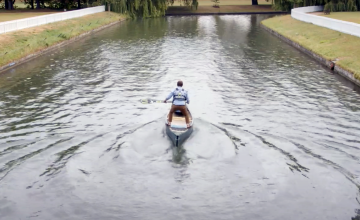
Next time you lose your paddle whilst canoeing - don't despair. There is another way to push your canoe forwards: by jumping on it! Gunwale bobbing refers to the act of standing on the gunwales (side walls) of a canoe and forcing it into oscillations with one's legs. When forced at the right frequency, the canoe can surf from crest to crest of the generated wave field by pushing into positive surface gradients.
The temporal rich club phenomenon
Pedreschi, N
Battaglia, D
Barrat, A
Nature Physics
volume 18
931-938
(13 Jun 2022)
New lower bounds for van der Waerden numbers
Green, B
Forum of Mathematics, Pi
volume 10
(13 Jul 2022)
An adaptive iterative linearised finite element method for implicitly constituted incompressible fluid flow problems and its application to Bingham fluids
Heid, P
Süli, E
Applied Numerical Mathematics
volume 181
364-387
(01 Nov 2022)
Delamination from an adhesive sphere: Curvature-induced dewetting versus
buckling
Box, F
Domino, L
Corvo, T
Adda-Bedia, M
Démery, V
Vella, D
Davidovitch, B
(16 Jul 2022)
http://arxiv.org/abs/2207.07927v1
buckling
Thu, 04 Aug 2022
15:00
15:00
S2.27
K-theoretic classification of inductive limit actions of fusion categories on AF-algebras
Roberto Hernandez Palomares
(Texas A&M University)
Abstract
I will introduce a K-theoretic complete invariant of inductive limits of finite dimensional actions of fusion categories on unital AF-algebras. This framework encompasses all such actions by finite groups on AF-algebras. Our classification result essentially follows from applying Elliott's Intertwining Argument adapted to this equivariant context, combined with tensor categorical techniques.
Our invariant roughly consists of a finite list of pre-ordered abelian groups and positive homomorphisms, which can be computed in principle. Under certain conditions this can be done in full detail. For example, using our classification theorem, we can show torsion-free fusion categories admit a unique AF-action on certain AF-algebras.
Connecting with subfactors, inspired by Popa’s classification of finite-depth hyperfinite subfactors by their standard invariant, we study unital inclusions of AF-algebras with trivial centers, as natural analogues of hyperfinite II_1 subfactors. We introduce the notion of strongly AF-inclusions and an Extended Standard Invariant, which characterizes them up to equivalence.
Mathematical Model of Fluid and Ion Transport across the Retinal Pigment Epithelium
Dvoriashyna, M
Foss, A
Gaffney, E
Jensen, O
Repetto, R
INVESTIGATIVE OPHTHALMOLOGY & VISUAL SCIENCE
volume 59
issue 9
(2018)
https://www.webofscience.com/api/gateway?GWVersion=2&SrcApp=PARTNER_APP&SrcAuth=LinksAMR&KeyUT=WOS:000442932800142&DestLinkType=FullRecord&DestApp=ALL_WOS&UsrCustomerID=4fd6f7d59a501f9b8bac2be37914c43e
Thu, 24 Nov 2022
14:00 -
15:00
L3
Nonlinear and dispersive waves in a basin: theory and numerical analysis
Dimitrios Mitsotakis
(Victoria University of Wellington)
Abstract
Surface water waves of significant interest, such as tsunamis and solitary waves, are nonlinear and dispersive waves. Unluckily, the equations derived from first principles that describe the propagation of surface water waves, known as Euler's equations, are immensely hard to study. For this reason, several approximate systems have been proposed as mathematical alternatives. We show that among the numerous simplified systems of PDEs of water wave theory there is only one that is provably well-posed (in Hadamard’s sense) in bounded domains with slip-wall boundary conditions. We also show that the particular well-posed system obeys most of the physical laws that acceptable water wave equations must obey, and it is consistent with the Euler equations. For the numerical solution of our system we rely on a Galerkin/finite element method based on Nitsche's method for which we have proved its convergence. Validation with laboratory data is also presented.
Metastable oscillatory modes emerge from synchronization in the brain spacetime connectome
Cabral, J
Castaldo, F
Vohryzek, J
Litvak, V
Bick, C
Lambiotte, R
Friston, K
Kringelbach, M
Deco, G
COMMUNICATIONS PHYSICS
volume 5
issue 1
(15 Jul 2022)
Influence of late Pleistocene sea-level variations on midocean ridge spacing in faulting simulations and a global analysis of bathymetry
Huybers, P
Liautaud, P
Proistosescu, C
Boulahanis, B
Carbotte, S
Katz, R
Langmuir, C
Proceedings of the National Academy of Sciences
volume 119
issue 28
(07 Jul 2022)