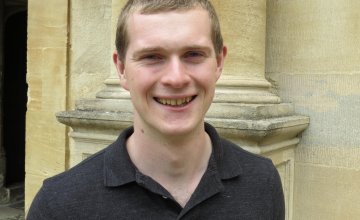
Mathematrix - Meet Vicky Neale
Sharing her academic path and experience with teaching and outreach
This session is open to all women and non-binary students, and joined with Mirzakhani society, the undergraduate mathematics society for women and non-binary students. The topic will be related to women and confidence.
In recent years, more and more compactifications have emerged whose existence depends crucially on the presence of internal sources to the supergravity fields, such as D-branes and orientifold planes. I will review some solutions of this type in various dimensions, and illustrate their applications to holography and potentially to the problem of finding de Sitter solutions.
In this talk I will present a large class of non-supersymmetric AdS7 solutions of IIA supergravity, and their (in)stabilities. I will start by reviewing supersymmetric AdS7 solutions of 10D supergravity dual to 6D (1,0) SCFTs. I will then focus on their non-supersymmetric counterpart, discussing how they are related. The connection between supersymmetric and non-supersymmetric solutions leads to a hint for the SUSY breaking mechanism, which potentially allows to evade some of the assumptions of the Ooguri-Vafa Conjecture about the AdS landscape. A big subset of these solutions shows a curious pattern of perturbative instabilities whenever many open-string modes are considered. On the other hand an infinite class remains apparently stable.
The idea of adjusting prices in order to sell goods at the highest acceptable price, such as haggling in a market, is as old as money itself. We consider the problem of pricing multiple products on a network of resources, such as that faced by an airline selling tickets on its flight network. In this talk I will consider various optimization relaxations to the deterministic dynamic pricing problem on a network. This is joint work with Raphael Hauser.
In recent years, there has been an increased interest in exploiting rank structure of matrices arising from the discretization of partial differential equations to develop fast direct solvers. In this talk, I will outline the fundamental ideas of this topic in the context of solving the integral equation formulation of the Helmholtz equation, known as the Lippmann-Schwinger equation, and will discuss some plans for future work to develop new, higher-order solvers. This is joint work with Gunnar Martinsson.
This talk will feature a brief introduction to persistent homology, the vanguard technique in topological data analysis. Nothing will be required of the audience beyond a willingness to row-reduce enormous matrices (by hand if we can, by machine if we must).
For decades, researchers have been studying efficient numerical methods to solve differential equations, most of them optimised for one-core processors. However, we are about to reach the limit in the amount of processing power we can squeeze into a single processor. This explains the trend in today's computing industry to design high-performance processors looking at parallel architectures. As a result, there is a need to develop low-complexity parallel algorithms capable of running efficiently in terms of computational time and electric power.
Parallelisation across time appears to be a promising way to provide more parallelism. In this talk, we will introduce the main algorithms, following (Gander, 2015), with a particular focus on the parareal algorithm.