

Cell proliferation within small intestinal crypts is the principal driving force for cell migration on villi
Parker, A
MacLaren, O
Fletcher, A
Muraro, D
Kreuzaler, P
Byrne, H
Maini, P
Watson, A
Pin, C
FASEB Journal
volume 31
issue 2
636-649
(01 Jan 2016)
doi:10.1096/fj.201601002
Tue, 18 Oct 2016
12:45 -
13:30
C5
Scalable Two-Phase Flow Solvers
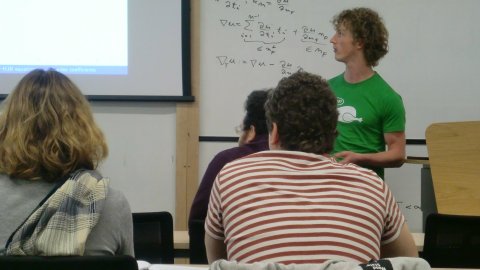
Niall Bootland
(University of Oxford)
Abstract
My research focuses on numerical techniques that help provide scalable computation within simulations of two-phase fluid flow problems. The efficient solution of the linear systems which arise is key to obtaining practical computation. I will motivate and discuss new methods which seek to generalise effective techniques for a single phase to the more challenging setting of two-phase flow where the governing equations have discontinuous coefficients.
Tue, 18 Oct 2016
14:15 -
15:15
L4
Tensor diagrams and Chebyshev polynomials
Lisa Lamberti
(Oxford)
Abstract
Given a complex vector space $V$, consider the ring $R_{a,b}(V)$ of polynomial functions on the space of configurations of $a$ vectors and $b$ covectors which are invariant under the natural action of $SL(V)$. Rings of this type play a central role in representation theory, and their study dates back to Hilbert. Over the last three decades, different bases of these spaces with remarkable properties were found. To explicitly construct, as well as to compare, some of these bases remains a challenging problem, already open when $V$ is 3-dimensional.
In this talk, I report on recent developments in the 3-dimensional setting of this theory.
Tue, 01 Nov 2016
15:45 -
16:45
L4
A geometric approach to Hall algebras
Adam Gal
(Oxford)
Abstract
The Hall algebra can be constructed using the Waldhausen S-construction. We will give a systematic recipe for this and show how it extends naturally to give a bi-algebraic structure. As a result we obtain a more transparent proof of Green's theorem about the bi-algebra structure on the Hall algebra.
Mon, 31 Oct 2016
14:15 -
15:15
L4
The cohomological McKay correspondence via Floer theory
Alex Ritter
(Oxford)
Abstract
Abstract: (This is joint work with Mark McLean, Stony Brook University N.Y.).
The classical McKay correspondence is a 1-1 correspondence between finite subgroups G of SL(2,C) and simply laced Dynkin diagrams (the ADE classification). These diagrams determine the representation theory of G, and they also describe the intersection theory between the irreducible components of the exceptional divisor of the minimal resolution Y of the simple surface singularity C^2/G. In particular those components generate the homology of Y. In the early 1990s, Miles Reid conjectured a far-reaching generalisation to higher dimensions: given a crepant resolution Y of the singularity C^n/G, where G is a finite subgroup of SL(n,C), the claim is that the conjugacy classes of G are in 1-1 correspondence with generators of the cohomology of Y. This has led to much active research in algebraic geometry in recent years, in particular Batyrev proved the conjecture in 2000 using algebro-geometric techniques (Kontsevich's motivic integration machinery). The goal of my talk is to present work in progress, jointly with Mark McLean, which proves the conjecture using symplectic topology techniques. We construct a certain symplectic cohomology group of Y whose generators are Hamiltonian orbits in Y to which one can naturally associate a conjugacy class in G. We then show that this symplectic cohomology recovers the classical cohomology of Y.
This work is part of a large-scale project which aims to study the symplectic topology of resolutions of singularities also outside of the crepant setup.
Fri, 18 Nov 2016
10:00 -
11:00
L4
Coupled electromagnetic and thermal modelling of the quench behaviour of a plasma confinement magnet made from ReBCO HTS cables
Robert Slade
(Tokamak Energy)
Scaling-up of Multi-Capsule Depth Filtration Systems by Modelling Flow and Pressure Distribution
Krupp, A
Please, C
Kumar, A
Griffiths, I
Separation and Purification Technology
(Sep 2016)
doi:10.1016/j.seppur.2016.07.028
Optimizing the operation of a direct-flow filtration device
Griffiths, I
Herterich, J
Field, R
Vella, D
Xu, Q
Journal of Engineering Mathematics
volume 104
issue 1
195-211
(01 Oct 2016)
doi:10.1007/s10665-016-9879-1