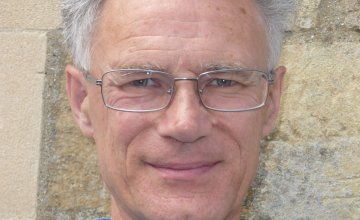
Roger Heath-Brown is one of Oxford's foremost mathematicians. His work in analytic number theory has been critical to the advances in the subject over the past thirty years and garnered Roger many prizes.
14:30
SNIPE for memory-limited PCA with incomplete data: From failure to success
Abstract
Consider the problem of identifying an unknown subspace S from data with erasures and with limited memory available. To estimate S, suppose we group the measurements into blocks and iteratively update our estimate of S with each new block.
In the first part of this talk, we will discuss why estimating S by computing the "running average" of span of these blocks fails in general. Based on the lessons learned, we then propose SNIPE for memory-limited PCA with incomplete data, useful also for streaming data applications. SNIPE provably converges (linearly) to the true subspace, in the absence of noise and given sufficient measurements, and shows excellent performance in simulations. This is joint work with Laura Balzano and Mike Wakin.
12:00
Boundary regularity for strong local minimizers and Weierstrass problem
Abstract
Chern-Gauss-Bonnet formulas for singular non-compact manifold
Abstract
A generalisation of the classical Gauss-Bonnet theorem to higher-dimensional compact Riemannian manifolds was discovered by Chern and has been known for over fifty years. However, very little is known about the corresponding formula for complete or singular Riemannian manifolds. In this talk, we explain a new Chern-Gauss-Bonnet theorem for a class of manifolds with finitely many conformally flat ends and singular points. More precisely, under the assumptions of finite total Q curvature and positive scalar curvature at the ends and at the singularities, we obtain a Chern-Gauss-Bonnet type formula with error terms that can be expressed as isoperimetric deficits. This is joint work with Huy Nguyen.
15:00
On the Enumeration of Irreducible Polynomials over GF(q) with Prescribed Coefficients
Abstract
Gauss was the first to give a formula for the number of monic irreducible polynomials of degree n over a finite field. A natural problem is to determine the number of such polynomials for which certain coefficients are prescribed. While some asymptotic and existence results have been obtained, very few exact results are known. In this talk I shall present an algorithm which for any finite field GF(q) of characteristic p expresses the number of monic irreducibles of degree n for which the first l < p coefficients are prescribed, for n >= l and coprime to p, in terms of the number of GF(q^n)-rational points of certain affine varieties defined over GF(q).
The GF(2) base field case is related to the distribution of binary Kloosterman sums, which have numerous applications in coding theory and cryptography, for example via the construction of bent functions. Using a variant of the algorithm, we present varieties (which are all curves) for l <= 7 and compute explicit formulae for l <= 5; before this work such formulae were only known for l <= 3. While this connection motivates the problem, the talk shall focus mainly on computational algebraic geometry, with the algorithm, theoretical questions and computational challenges taking centre stage.
Feasibility projection for vibrational and damping constraints of turbines
Abstract
The challenge is to develop an automated process that transforms an initial desired design of turbine rotor and blades in to a close approximation having eigenfrequencies that avoid the operating frequency (and its first harmonic) of the turbine.