

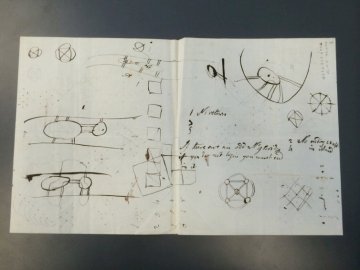
When you think about the founders of computing you may think Alan Turing, you may even think Charles Babbage. But you should definitely think about Ada Lovelace. Ada is not only the link between Babbage and Turing, but a woman of fierce originality and intellectual interests whose ideas went beyond Babbage’s ideas of computers as manipulating numbers, and focused on their creative possibilities and their limits, the very issues with which we are wrestling today.
Thu, 15 Oct 2015
16:00 -
17:30
L4
Numerical approximation of irregular SDEs via Skorokhod embeddings
Stefan Ankirchner
(Friedrich-Schiller-Universität Jena)
Abstract
We provide a new algorithm for approximating the law of a one-dimensional diffusion M solving a stochastic differential equation with possibly irregular coefficients.
The algorithm is based on the construction of Markov chains whose laws can be embedded into the diffusion M with a sequence of stopping times. The algorithm does not require any regularity or growth assumption; in particular it applies to SDEs with coefficients that are nowhere continuous and that grow superlinearly. We show that if the diffusion coefficient is bounded and bounded away from 0, then our algorithm has a weak convergence rate of order 1/4. Finally, we illustrate the algorithm's performance with several examples.

There is a specific requirement to broaden students’ knowledge and understanding of the Mathematical Sciences. This broadening will ensure that students understand their own research as part of the wider Mathematical Sciences, appreciating the variety of questions, objectives, and ways of thinking there are; and it will also familiarise students with different ideas so they can make the surprising links across mathematics which are the basis of some of the most fruitful advances.

To have had some teaching experience is likely to benefit your career, especially if you intend to continue in academia, where academic jobs increasingly expect some teaching experience, but also more generally as it should help you to develop your communication skills.


From Roger Bacon in the thirteenth century to Roger Penrose in the twenty-first, Oxford has been critical to the development of mathematics.

Are you interested in pushing the boundaries of mathematical research and developing novel ideas and techniques to solve problems? If so, apply for a PhD (or DPhil as it's known in Oxford) in Mathematics, and find out more about our research groups.


Developing research, subject specific, personal and professional expertise is crucial to the success of your future career. The skills and experience that got you to where you are now will not necessarily be sufficient to get you to where you want to go next, and so it is important that you continue to develop both depth and breadth of your expertise. The importance of this has been recognised by stakeholders such as the Research Councils and RCUK, and is now supported by two documents - the