

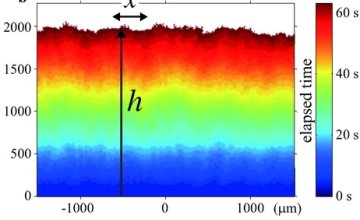
Oxford Mathematician Weijun Xu talks about his exploration of the universal behaviour of large random systems:

"Nature comes with a separation of scales. Systems that have apparently different individual interactions often behave very similarly when looked at from far away. This phenomenon is particularly attractive when randomness is involved.

Tue, 28 Apr 2020

12:00 - 13:00
C1

Atomic structures and the statistical mechanics of networks

Anatol Wegner
(University College London)
Abstract

We consider random graph models where graphs are generated by connecting not only pairs of nodes by edges but also larger subsets of
nodes by copies of small atomic subgraphs of arbitrary topology. More specifically we consider canonical and microcanonical ensembles
corresponding to constraints placed on the counts and distributions of atomic subgraphs and derive general expressions for the entropy of such
models. We also introduce a procedure that enables the distributions of multiple atomic subgraphs to be combined resulting in more coarse
grained models. As a result we obtain a general class of models that can be parametrized in terms of basic building blocks and their
distributions that includes many widely used models as special cases. These models include random graphs with arbitrary distributions of subgraphs (Karrer & Newman PRE 2010, Bollobas et al. RSA 2011), random hypergraphs, bipartite models, stochastic block models, models of multilayer networks and their degree corrected and directed versions. We show that the entropy expressions for all these models can be derived from a single expression that is characterized by the symmetry groups of their atomic subgraphs.

Mon, 02 Mar 2020

16:00 - 17:00

Problems on compatible systems of Galois representations

Federico Amadio
Abstract

We will discuss some problems around independence of l in compatible systems of Galois representations, mostly focusing on the independence of l of algebraic monodromy groups. We will explain how these problems fit into the context of the Langlands program, and present results both in characteristic zero and in positive characteristic settings.

Mon, 24 Feb 2020

16:00 - 17:00

How close together are the rational points on a curve?

Netan Dogra
Abstract

Understanding the size of the rational points on a curve of higher genus is one of the major open problems in the theory of Diophantine equations. In this talk I will discuss the related problem of understanding how close together rational points can get. I will also discuss the relation to the subject of (generalised) Wieferich primes.

Mon, 17 Feb 2020

16:00 - 17:00

Random matrices over p-adic numbers

Valerie Kovaleva
Abstract

The goal of this talk is to introduce a way to use the philosophy of Random Matrix Theory to understand, pose, and maybe even solve problems about p-adic matrices.

Mon, 10 Feb 2020

16:00 - 17:00
C1

Periods and the motivic Galois group

Deepak Kamlesh
(Oxford)
Abstract

A long time ago, Grothendieck made some conjectures. This has resulted in some things.

Subscribe to