


Algebra Solutions
Part of the Oxford Maths Admissions Test Livestream 2026
These are the solutions for the Algebra worksheet
Revision Questions
- \(p(2)=2\times 2^3-5\times 2^2+7\times 2-3=7.\) So \(p(2)=7\).
- We can rearrange to \(x^2-x-1=0\) and then use the quadratic formula for \(x=\frac{1}{2}\left(1\pm \sqrt{5}\right)\). If we choose the solution with the \(+\) sign then we'll get a positive number.
- In this case, the discriminant "\(b^2-4ac\)" is \(5^2-4\times 2 \times 1=17\).
- The discriminant for this quadratic is \(1-4k\). There are exactly two real solutions if this is positive, which happens when \(k<\frac{1}{4}\).
This is not a quadratic, but if we change variable by writing \(u=x^2\) then we get \(u^2-u+k=0\). That's got two real solutions if \(k<\frac{1}{4}\), one real solution if \(k=\frac{1}{4}\), and no real solutions if \(k>\frac{1}{4}\) (thinking about the discriminant again). But let's be careful, because that's the number of solutions there are for \(u\), and we really want to know how many solutions there are for \(x\).
If there are no real solutions for \(u\) then there can't be any real solutions for \(x\). So that rules out \(k>\frac{1}{4}\). If there's exactly one solution for \(u\) then we might get two real solutions for \(x\); they'd be \(\pm\sqrt{u}\), but that only works if the solution for \(u\) is a positive number. In the case \(k=\frac{1}{4}\), we've got one solution for \(u\), and if we write down the quadratic formula then that solution is actually \(\frac{1}{2}\), so we do get two real solutions for \(x\). In the other remaining case \(k<\frac{1}{4}\) there are two real solutions for \(u\). That could give us as many as four real solutions for \(x\). We'd get exactly two real solutions for \(x\) if and only if one of the solutions for \(u\) is positive and one is negative. Thinking about the factorisation \((u-a)(u-b)\), we can see that the constant term \(k\) in our quadratic for \(u\) would have to be negative for there to be one positive solution and one negative solution. So we would get two real solutions for \(x\) only if \(k<0\).
Putting all that together, there are two real solutions for \(x\) if \(k<0\) or if \(k=\frac{1}{4}\), and for no other values of \(k\).
- The discriminant is \(b^2-4\). That's positive (and the quadratic has two real solutions) if \(b>2\) or if \(b<-2\). If \(b=\pm 2\) then the quadratic has one solution. If \(-2<b<2\) then the quadratic has no real solutions.
- If I imagine multiplying out \((x+a)^2\), then I would get a term \(2ax\), and I want that to match with the \(4x\) term. So I'll take \(a=2\). Then if I multiply out \((x+2)^2\), I'd get a term \(+4\) at the end; that's not quite what I want, so I'll take \(b=-1\) to fix the constant coefficient of this quadratic. I get \((x+2)^2-1\).
- We can write this polynomial as \(-2(x-2)^2+13\). The extreme value is therefore 13. This is a maximum because \(-2(x-2)^2\leq 0\).
First we're asked to check that \(17^3-13\times 17^2-65\times 17-51=0\). To make this easier, don't work out the terms individually. Instead pull out factors of \(17\);
\(17^3-13\times 17^2-65\times 17-51=17\left(17^2-13\times 17 -65-3\right)\) because \(51=3\times 17\).
\(17^2-13\times 17 -68=17\left(17-13-4\right)\) because \(68=4\times 17\).
\(17-13-4=0\) so each line above is equal to zero. By the Factor Theorem, if \(p(17)=0\) then \((x-17)\) is a factor of the polynomial. Doing some polynomial division, we can work out that \(p(x)=(x-17)(x^2+4x+3)\). We can then write \(x^2+4x+3=\left(x+3\right)\left(x+1\right)\) and we've factorised \(p(x)\).
We start by writing $$2x^3+5x^2-5x-19 = (Ax+B)(x^2+4x+3)+(Cx+D).$$
Comparing the coefficients of $x^3$, we see that $2=A$, so we now have
$$2x^3+5x^2-5x-19 = (2x+B)(x^2+4x+3)+(Cx+D).$$Now we compare the coefficients of $x^2$ and we see that $5=2\times 4+B$. So $B=-3$. We now have
$$2x^3+5x^2-5x-19 = (2x-3)(x^2+4x+3)+(Cx+D).$$Now we compare the coefficients of $x^1$ and we see that $-5=2\times 3-3\times 4 +C$. So $C=1$. We now have
$$2x^3+5x^2-5x-19 = (2x-3)(x^2+4x+3)+(x+D).$$Now we compare the coefficients of $x^0$ and we see that $-19 = -3\times 3+D$ so $D=-10$. We have
$$2x^3+5x^2-5x-19 = (2x-3)(x^2+4x+3)+(x-10).$$
and we're done.We start by writing $$x^3-7x^2+15x+1=(Ax^2+Bx+C)(x-3)+D$$ where I've noticed that the quotient must have degree 2, and the remainder must have degree 0.
Now work through the coefficients one-by-one. Comparing coefficients of $x^3$ we have $1=A$ so we can write
$$x^3-7x^2+15x+1=(x^2+Bx+C)(x-3)+D$$Comparing coefficients of $x^2$ we have $-7=-3+B$ so $B=-4$, so we now have
$$x^3-7x^2+15x+1=(x^2-4x+C)(x-3)+D$$Comparing coefficients of $x^1$ we have $15=C\times 1+(-4)\times(-3)$ so $C=3$, and we now have
$$x^3-7x^2+15x+1=(x^2-4x+3)(x-3)+D$$Now comparing coefficients of $x^0$ we have $1=3\times (-3)+D$ so $D=10$. That's the remainder.
We're asked to check that this agrees with $p(3)$. Evaluating $p(3)=3^3-7\times3^2+15\times 3+1 = 27-7\times 9 +15\times 3+1=27-63+45+1=10$. This value agrees with the polynomial division above, because the algebra holds for all values of $x$, including the value $x=3$, when the term $(x-3)$ is zero, leaving just the remainder.
- The polynomial \(p(x)\) has a factor of \((x-2)\).
Check that \(f(2)=0\).
Now factorise \(f(x)=(x-2)(x^3-4x^2+5x-2)\). Look for more roots; perhaps \(x=2\) is a repeated root? In fact $2^3-4\times 2^2+5\times 2-2=0$ so it is a repeated root.
\(f(x)=(x-2)^2(x^2-2x+1)\) and we can recognise that quadratic as \((x-1)^2\).
So \(f(x)=(x-1)^2(x-2)^2\).
- We might notice that \(p(1)=0\). Then write \(p(x)=(x-1)(x^2-5x+6)\) and factorise the quadratic for \(p(x)=(x-1)(x-2)(x-3)\).
- \(p(3)=-9\) is not zero, so \((x-3)\) is not a factor.
-
- \(y=2x^6+x^3+1\). Choosing \(u=x^3\) gives \(y=2u^2+u+1\).
- \(y=x+\sqrt{2x}\). Choosing \(u=\sqrt{x}\) gives \(y=u^2+\sqrt{2}u\).
- \(y=3e^{-3x}+6e^{-6x}\). Choosing \(u=e^{-3x}\) gives \(y=3u+6u^2\).
- \(\displaystyle y=\frac{1+x}{(1-x)^2}\). We can rearrange this to \(\displaystyle y=\frac{(x-1)+2}{(1-x)^2}=\frac{-1}{1-x}+\frac{2}{(1-x)^2}\). Choosing \(\displaystyle u=\frac{1}{1-x}\) gives \(y=-u+2u^2\).
- \(q(x)\) could be something like \(17(x-2)(x+3)(x-1)\) or \(39(x-2)^2(x+3)^2(x-1)^2\) or \(-(x-3)(x-2)(x-1)x(x+1)(x+2)(x+3)\). We aren't told if these are repeated roots or not, or whether there are any other roots, or what the leading coefficient is.
- \(v(1)=3+a+b\) and that must be zero. Try polynomial division; \[v(x)=(x-1)(x^2+3x+(a+3)),\] provided that \(3+a+b=0\). Now we want \(x=1\) to be root of that quadratic, so we need \(1+3+a+3=0\). Solve these equations for \(a=-7\) and \(b=4\).
- We can rearrange the first equation for \(x\) and substitute into the second equation; \(x=1-4y\) so \(2(1-4y)-y=3\) which is a linear equation for \(y\) with solution \(y=-1/9\). Then from the equation \(x=1-4y\) we have \(x=13/9\).
- We can rearrange the second equation for \(y=2-x\) and substitute into the first equation to get \(x^2+2x+x(2-x)+(2-x)^2=5\) which rearranges to \(x^2-1=0\) so \(x=1\) or \(x=-1\). We can then use \(y=2-x\) to find the corresponding values of \(y\). The solution is that \((x,y)\) is \((1,1)\) or \((-1,3)\).
- We can rearrange the first equation for \(y=2-x^2\) and substitute into the second equation to get \(x^4-4x^2+x+2=0\). The first two terms are the difference of two squares, so this is \(x^2(x+2)(x-2)+(x+2)=0\). So $x=2$ is a solution, or $x^3-2x^2+1=0$. This has a root at $x=1$ and two other roots when $x^2-x-1=0$ which we can find with the quadratic formula. Substituting these back into the equation \(y=2-x^2\) we have four solutions for \((x,y)\); \[(-2,-2)\quad\text{or}\quad (1,1)\quad\text{or}\quad \left(\frac{1+\sqrt{5}}{2},\frac{1-\sqrt{5}}{2}\right)\quad\text{or}\quad \left(\frac{1-\sqrt{5}}{2},\frac{1+\sqrt{5}}{2}\right).\]
- Thinking about the shape of \(y=x^2+4x+3\), we should look for any points where \(y=0\) because if there are two roots then the function will be negative in between those roots. We have \(x^2+4x+3=0\) when \(x=-1\) or \(x=-3\), so \(x^2+4x+3>0\) if \(x>-1\) or if \(x<-3\).
- \(a^2\) could be as small as zero, because \(a\) could be zero. It definitely can't be negative, so that's a lower bound on \(a^2\). On the other hand, \(a^2\) could be almost as large as \(4\), but not equal to 4 or any larger. So the most that we can say is that \(0\leq a^2<4\).
In the first case, there's nothing we can say about the relationship between \(ac\) and \(bd\); those could be any two numbers.
In the second case, we can say something! We have \(c<d\) and then because \(a>0\) we can multiply each side by \(a\) to get \(ac<ad\). Separately, we can start with \(a<b\) and multiply by \(d\) to get \(ad<bd\) since \(d>0\) (because \(d>c\) and \(c>0\)). Combining these two results, we have \(ac<bd\).
TMUA Questions
TMUA 2020 Paper 1 Question 3
First I looked at the inequality $(x+4)(x+3)(1-x)>0$. I tried to make a little sketch of the graph of the polynomial $y=(x+4)(x+3)(1-x)$, thinking about the roots first. Because the expression is factorised, I can read off the roots at $-4$ and $-3$ and $1$. My sketch looks like this
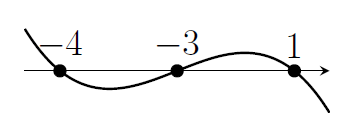
I've drawn the cubic tending in a general downward direction because I can see that if I multiplied out the brackets, the coefficient of $x^3$ would be negative.
- I can see that the inequality (with "$>0$") would be true for $x<-4$ or for $-3<x<1$.
Similarly for the other inequality, I drew a sketch like this
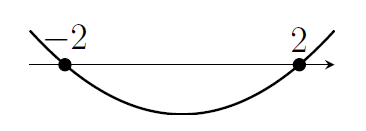
- The second inequality (with "$<0$") is true when $-2<x<2$.
To work out when both of these inequalities hold, I made a little table to record the state of play between certain values of $x$. I included all the relevant values of $x$ that have come up so far.
\(-4\) \(-3\) \(-2\) \(1\) \(2\) \(\checkmark\) \(\times\) \(\checkmark\) \(\checkmark\) \(\times\) \(\times\) \(\times\) \(\times\) \(\times\) \(\checkmark\) \(\checkmark\) \(\times\) My first row refers to the first inequality (true when $x<-4$ or $-3<x<1$), and my second row refers to the second inequality (true when $-2<x<2$).
- Both hold if and only if $-2<x<1$ (the only column with two $\checkmark$ in the table).
- The answer is B.
Extension
- Test your understanding; what's the answer if I swap the $<$ and $>$ signs in the question?
- If I were using this as the start of an interview question, then next I might ask you to construct a single polynomial that is positive if and only if the pair of inequalities are both true. What if I'd like exactly one, but not both, of the inequalities to be true? Can we generalise this to other pairs of polynomials? What might go wrong?
TMUA 2020 Paper 1 Question 9
- First I wrote down the roots of the quadratic; $x^2-14x+9=0$ when $x=7\pm \sqrt{40}$. I decided not to try to work out $\sqrt{\alpha}$ and $\sqrt{\beta}$ from that, because I can't see how to do that (I could come back to this idea if I need be).
- Instead, I wrote out what I knew and what I wanted. I've decided to call the quadratic that I'm looking for $x^2+Ax+B$, giving names to the coefficients. We have $$x^2-14x+9=(x-\alpha)(x-\beta) \quad\text{and}\quad x^2+Ax+B = (x-\sqrt{\alpha})(x-\sqrt{\beta}).$$
- I suppose that we could compare coefficients. It's something to try, anyway! That gives
$$-14=-\alpha-\beta \quad\text{and}\quad 9=\alpha\beta \quad\text{and}\quad A=-\sqrt{\alpha}-\sqrt{\beta} \quad\text{and}\quad B = \sqrt{\alpha\beta}.$$ - While I was writing out that last expression I noticed that I could write it as $\sqrt{\alpha\beta}$. I have an equation for $\alpha\beta$, it's 9. So $B=\sqrt{9}=3$. That eliminates half the options.
- Emboldened by this approach, my new aim is to find $\sqrt{\alpha}+\sqrt{\beta}$ given $\alpha+\beta =14$ and $\alpha\beta=9$.
- I had to stop and think here. For something to do while I was thinking, I tried squaring $\sqrt{\alpha}+\sqrt{\beta}$, because I can at least see that I'll get both $\alpha$ and $\beta$ from that square. I have $$\left(\sqrt{\alpha}+\sqrt{\beta}\right)^2 = \alpha + \beta + 2\sqrt{\alpha \beta}.$$
- Great; I know that the right-hand side is $14+6$, so $\sqrt{\alpha}+\sqrt{\beta}=\sqrt{20}$. I've somewhat lost track of minus signs (was $A$ equal to $\sqrt{\alpha}+\sqrt{\beta}$ or the negative of that?), but I'm confident that...
- The answer is C.
Extension
- Without solving for $\alpha$ and $\beta$ (or ignoring your solutions if you already solved, like I did), find the values of
$$\alpha^2 + \beta^2 \quad\text{and}\quad \frac{1}{\alpha}+\frac{1}{\beta} \quad\text{and}\quad \frac{1}{\alpha^2}+\frac{1}{\beta^2}.$$ - If I were using this as the start of an interview question, then next I might ask you to find a polynomial that can be factorised as $(x+\sqrt{\alpha})(x+\sqrt{\beta})$, and then ask you what would happen if you multiply together your two answers (the polynomial above in the TMUA question multiplied by the polynomial I've just asked for will give something that is related to the original polynomial; can you see how without actually multiplying out?).
- However, I'd be cautious about using this in an interview question, because we're getting quite close to Vieta's formulas (relationships between the coefficients of a polynomial and the roots), and not everyone has met those by the time of interview. That said, I would have the option to teach them to people during the interview, if I wanted to!
TMUA 2020 Paper 1 Question 20
- I started by noting that this equation is definitely satisfied when $x=a$.
- Also, using the quadratic formula on $x^2-x+a=0$, it's satisfied by $\frac{1}{2}\left(1\pm \sqrt{1-4a}\right)$.
- "Exactly two" is weird because it looks like I've got three values.
- Let's be careful though; I know that quadratics can have repeated roots. In this case, if $a=\frac{1}{4}$ then I get roots at $x=\frac{1}{2}$ from the quadratic (repeated root) and at $x=\frac{1}{4}$ (from $x=a$).
- Crucially there, I haven't forgotten about the factor of $(x-a)$! I wanted to check, because I was worried that it would be a trap, with the other factor giving the same value of $x$ (for exactly one distinct value of $x$). No trick detected.
- But that's given me an idea; maybe the $x=a$ root could have the same value as one of the roots of the quadratic (but not both... we've already checked that case).
- Could we have $a = \frac{1}{2}\left(1\pm \sqrt{1-4a}\right)$?
- I'm going to rearrange and square both sides. That makes me cautious, so I'm going to remember to check my answers later.
- $(2a-1)^2=1-4a$
- $4a^2=0$
- $a=0$ repeated solution. I can't explain it, but the fact that this has a repeated solution makes me even more cautious! So let's check for roots for $x$ with this value of $a$.
- In the case $a=0$, we have $x=0$ (from $x=a$) and "$x=0$ or $x=1$" (from the quadratic $x^2-x=0$). That's exactly two distinct values of $x$, so maybe I was worried about nothing.
- That's all the ways I can think of for two of the three roots to be equal to each other.
- The answer is C.
Extension
- Check your understanding; for other values of $a$, how many distinct values of $x$ satisfy the equation? Find different regions or values of $a$ for each number of distinct values of $x$.
- If I were using this as the start of an interview question, then next I might ask you to sketch the part of the $(x,y)$-plane where $(x-y)(x^2-x+y)=0$. Interpret your answer to the above questions in terms of your sketch. If I change the factor $(x-a)$ to $(mx-a)$ for some fixed number $m$, how does that affect your answers to the questions above?
TMUA 2021 Paper 1 Question 8
- If the line $y=2x+3$ meets the curve $y=x^2+bx+c$ at exactly one point, that means that the difference between these polynomials has a repeated root at that point. One way to understand this is to think about how the difference between the curve and the line behaves; perhaps the distance decreases, is zero at that meeting point, then it increases again. In the context of polynomials, that's a description of a repeated root.
These two sketches show the line meeting the curve, and then the difference between those two polynomials.
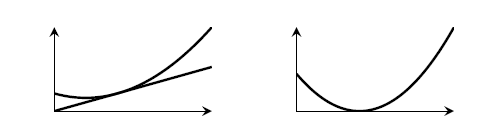
- So we know that the equation for the difference, $x^2+(b-2)x+(c-3)=0$, has a repeated root.
- Also, from the other fact, we know that $x^2+(b-4)x+(c+2)=0$ has a repeated root, possibly at a different value of $x$.
- When I hear that a quadratic has a repeated root, I always want to write down the discriminant (even if it involves parameters like $b$ and $c$).
- We have $$(b-2)^2 - 4(c-3)=0 \quad\text{and}\quad (b-4)^2-4(c+2)=0.$$
- That's two equations for two unknowns. I can't think of anything better, so I'm going to multiply out the squares, with the aim to take the difference of these equations to eliminate the $b^2$ term that I'll get.
- I have
$$ b^2-4b+4 -4c+12 =0 \quad\text{and}\quad b^2-8b+16-4c-8=0$$ - Taking the difference of these gives me $4b+8=0$. It's interesting that the $c$ term cancelled out too, but no time to think about that now; we have an equation to solve for $b=-2$.
- Then back-substituting into one of the equations before, we have $16-4c+12=0$ so $c=7$.
So $b-c=-9$. - The answer is A.
Extension
- Find the points where the lines meet the curve. Sketch both lines and the curve.
- If I were using this as the start of an interview question, then next I might observe that you've found a quadratic with leading coefficient 1 that is tangent to two given lines. I might ask if you could generalise that to an arbitrary pair of lines, $y=Ax+B$ and $y=Cx+D$ say. What condition(s) on $A$, $B$, $C$, and $D$ must be satisfied for there to be a solution for $b$ and $c$?
TMUA 2021 Paper 2 Question 16
I drew a sketch of the function on the left-hand side. This was easier than it sounds; when $x\geq 0$ it's just $x^2$ (I can sketch that), and when $x<0$ it's just $-x^2$ (I can sketch that too). My sketch looks like this
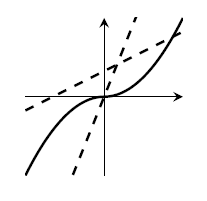
- I'm going to call the two parts of this sketch "the quadratic on the left" and "the quadratic on the right", because I'm thinking of them as two separate problems.
- As you can see from my sketch, I've already started doodling straight lines on the picture.
- I'm going to look for points of intersection between the function that I've sketched and various straight lines $y=px+q$.
- Part of this involves imagining what will happen if the lines and the curve continue off the graph. The steeper dashed line that I've drawn looks like it only intersects the curve once, but I have to imagine that the quadratic expression will get steeper and steeper until it catches up, giving a second point of intersection.
- Anyway, let's see if we can find lines with a particular number of points of intersection. For one point of intersection, I think my shallower dashed line works. I could even make it horizontal to make sure that it definitely won't intersect the curve again.
- I think my steeper line intersects three times; once at the origin, once for a large positive value of $x$ and (symmetrically), once for a very large negative value of $x$.
Could I make two points of intersection? Probably yes, if I moved my shallower line downwards until it just touched the curve on the left, like this
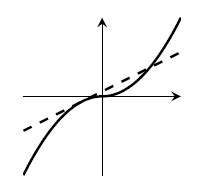
- Could I have zero points of intersection? No, if the line is above the curve at $x=0$ then the quadratic on the right will catch up and cross it, and if the line is below the curve at $x=0$, then the quadratic on the left will catch up and cross it as we look at more and more negative values of $x$.
- Could I have four points of intersection? No, if there are two intersections on the right then the $y$-intercept is negative, and vice versa if there are two intersections on the left then the $y$-intercept is positive.
- The answer is E.
Extension
- Check your understanding; replace the equation in the question with $x^2|x|=px+q$.
TMUA 2022 Paper 1 Question 13
- This looks nasty. I don't generally like multiplying out brackets unless I can't think of anything else to do.
- I can't think of any quick way to get to "the least value of $ab$", because I can't see $ab$ in the question, and I can't see any inequalities or familiar things like polynomials where I might be able to work out the sign of an expression.
- I'll multiply out the brackets. I get
$$\frac{2a^3}{a^3}+\frac{4}{a^3b^3}-a^3b^3-\frac{2b^3}{b^3}=\sqrt{2}.$$ - The first and last terms on the left simplify and then cancel! I feel like I'm on the right path now.
- I have $$\frac{4}{a^3b^3}-a^3b^3=\sqrt{2}.$$
- Both terms involve $a^3b^3$. I decide to write $u=a^3b^3$ (I write this as neatly as I can, because I'll definitely need it later when I want to know what on Earth $u$ is). This looks like it's going to turn into a quadratic equation if I multiply up by $u$.
- I don't really know where I'm going, but I'm definitely going somewhere.
- $u^2+\sqrt{2}\,u-4=0$ has solutions $$u=\frac{-\sqrt{2}\pm \sqrt{18}}{2} = \frac{-\sqrt{2}\pm3\sqrt{2}}{2}$$ so $u$ could be $-2\sqrt{2}$ or $\sqrt{2}$.
- The question wants the least value of $ab$. I have values for $u$. What on Earth is $u$?
- Oh, it's $a^3b^3$. I need a cube root.
- For the least value, I'll pick $u=-2\sqrt{2}$ (I have a quick think about the graph of $y=x^3$ and whether we can take cube roots of negative numbers. Yes we can.)
- I think that I can rewrite $2\sqrt{2}$ to make the expression for this cube root nicer.
- My cube root is $(-2^{3/2})^{1/3}=-2^{1/2}$.
- The answer is A.
Extension
- TMUA 2021 Paper 1 Q4. Find the minimum value of $2^{2x}-2^{x+3}+4$.
- TMUA 2020 Paper 1 Q6. Find the maximum value of $\left(5^{2x}-4\left(5^x\right)+7\right)^{-1}$.
- TMUA 2020 Paper 1 Q15. Solve $\left(\log_2 x\right)^4 +12\left(\log_2 x\right)^2-2^6=0$.