


Precision
Part of the Oxford Maths Admissions Test Livestream 2026
Solutions are available here
General Advice
We can use logic and proof to make an idea precise.
- The TMUA Content Specification has sections on logic and proof, reproduced below.
- For TMUA, if statements A and B are both true, then the statement "A or B" is considered to be true.
- The statement "A if B" can be rewritten as "if B then A".
- The statement "A only if B" can be rewritten as "if A then B".
- The statement "A if and only if B" can be rewritten as "if A then B, and if B then A".
- The statement "A is necessary for B" can be rewritten as "if B then A".
- The statement "A is sufficient for B" can be rewritten as "if A then B".
- The statement "A is necessary and sufficient for B" can be rewritten as "if A then B, and if B then A".
- The converse of "if A then B" is "if B then A".
- The contrapositive of "if A then B" is "if (not B) then (not A)".
TMUA Specification (April 2025, Section 2 § "The Logic of Arguments")
Understand and be able to use mathematical logic in simple situations:
- The terms true and false;
- The terms and, or (meaning inclusive or), not;
- Statements of the form:
if A then B,
A if B,
A only if B,
A if and only if B. - The converse of a statement;
- The contrapositive of a statement;
- The relationship between the truth of a statement and its converse and its contrapositive.
Note: candidates will not be expected to recognise or use symbolic notation for any of these terms, nor will they be expected to complete formal truth tables.
- Understand and use the terms necessary and sufficient.
- Understand and use the terms for all, for some (meaning for at least one), and there exists.
- Be able to negate statements that use any of the above terms.
TMUA Specification (April 2025, Section 2 § "Identifying Errors in Proofs")
- Identifying errors in purported proofs.
- Be aware of common mathematical errors in purported proofs; for example, claiming "if $ab=ac$, then $b=c$", or assuming "if $\sin A = \sin B$, then $A=B$" neither of which are valid deductions.
Warm-up
What's wrong with the following claims?
- if $ab=ac$, then $b=c$.
- if $\sin A = \sin B$, then $A=B$.
- if $\sqrt{x^2}=\sqrt{y^2}$ then $x=y$.
- for all real $x$, if $x^2\gt x$ then $x\gt 1$.
- the equation $a(x-p)(x-q)=0$ has two real solutions for $x$.
- if $b^2-4ac\gt 0$ then $ax^2+bx+c=0$ has two real solutions for $x$.
- for all integers $N$, if $N^2$ is a multiple of 100 then $N$ is a multiple of 100.
- for all integers $n$, the integer $n^2+n+41$ is prime.
- for all positive real numbers $a$ and for all $x$ and $y$, if $a^x=a^y$ then $x=y$.
Questions
TMUA 2021 Paper 2 Question 10
The first seven terms of a sequence of positive integers are: \[ u_1 = 15,\qquad u_2 = 21,\qquad u_3 = 30,\qquad u_4 = 37,\qquad u_5 = 44,\qquad u_6 = 51,\qquad u_7 = 59. \] Consider the following statement about this sequence:
$(*)$ If $n$ is a prime number, then $u_n$ is a multiple of 3 or $u_n$ is a multiple of 5.
What is the smallest value of $n$ that provides a counterexample to $(*)$?
(A) 1
(B) 2
(C) 3
(D) 4
(E) 5
(F) 6
(G) 7
TMUA 2022 Paper 2 Question 5
A straight line $L$ passes through $(1, 2)$.
Let P be the statement
if the $y$-intercept of $L$ is negative, then the $x$-intercept of $L$ is positive.
Which of the following statements must be true?
I P
II the converse of P
III the contrapositive of P
(A) none of them
(B) I only
(C) II only
(D) III only
(E) I and II only
(F) I and III only
(G) II and III only
(H) I, II and III
TMUA 2021 Paper 2 Question 5
On which line is the first error in the following argument?
(A) $\sin^2 x + \cos^2 x = 1$ for all values of $x$.
(B) Therefore $\cos x = \sqrt{1 - \sin^2 x}$ for all values of $x$.
(C) Hence $1 + \cos x = 1 + \sqrt{1 - \sin^2 x}$ for all values of $x$.
(D) Thus $(1 + \cos x)^2 = \left(1 + \sqrt{1 - \sin^2 x}\right)^2$ for all values of $x$.
(E) Substituting $x = \pi$ gives $0 = 4$.
TMUA 2022 Paper 2 Question 6
A list consists of $n$ integers. Consider the following statements:
P: $n$ is odd.
Q: The median of the list is one of the numbers in the list.
Which one of the following is true?
(A) P is necessary and sufficient for Q.
(B) P is necessary but not sufficient for Q.
(C) P is sufficient but not necessary for Q.
(D) P is not necessary and not sufficient for Q.
MAT 2021 Q1J
Four distinct real numbers $a$, $b$, $c$, and $d$ are used to define four points \[ A=(a,b), \quad B=(b,c),\quad C=(c,d),\quad D=(d,a). \] The quadrilateral $ABCD$ has all four sides the same length
(a) if and only if $(a-b)^2=(c-d)^2$,
(b) if and only if $(a-c)^2=(b-d)^2$,
(c) if and only if $(a-d)^2=(b-c)^2$,
(d) if and only if $a-b+c-d=0$,
(e) for no values of $a$, $b$, $c$, $d$.
Part of an Interview
Adapted from an interview question used by James Munro for Maths interviews at Oxford. Reproduced here with permission.
I'd like my computer to calculate the sum $1+2+3+4+5.$
My computer can only add two numbers at a time, and it's expensive! The cost for replacing $a+b$ with $c$ is £$a\times b \times c$.
For example, 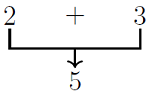 costs £30, and I'm not done; my sum is now $1+5+4+5$.
The calculation ends when there's only a single number.
There are lots of ways that we could order the operations.
What's the minimum total cost?
(If you have a theory but you can't prove it, it can help to look at cases that are simpler but more general; try experimenting with the different ways to get my computer to calculate the sum $a+b+c$.)
(It's also a good idea to try to understand $a^2 b + ab^2$. Where have you seen terms like that?)