


Reflection
Part of the Oxford Maths Admissions Test Livestream 2026
Solutions are available here
General Advice
After you've completed something, you can look back on it. Maybe it will be easier next time.
- Why did this work?
- When does this work?
- When would this fail?
- How can I make this harder?
- Is there something larger going on here?
Warm-up
Try this question (TMUA 2021 Paper 1 Question 1).
Two circles have the same radius. The centre of one circle is $(-2, 1)$. The centre of the other circle is $(3, -2)$. The circles intersect at two distinct points. What is the equation of the straight line through the two points at which the circles intersect?
(A) $3x - 5y = 4$
(B) $3x + 5y = -1$
(C) $5x - 3y = -4$
(D) $5x - 3y = -1$
(E) $5x - 3y = 1$
(F) $5x - 3y = 4$
(G) $5x + 3y = 1$
Once you've tried the question, here are some suggestions for reflection;
- Why doesn't the (unknown) radius of the two circles appear in your answer?
- What can you say about that radius, given the information in the question?
- Suppose that the circles had different radii. What condition would those radii need to satisfy for there to be two distinct points where the circles intersect? If that condition holds and you're told the radii of the two circles, how could you find the equation of the straight line through the two points at which the circles intersect?
Questions
TMUA 2021 Paper 2 Question 2
$A(0,2)$ and $C(4,0)$ are opposite vertices of the square $ABCD$.
What is the equation of the straight line through $B$ and $D$?
(A) $y= -2x + 5$
(B) $y= -\dfrac{1}{2}x - 3$
(C) $y= -\dfrac{1}{2}x + 2$
(D) $y= x$
(E) $y= 2x - 3$
(F) $y= 2x + 2$
TMUA 2022 Paper 2 Question 2
Find the coefficient of the $x^5$ term in the expansion of \[ (1+x)^5 \times \sum_{i=0}^{5} x^i \]
(A) 1
(B) 5
(C) 16
(D) 25
(E) 32
TMUA 2021 Paper 1 Question 2
The curve $y = x^3 - 6x + 3$ has turning points at $x = \alpha$ and $x = \beta$, where $\beta \gt \alpha$.
Find \[ \int_{\alpha}^{\beta} x^3 - 6x + 3 \,\mathrm{d}x \]
(A) $-8\sqrt{2}$
(B) $-10$
(C) $-10 + 6\sqrt{2}$
(D) $0$
(E) $12 - 8\sqrt{2}$
(F) $6\sqrt{2}$
(G) $12$
TMUA 2020 Paper 1 Question 11
The quadratic function shown passes through $(2,0)$ and $(q,0)$, where $q \gt 2$.
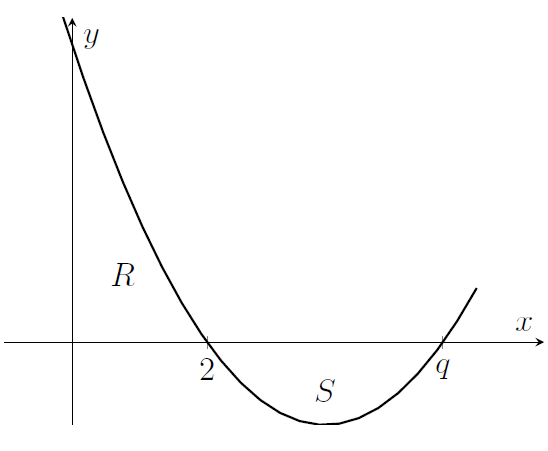
What is the value of $q$ such that the area of region $R$ equals the area of region $S$?
(A) $\sqrt{6}$
(B) $3$
(C) $\dfrac{18}{5}$
(D) 4
(E) 6
(F) $\dfrac{33}{5}$
MAT 2014 Q1D
The reflection of the point $\left( 1,0\right) $ in the line $\ y=mx$ has coordinates
(a) $\displaystyle \left( \frac{m^{2}+1}{m^{2}-1},\frac{m}{m^{2}-1}\right)$,
(b) $\displaystyle \left( 1,m\right)$,
(c) $\displaystyle \left( 1-m,m\right)$,
(d) $\displaystyle \left( \frac{1-m^{2}}{1+m^{2}},\frac{2m}{1+m^{2}}\right)$,
(e) $\displaystyle \left( 1-m^{2},m\right)$.
Part of an Interview
Adapted from an interview question used by James Munro for Maths interviews at Oxford. Reproduced here with permission.
Suppose that $A$ and $C$ are points on the parabola $y=x^2$, and write $B$ for the origin $(0,0)$.
I would like the triangle $ABC$ to be equilateral. Where should I put $A$ and $C$?
Once you've tried that calculation, think about what other sorts of triangle we can make by moving $A$ and $C$.
Given a particular isosceles triangle, can you always move $A$ and $C$ so that $ABC$ is similar to the given triangle?
Given the right-angled triangle with side lengths 3, 4, and 5, can you move $A$ and $C$ so that $ABC$ is similar to the given triangle?