


Reflection Solutions
Part of the Oxford Maths Admissions Test Livestream 2026
These are the solutions for the Reflection worksheet
Warm-up
- It's strange that we're not told the radius of the circles. Let's call it $R$ and write down an equation for each circle. I have \[ (x+2)^2+(y-1)^2=R^2 \quad \text{and} \quad (x-3)^2+(y+2)^2=R^2 .\]
- The key idea for me is that, if I wanted to find the points where the circles intersect, then I would solve these equations simultaneously. So I can do things like adding and subtracting the two equations, since I'm thinking about points $(x,y)$ where both equations are simultaneously true.
- I want the $R^2$ to go away, because that will make things simpler (and because none of the options for this TMUA question involve $R$).
- I can make $R^2$ go away by taking the difference between the two equations.
- That's the entire plan! Taking that difference gives one equation, and it is the equation of a line. It simplifies to $5x-3y=4$.
- The answer is F.
Here's a diagram.
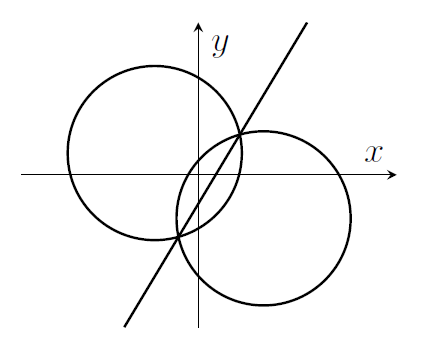
- Why didn't our answer involve $R$, the radius? Well, for any value of $R$, the points of intersection will lie on the perpendicular bisector of the line segment between the centres. That's the line that we've found. If we'd realised that, then we could have used that information to find the line (try that now, if you haven't already).
- What can we say about $R$? I suppose it must be large enough that these circles intersect. The distance between the centres is $\sqrt{34}$ so we must have $2R\gt \sqrt{34}$.
- If the radii aren't the same, then let's call them $R_1$ and $R_2$. Everything above works, except the radii won't cancel. If we know the values, then there will be some other constant in the equation for the straight line we get. So this won't be the perpendicular bisector any more, but it will be parallel to the perpendicular bisector.
- In that case, we must have $R_1+R_2 \gt \sqrt{34}$ and also $|R_1-R_2|\lt \sqrt{34}$ so that the circles intersect (avoiding the cases where the circles are both too small, and the cases where one circle lies inside the other).
Questions
TMUA 2021 Paper 2 Question 2
- The first thing that I noticed is that the square is not aligned with the axes (the corners are not $(0,0)$ and $(0,2)$ and $(4,0)$ and $(4,2)$, that's a rectangle).
- However, it's always true that the diagonals of a square meet at right angles.
- That means that if we find the equation for the line through $A$ and $C$, we're most of the way there.
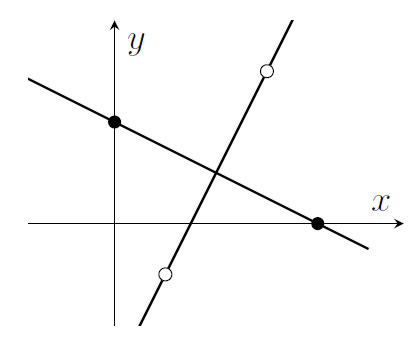
- The equation of the line through $A$ and $C$ is $y=2-\frac{x}{2}$.
- For the line through $B$ and $D$, we'd like a line with gradient $2$, so that it meets the line above at right angles.
- We need one more piece of information, such as a point that the line goes through. The line goes through $B$ and $D$, but we don't know the coordinates of those points.
- Instead of finding those coordinates, note that the line also goes through the midpoint of the line segment $AC$, the centre of the square.
- That point has coordinates $(2,1)$ and the line is $y=2x-3$.
Here's a diagram showing the diagonal lines.
- The answer is E.
Reflection
- We didn't find the locations of $B$ and $D$ with the method above. Can we find their locations?
- Can we replace the word "square" in the question with some other sort of quadrilateral, in such a way that the answer remains the same, but $B$ and $D$ could be anywhere on the line?
TMUA 2022 Paper 2 Question 2
- One idea might be to recognise $\displaystyle \sum_{i=0}^5 x^i$ as a geometric series, because we've got a formula for those. However, this doesn't make it much easier to find the coefficients (if anything, it disguises the fact that they're all $1$ for this sum). So I need another idea.
- Another idea might be to differentiate five times and then set $x=0$ (and divide by 120). This method technically works, but it's such a pain and uses so much maths that's not on the TMUA Content Specification that I'm not going to write up any of this method here. I need another idea!
- My idea of last resort is "just multiply it all out". I will (somewhat reluctantly) write out the binomial expansion for $(1+x)^5$, and I'll also write out what the sum means for $\displaystyle \sum_{i=0}^5 x^i$. We have \[ \left(1+5x+10x^2+10x^3+5x^4+x^5\right)\left(1+x+x^2+x^3+x^4+x^5\right). \]
I don't want to multiply out those brackets! I only need the coefficient of $x^5$. One way to imagine the multiplication is to construct a table; each term we get when we multiply out those brackets comes from one term in the first bracket multiplied by one term in the second bracket. Where will the $x^5$ terms appear?
$1$
$x$
$x^2$
$x^3$
$x^4$
$x^5$
$1$
?
?
?
?
?
$x^5$
$5x$
?
?
?
?
$5x^5$
?
$10x^2$
?
?
?
$10x^5$
?
?
$10x^3$
?
?
$10x^5$
?
?
?
$5x^4$
?
$5x^5$
?
?
?
?
$x^5$
$x^5$
?
?
?
?
?
- They will appear along that diagonal! For each term in the first bracket, there's exactly one term in the second bracket that it could be multiplied by to give a term involving $x^5$. All of the question marks in the table are terms where I haven't bothered to multiply because I can see that the term is not going to involve $x^5$.
- So I just need to add up $1+5+10+10+5+1$. That's 32.
- The answer is E.
Reflection
- Check your understanding; what's the coefficient of $x^4$ in the expansion?
- Without working out all eleven of the coefficients, find their average value.
- If I change all the "5"s in the question to "6"s, then the answer changes from 32 to 64. If I change them to "7"s, then the answer is now 128. What's going on here?
TMUA 2021 Paper 1 Question 2
- Let's find $\alpha$ and $\beta$.
- Differentiation gives $\displaystyle \frac{\mathrm{d}y}{\mathrm{d}x} = 3x^2 - 6$, which is zero for $x=\pm\sqrt{2}$.
- So $\alpha = -\sqrt{2}$ and $\beta = \sqrt{2}$.
- Time to integrate! I get \[ \int_{-\sqrt{2}}^{\sqrt{2}} x^3-6x+3\,\mathrm{d}x = \left[\frac{x^4}{4}-3x^2+3x\right]_{-\sqrt{2}}^{\sqrt{2}}. \]
- I can see that some of the terms will cancel, leaving me with just $3x$ evaluated at $\pm\sqrt{2}$. I could have seen this coming if I'd noticed that part of the integral is the odd function $x^3-6x$, with symmetric limits of integration.
- The integral is $6\sqrt{2}$.
- The answer is F.
Reflection
Let's investigate whether this cancellation was a lucky coincidence, or whether there's some deeper truth about cubic polynomials here.
Let's consider a general cubic $y=ax^3+bx^2+cx+d$, and let's suppose that this cubic has two turning points.
- If you like algebra, investigate whether the graph can be translated to give a cubic without an $x^2$ term. Convince yourself that, if this happens, then the work you would do to find the turning points and integrate the cubic between them will always involve some serious cancellation, just like the mathematics above.
- If you like symmetry, find the point on the general cubic $y=ax^3+bx^2+cx+d$ where the second derivative is zero. Convince yourself that the graph has rotational symmetry about that point. Convince yourself that, if this happens, then the integral of the cubic between its turning points involves the integral of a constant function and an integral that is zero.
Either way, check your theory for the particular case $y=x^3-6x+3$.
TMUA 2020 Paper 1 Question 11
- It's very tempting to write down (or even evaluate) two separate integrals.
- Things are a bit easier if we think about where this is going.
- We want these two areas to be equal. One of them is an area above the $x$-axis and one of them is an area below the $x$-axis. So if we integrate to find each, one of the integrals will be positive and one will be negative.
- We want the areas to be equal, which means that we want one of the integrals to be minus one times the other. Said differently, we want the integrals to sum to zero. That means that we just want the integral from 0 to $q$ to be zero. So we only need to do one integral!
- We need an expression for the quadratic function. What do we know about it? Well, it's got roots at $x=2$ and $x=q$. That's not actually enough information to fully determine the function, but we're going to be alright!
- The quadratic function must be $A(x-2)(x-q)$ for some unknown non-zero number $A$.
- We want \[\int_0^q A(x-2)(x-q)\,\mathrm{d}x =0.\]
- Notice that the value of $A$ doesn't matter, we just want \[\int_0^q (x-2)(x-q)\,\mathrm{d}x =0.\]
- Time to calculate! I did this by multiplying out $(x-2)(x-q)=x^2-(q+2)x+2q$ and integrating term-by-term for \[ \int_0^q x^2-(q+2)x+2q \,\mathrm{d}x = \left[\frac{x^3}{3}-(q+2)\frac{x^2}{2}+2qx\right]_0^q = \frac{q^3}{3}-(q+2)\frac{q^2}{2}+2q^2. \]
- We want this expression to be equal to zero, so it's time for a bit of algebra to solve for the value of $q$. I have $\displaystyle -\frac{q^3}{6}+q^2=0 $.
- That equation could be much worse! It's got solutions $q=0$ (no good because we're told that $q\gt 2$) and $q=6$.
- The answer is E.
Reflection
- Is it really true that I could ignore the number $A$? What happens if that constant is negative? (It doesn't look negative in the picture in the question, but does the mathematics require $A$ to be positive, or not?)
- Without doing any more integration, decide what the answer would be if the question were modified so that the quadratic function passed through $(20,0)$ and $(q,0)$, instead of $(2,0)$ and $(q,0)$. Justify your answer.
MAT 2014 Q1D
- I should think about how reflections work. One way to think about this is that the reflection of the point $(1,0)$ will be on the "other side" of the line, an equal distance from the line.
- That's not quite enough though, because lots of points on the other side have the same distance from the line. I want the one for which we cross the line $y=mx$ at right angles (it's directly opposite, not somewhere further down the line).
- I could do this by constructing a line that's at right angles to $y=mx$ and that goes through $(1,0)$, and then thinking about distances.
- I can't think of a better approach right now, and I can see how to get started with this one!
- I would need a line with gradient $\displaystyle -\frac{1}{m}$ through $(1,0)$. That's $\displaystyle y=-\frac{1}{m}(x-1)$.
- Distances are a bit tough to work with. Can I use something like similar triangles or vectors instead?
- Either way, I'll need to find the point where the lines cross; that happens when $\displaystyle mx=-\frac{1}{m}(x-1)$ which has solution $\displaystyle x=\frac{1}{1+m^2}$.
- The vector from $(1,0)$ to $\displaystyle \left(\frac{1}{1+m^2},\frac{m}{1+m^2}\right)$ is $\displaystyle \binom{\frac{1}{1+m^2}-1}{\frac{m}{1+m^2}}.$ Then I want to continue through the mirror an equal distance, so I'll add that vector again to get \[\left(\frac{2}{1+m^2}-2+1,\frac{2m}{1+m^2}\right).\]
- After a bit of rearranging, that's \[\left(\frac{1-m^2}{1+m^2},\frac{2m}{1+m^2}\right).\]
- The answer is (d).
Reflection
- If you know about "double-angle formulas", write $m=\tan \theta$ and find expressions for $\cos(2\theta)$ and $\sin(2\theta)$ in terms of $m$. What's going on here?
- What would you do if the line were $y=mx+c$ instead of $y=mx$?
- What would you do if the point were $(a,b)$ instead of $(1,0)$?
Part of an Interview
- Let's write $(a,a^2)$ for the coordinates of $A$, and $(c,c^2)$ for the coordinates of $C$.
- There are lots of methods that you could use for this problem, because you know lots of facts about equilateral triangles. Here are two methods that you might have used.
- Sides. We know that the side lengths of an equilateral triangle are all equal, so we want the following three expressions to be equal. \[ \sqrt{a^2+a^4},\qquad \sqrt{c^2+c^4},\qquad \sqrt{(a-c)^2+(a^2-c^2)^2}\]
- The first two are equal if $c=-a$ (or if $c=a$, but then $A$ and $C$ are in the same place).
- With $c=-a$, the other expression simplifies to $\sqrt{(2a)^2+0^2}$. We'd like this to be equal to $\sqrt{a^2+a^4}$. With a bit of algebra, these are equal if $a^4=3a^2$, which happens if $a=\pm \sqrt{3}$. Let's put $A$ at $(-\sqrt{3},3)$ and $C$ at $(\sqrt{3},3)$. $\square$
- Angles. We know that the angles in an equilateral triangle are $60^\circ$. Perhaps $A$ and $C$ have the same $y$-coordinate "by symmetry" (more on this later!), in which case everything is nice and symmetric, and we'd expect $BC$ to make a $60^\circ$ angle with the $x$-axis.
- Trigonometry then reveals that we would want $\tan 60^\circ = \frac{c^2}{c}$.
- We know the value of $\tan{60^\circ}$, it's $\sqrt{3}$.
- So the point $C$ should be at $(\sqrt{3},3)$ and, "by symmetry" the point $A$ should be at $(-\sqrt{3},3)$. $\square$
- The second method makes the argument that $A$ and $C$ will have the same $y$-coordinate. I've found that students often want to say "by symmetry" without giving any detail. That's not a problem for the interview, because the nice thing about interviews is that we can ask follow-up questions, so if I'm interviewing you then I can get you to elaborate on what you mean.
- Just to show why I have to do this, here's an incorrect argument that we should avoid!
- Every equilateral triangle has a line of symmetry.
- The $y$-axis is a line.
- Therefore every equilateral triangle has the $y$-axis as a line of symmetry.
- That's probably not what you're thinking, but if you just say "by symmetry" then I have to check what you're actually thinking.
- For this particular question I would accept "we're just looking for one solution, not every solution, so I'm going to try cases where $A$ and $C$ have the same $y$-coordinate and then if that doesn't work I'll look elsewhere".
- But students often seem to be making a stronger claim than that; "if $ABC$ is equilateral then $A$ and $C$ must have the same $y$-coordinate". Let's prove that.
- I think that the best way to do this is to write down the expressions for the lengths of $AB$ and $BC$ above, and prove that if $\sqrt{a^2+a^4}=\sqrt{c^2+c^4}$ then $a=\pm c$. This is not too hard; you can square both sides, rearrange and use the difference of two squares on $a^2-c^2 = c^4-a^4$.
- One reason that I might get a student to think about this argument carefully is that it's helpful for the next part of the question about making isosceles triangles.
- We have $AB$ and $BC$ of equal length whenever $A$ and $C$ have the same $y$-coordinate, and then different values for that $y$-coordinate give us different angles in the triangle.
- Either by thinking about $\tan \theta$ like above, or by thinking about what happens for very small and very large triangles, you can convince me that given any isosceles triangle, you can move $A$ and $C$ to make $ABC$ be similar to that isosceles triangle (a key part of that argument might be convincing me that once we have the correct angle between the two equal sides, we have similar triangles).
- Next, we're thinking about the right-angled triangle with side lengths $3$, $4$, and $5$.
- We could write down ratios for the side lengths, using the expressions above, but this turns out to be hard work.
- Instead, let's think about angles.
- We want a right angle. Let's see if we can have $B$ be the right angle.
- Then sides $AB$ and $BC$ would have gradients that multiply to $-1$.
- In terms of $a$ and $c$, these gradients are (surprisingly?) just $a$ and $c$, so the condition becomes $ac=-1$.
- Now let's think about the ratio of the side lengths for $AB$ and $BC$ (the two non-hypotenuse sides of the triangle). We get a choice of which is the slightly longer of the two sides. We're just looking for one way to make this work, so I'll make the arbitrary choice to make $BC$ the slightly longer side. I have \[ \frac{\sqrt{c^2+c^4}}{\sqrt{a^2+a^4}}=\frac{4}{3} \]
- Making the substitution $\displaystyle c=-\frac{1}{a}$, the equation simplifies beautifully to $|a|^3=\dfrac{3}{4}$. I'll take $\displaystyle a=-\left(\frac{3}{4}\right)^{1/3}$ and $\displaystyle c=\left(\frac{4}{3}\right)^{1/3}$, where I've made (another) arbitrary choice to have $A$ on the left of $B$.
- Depending on how the interview is going, there might be some open-ended discussion here about what other triangles we can make, reflecting on the methods we've used so far and whether we can make them work more generally.
- I never used this last idea in an interview, but it's interesting to think about whether we can move $A$ and $C$ to make something else that's similar to the 3-4-5 triangle, but with the right angle at either $A$ or $C$, instead of at $B$.