


Trigonometry
Part of the Oxford Maths Admissions Test Livestream 2026
TMUA Specification (April 2025, Section 1 § MM4)
- The sine and cosine rules, and the area of a triangle in the form $\frac{1}{2}ab\sin C$.
- The sine rule includes an understanding of the "ambiguous" case (angle–side–side).
- Problems might be set in 2 or 3 dimensions.
- Radian measure, including use for arc length and area of sector and segment.
- The values of sine, cosine and tangent for the angles: $0^\circ$, $30^\circ$, $45^\circ$, $60^\circ$, $90^\circ$.
- The sine, cosine and tangent functions; their graphs, symmetries, and periodicity.
- Knowledge and use of the equations:
- $\displaystyle \tan\theta = \frac{\sin\theta}{\cos\theta}$
- $\sin^2\theta + \cos^2\theta = 1$
- Solution of simple trigonometric equations in a given interval (this may involve the use of the identities above).
There is also a part of the TMUA Specification listing content that test-takers are expected to recall from GCSE or equivalent. For most of these worksheets, we haven't felt the need to include this content, but for trigonometry in particular, we want to highlight one item.
TMUA Specification (April 2025, Section 1 § M5) – selected item
- Understand and use the basic congruence criteria for triangles (SSS, SAS, ASA, RHS)
Revision
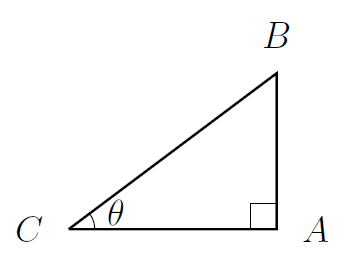
- If triangle $ABC$ is right-angled at $A$ and $\angle BCA=\theta$, then we define $$\sin\theta=\frac{|AB|}{|BC|}, \qquad \cos \theta=\frac{|AC|}{|BC|},\qquad \tan\theta=\frac{|AB|}{|AC|}.$$
- So $\displaystyle \tan\theta=\frac{\sin\theta}{\cos\theta}$.
Pythagoras' Theorem states that $|AB|^2+|AC|^2=|BC|^2$ so $\sin^2\theta+\cos^2\theta=1$.
It follows that $-1\leq \sin \theta \leq 1$ and $-1\leq \cos \theta \leq 1$.
Since the angles in a triangle add up to $180^\circ$, the angle at $B$ is $90^\circ-\theta$.
Looking at the triangle that way around, we can deduce that $\sin(90^\circ-\theta)=\cos\theta$ and $\cos(90^\circ-\theta)=\sin\theta$.
- The sine, cosine, and tangent functions are all periodic; $$\sin(x+360^\circ)=\sin x, \qquad \cos(x+360^\circ)=\cos x,\qquad \tan (x+180^\circ)=\tan x.$$
- Also, we have $\sin (-x)=-\sin x$, and $\cos(-x)=\cos(x)$.
- Radians are another way to measure angles. An arc of a unit circle with arc length 1 subtends an angle of one radian at the origin. This means that there are $2\pi$ radians at a point, $\pi$ radians on a line, $\frac{\pi}{2}$ radians in a right-angle, and so on. To convert, I remember that $180^\circ$ is equal to $\pi$ radians and work from there (for example, $60^\circ$ is $\frac{\pi}{3}$ radians). Angles measured in degrees have the $^\circ$ symbol and angles measured in radians do not.
Here are some values of $\sin$ and $\cos$ and $\tan$. The first table uses degrees and the second table uses radians.
$\theta$ $0^\circ$ $30^\circ$ $45^\circ$ $60^\circ$ $90^\circ$ $\sin\theta$ $0$ $\dfrac{1}{2}$ $\dfrac{1}{\sqrt{2}}$ $\dfrac{\sqrt{3}}{2}$ $1$ $\cos\theta$ $1$ $\dfrac{\sqrt{3}}{2}$ $\dfrac{1}{\sqrt{2}}$ $\dfrac{1}{2}$ $0$ $\tan\theta$ $0$ $\dfrac{1}{\sqrt{3}}$ $1$ $\sqrt{3}$ $\ast$ $\theta$ $0$ $\dfrac{\pi}{6}$ $\dfrac{\pi}{4}$ $\dfrac{\pi}{3}$ $\dfrac{\pi}{2}$ $\sin\theta$ $0$ $\dfrac{1}{2}$ $\dfrac{1}{\sqrt{2}}$ $\dfrac{\sqrt{3}}{2}$ $1$ $\cos\theta$ $1$ $\dfrac{\sqrt{3}}{2}$ $\dfrac{1}{\sqrt{2}}$ $\dfrac{1}{2}$ $0$ $\tan\theta$ $0$ $\dfrac{1}{\sqrt{3}}$ $1$ $\sqrt{3}$ $\ast$ - where $\ast$ is my way of indicating that $\tan\theta$ is undefined for $\theta=90^\circ$.
Now consider a triangle that is not necessarily right-angled.
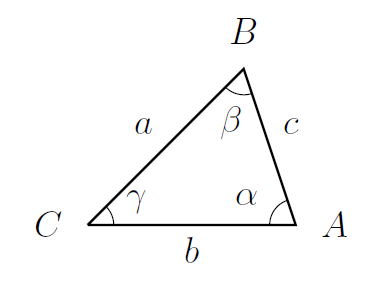
Let's write $\alpha$, $\beta$, and $\gamma$ for the angles at $A$, $B$, and $C$ respectively, and let's call the side-lengths $a=|BC|$, $b=|AC|$, and $c=|AB|$.
- The area of this triangle is $\displaystyle \frac{1}{2}ab\sin\gamma=\frac{1}{2}bc\sin \alpha=\frac{1}{2}ca\sin\beta$.
- (The cosine rule) We have $a^2=b^2+c^2-2bc\cos\alpha$.
- (The sine rule) We have $\displaystyle \frac{\sin \alpha}{a} = \frac{\sin \beta }{b} = \frac{\sin \gamma}{c}$.
- Triangles are congruent if they have the same side lengths and the same angles (they might be translated / rotated / reflected / all of the above).
Here are several sufficient conditions that tell us that two triangles are congruent.
- (SSS) if two triangles have all three side lengths in common, then they are congruent. You can check this with the cosine rule. Suppose the three side lengths are $a$, $b$, and $c$. The cosine rule determines $\cos\alpha$, and since $\cos$ is a one-to-one function for angles between $0^\circ$ and $180^\circ$, the angle $\alpha$ is uniquely determined. Similarly for the other angles.
- (SAS): if two triangles share two side lengths and the angle between those sides, then they are congruent. You can check that the cosine rule lets you determine the other side length, and then we're in the SSS case.
- (ASA): if two triangles share two angles and the side between those angles, then they are congruent. Knowing two angles determines the third, and then the sine rule determines the remaining sides.
- (RHS): if two right-angled triangles share their hypotenuse length and one other side length, then they are congruent. This follows from Pythagoras, which determines the third side, giving SSS.
Note that SSA (two sides and an angle that's not between those sides) is not on this list, because it's not a sufficient condition. This is called the ambiguous case of the sine rule.
(Ambiguous case) Suppose that we're given $a$, $b$, and $\alpha$, and we would like to determine $c$. Then the cosine rule tells us that $b^2+c^2-2bc\cos\alpha = a^2$. This is a quadratic equation for $c$ $$ c^2 - \left(2b\cos\alpha\right)c +b^2-a^2 = 0 $$ We're interested in positive solutions for the length $c$, and sometimes there are two such solutions. By calculating the discriminant and thinking about the signs of the coefficients, we see that this happens if $b\sin \alpha < a < b$ and $\alpha$ is an acute angle ($0<\alpha<90^\circ$).
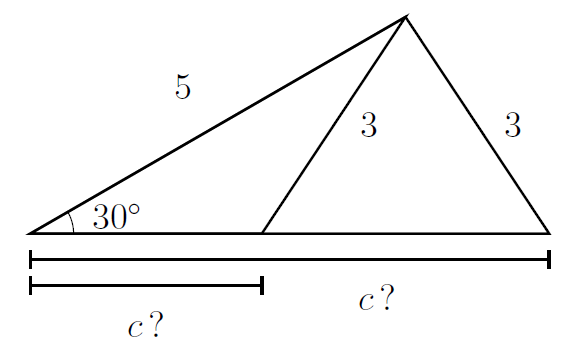
Example; let's set $a=3$, $b=5$, and $\alpha=30^\circ$.
The angle $\alpha$ is acute, and $b\sin\alpha <a< b$, so we expect two positive solutions for $c$, corresponding to a pair of non-congruent triangles with matching $a$, $b$, and $\alpha$. Here's a diagram showing both of them.
Revision Questions
- Find the area of an equilateral triangle with all three sides of length $a$.
- Find all the solutions to $\displaystyle \sin x = \frac{1}{2}$ with $0\leq x < 360^\circ$.
- Find all the solutions to $\tan x = 1$ with $0\leq x < 360^\circ$.
- Find all the solutions to $\tan (45x) = 1$ with $0\leq x < 360^\circ$.
- A triangle has angles $\dfrac{\pi}{6}$, $\dfrac{\pi}{3}$, $\dfrac{\pi}{2}$, and has side lengths $1$, $\sqrt{3}$, $2$ opposite those angles respectively. Write down three expressions for the area using the three formulas above, and check that they all give the same value.
- Write $(\cos x + \sin x)^2$ in terms of the variable $u=\cos x \sin x$.
- For $0\leq x<\dfrac{\pi}{2}$, write $1-\sin^2 x+\sin^4 x-\sin^6 x+...$ as a single expression (not an infinite sum) in terms of $\cos x$. Why have I excluded $\dfrac{\pi}{2}$ from the range here?
- Write $\cos^4x+\cos^2x$ in terms of $\sin x$.
- Simplify $\cos(450^{\circ} -x)$.
Simplify $\cos(90^\circ-x)\sin (180^\circ-x)-\sin(90^\circ-x)\cos(180^\circ -x)$.
(If you know a fact about $\sin(A-B)$, you may only use it here if you prove it!)
- A triangle $ABC$ has side lengths $|AB|=8$ and $|BC|=7$, and the angle $\angle ABC=\dfrac{\pi}{3}$. Find the remaining side length $|AC|$, the area of the triangle, and an expression for $\sin \angle BCA$.
A triangle $ABC$ has side lengths $|AB|=8$ and $|AC|=7$, and the angle $\angle ABC=\dfrac{\pi}{3}$.
Find all possibilities for the remaining side length $|BC|$.
This question explores the ambiguous case (SSA), this time using the sine rule rather than the cosine rule. Given $a$ and $b$ and $\alpha$, use the sine rule to write down an expression for $\sin\beta$.
Explain why there are no solutions if $a<b\sin\alpha$, and exactly one solution if $a=b\sin\alpha$.
For $a>b\sin\alpha$ there are two solutions for $\beta$ in the range $0<\beta<\pi$. By considering the sum of the angles in the triangle, explain why, if $a\geq b$ or if $\frac{\pi}{2}\leq\alpha<\pi$, then the larger of these solutions for $\beta$ does not correspond to a real triangle.
- From the cosine rule, and the fact that $-1\leq \cos \alpha\leq 1$, deduce that for any triangle with side lengths $a>b>c>0$, we must have $a<b+c$ (this is the rule that "the longest side is shorter than the sum of the other two sides" or said differently "the shortest route from $B$ to $C$ is a straight line" also known as "the triangle inequality").
- A triangle has side lengths 8, 13, and 15. You are told that one of the angles of this triangle has a value that is a whole number when measured in degrees. Find the exact value of this angle.
TMUA Questions
TMUA 2020 Paper 1 Question 12
How many real solutions are there to the equation
\[ 3\cos x = \sqrt{x} \]
where $x$ is in radians?
(A) 0 (B) 1 (C) 2 (D) 3 (E) 4 (F) 5 (G) infinitely many
[Scroll down for hints]
TMUA 2021 Paper 1 Question 6
The function $\mathrm{f}$ is given by
\[ \mathrm{f}(x) = \frac{\cos x + 3}{7 + 5\cos x - \sin^2 x} \]
Find the positive difference between the maximum and the minimum values of $\mathrm{f}(x)$.
(A) $0$ (B) $\dfrac{1}{3}$ (C) $\dfrac{1}{2}$ (D) $\dfrac{2}{3}$ (E) $1$ (F) $2$
[Scroll down for hints]
TMUA 2021 Paper 1 Question 19
The equation
\[ \sin^2\!\left(4^{\cos\theta} \times 60^\circ\right) = \frac{3}{4} \]
has exactly three solutions in the range $0^\circ \le \theta \le x^\circ$
What is the range of all possible values of $x$?
(A) $90 \le x < 120$ (B) $90 \le x < 270$ (C) $120 \le x < 240$ (D) $270 \le x < 300$ (E) $300 \le x < 360$ (F) $450 \le x < 630$
[Scroll down for hints]
TMUA 2021 Paper 2 Question 18
A student chooses two distinct real numbers $x$ and $y$ with $0 < x < y < 1$.
The student then attempts to draw a triangle $ABC$ with:
\[ \begin{aligned} AB &= 1 \\ \sin A &= x \\ \sin B &= y \end{aligned} \]
Which of the following statements is/are correct?
(I) For some choice of $x$ and $y$, there is exactly one triangle the student could draw.
(II) For some choice of $x$ and $y$, there are exactly two different triangles the student could draw.
(III) For some choice of $x$ and $y$, there are exactly three different triangles the student could draw.
(Note that congruent triangles are considered to be the same.)
(A) none of them (B) I only (C) II only (D) III only (E) I and II only (F) I and III only (G) II and III only (H) I, II and III
[Scroll down for hints]
TMUA 2022 Paper 1 Question 17
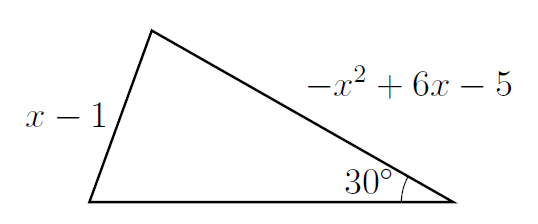
Find the complete set of values of $x$ for which there are two non-congruent triangles with the side lengths and angle as shown in the diagram.
(A) $1 < x < 3$ (B) $1 < x < 4$ (C) $1 < x < 5$ (D) $3 < x < 4$ (E) $3 < x < 5$ (F) $4 < x < 5$
[Scroll down for hints]
TMUA 2022 Paper 2 Question 20
The functions $\mathrm{f}_1$ to $\mathrm{f}_5$ are defined on the real numbers by
\[ \begin{aligned} \mathrm{f}_1(x) &= \cos x \\ \mathrm{f}_2(x) &= \sin(\cos x) \\ \mathrm{f}_3(x) &= \cos(\sin(\cos x)) \\ \mathrm{f}_4(x) &= \sin(\cos(\sin(\cos x))) \\ \mathrm{f}_5(x) &= \cos(\sin(\cos(\sin(\cos x)))) \end{aligned} \]
where all numbers are taken to be in radians.
These functions have maximum values $m_1$, $m_2$, $m_3$, $m_4$ and $m_5$, respectively.
Which one of the following statements is true?
(A) $m_1$, $m_2$, $m_3$, $m_4$ and $m_5$ are all equal to 1 (B) $0 < m_5 < m_4 < m_3 < m_2 < m_1 = 1$ (C) $m_1 = m_3 = m_5 = 1$ and $0 < m_2 = m_4 < 1$ (D) $m_1 = m_3 = m_5 = 1$ and $0 < m_4 < m_2 < 1$ (E) $m_1 = m_3 = 1$ and $0 < m_2 = m_4 < 1$ and $0 < m_5 < 1$ (F) $m_1 = m_3 = 1$ and $0 < m_4 < m_2 < 1$ and $0 < m_5 < 1$
[Scroll down for hints]
Hints
TMUA 2020 Paper 1 Question 12
- Don't try to solve for the actual values of these solutions! I don't even really know what that would involve.
- We're not given a range for $x$, so when we start the question $x$ could be any real number. However, you know that only certain values are permitted for one of the functions in the question, so that immediately restricts the range of potential solutions $x$. What else can you say about the functions in the question?
- Draw a diagram or diagrams!
- This is secretly a question about inequalities. Given two functions (without any "jumps" in value), if $f(a)<g(a)$ and $f(b)>g(b)$, then somewhere between $a$ and $b$ there's a point where $f(x)=g(x)$.
TMUA 2021 Paper 1 Question 6
- Depending on the maths that you've learned, you might be able to differentiate this function. Even if you can technically do this, I wouldn't encourage you to do so!
- It's a shame about that $\sin^2 x$. If that were a $\cos^2 x$ then all the trigonometric functions in this question would be $\cos x$.
- Try to simplify the fraction. It's just about possible to reason about the fraction if you don't simplify it, but this question is much easier if you can simplify first.
- If in doubt, try some simple values of $\cos x$.
TMUA 2021 Paper 1 Question 19
- There's something slightly odd about being asked for solutions in the range $0^\circ \leq \theta \leq x^\circ$ for various values of $x$, rather than just solving the equation for $\theta$. Let's try to solve the equation for $\theta$ and see how far we get.
- $4^{\cos\theta}$ doesn't vary as much as you might think. What are the minimum and maximum values of that function?
- Try to work one step at a time. Keep track of various possibilities, but be proactive about eliminating the ones that aren't going to lead anywhere.
TMUA 2021 Paper 2 Question 18
- This looks like the ASA case, I think? We're looking at the angle at $A$, the angle at $B$, and the side length in between. What could go wrong?
- Note that we're told $x$ and $y$, the values of $\sin A$ and $\sin B$. That's slightly different from being told the values of the angles. Does that matter?
- Draw diagrams!
- For your diagrams, you could choose to have the line $AB$ to be horizontal, because rotations don't matter for congruent triangles.
TMUA 2022 Paper 1 Question 17
- This is the ambiguous SSA case.
- I sketched a little right-angled triangle for this.
- It might be a good idea to factorise that quadratic, if we can.
- Why can we say that $x>1$? (I'm not looking for "because all the options have $x>1$"!)
TMUA 2022 Paper 2 Question 20
- The question asks about the maximum value, but you should also track the minimum value for $\mathrm{f}_1$, $\mathrm{f}_2$, and so on.
- $y=\sin(\cos x)$ is a bit of a classic for curve-sketching. It's relevant that $1<\dfrac{\pi}{2}$.
- Note that when you apply cosine to a range of values, the maximum output might come from the minimum input, the maximum input, or some other value.
- The options look really complicated, but you can eliminate options as you go, working through the functions one at a time.