


Trigonometry Solutions
Part of the Oxford Maths Admissions Test Livestream 2026
These are the solutions for the Trigonometry worksheet
Revision Questions
Split the equilateral triangle into two right-angled triangles.
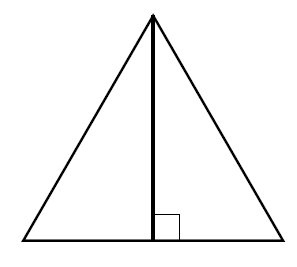
Each has base $\displaystyle\frac{a}{2}$ and height $\displaystyle\frac{\sqrt{3}a}{2}$, so the total area is $\displaystyle \frac{\sqrt{3}a^2}{4}$.
- From the graph of $\sin x$, we expect two solutions in that range. If I draw a little triangle with opposite side 1 and hypotenuse 2 then I recognise this as half an equilateral triangle (so one solution is $30^\circ$, then using $\sin(180^\circ-x)=\sin x$ another is $150^\circ$).
- From the graph of $\tan x$, we expect solutions to be $45^\circ+180^\circ n$ for any whole number $n$. In the given range, this is $x=45^\circ$ or $x=225^\circ$.
- If we write $u=45x$ then we've got $\tan (u)=1$ so $u=45^\circ+180^\circ n$ just like in the previous part. But careful, because if $45x=45^\circ+180^\circ n$ then $x=1^\circ + 4^\circ n$, so the solutions are the angles $1^\circ, 5^\circ, 9^\circ,...,357^\circ$, not just $1^\circ$ and $5^\circ$ (there are 90 solutions).
Let's draw a picture
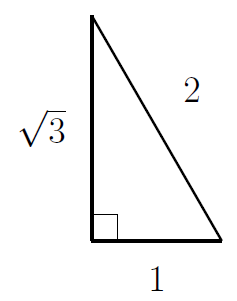
The three area formulas give the area as $$ \frac{1}{2}\times 1 \times \sqrt{3} \times \sin \left(\frac{\pi}{2}\right) \quad \text{or}\quad \frac{1}{2}\times \sqrt{3} \times 2 \times \sin \left(\frac{\pi}{6}\right) \quad \text{or}\quad\frac{1}{2}\times 1 \times 2 \times \sin\left(\frac{\pi}{3}\right) $$ all of which are equal to $\dfrac{\sqrt{3}}{2}$.
First I can expand the square to get $\cos^2 x + 2\cos x \sin x + \sin^2 x$.
Now I can use $\cos^2 x+ \sin^2 x=1$ and I can write $2\cos x \sin x$ as $2u$.
So the expression is $2u+1$.
This is a geometric series with first term $a=1$ and common ratio $r=-\sin^2x$, so the sum to infinity is $(1+\sin^2 x)^{-1}$ which is $(2-\cos^2 x)^{-1}$ in terms of $\cos x$.
The sum only converges if the common ratio $r$ satisfies $|r|<1$. This is not the case if $x=\dfrac{\pi}{2}$.
I'll use $\cos^2 x=1-\sin^2 x$ and substitute this into the expression.
$\cos^4x+\cos^2x=(1-\sin^2 x)^2+(1-\sin^2 x)=2-3\sin^2 x+\sin^4 x$.
$\cos(450^\circ-x)=\cos(90^\circ-x)$ using the fact that $\cos x$ is periodic with period $360^\circ$.
Then $\cos(90^\circ-x)=\sin x$.
We can use $\cos(90^\circ-x)=\sin x$ and $\sin(90^\circ-x)=\cos x$, and also $\sin(180^\circ-x)=\sin x$ and $\cos(180^\circ -x)=-\cos x$.
We have $(\sin x)(\sin x)-(\cos x)(-\cos x)=\sin^2 x+\cos^2 x=1$.
Use the cosine rule: $|AC|^2=8^2+7^2-2\times 8 \times 7 \times \cos \left(\frac{\pi}{3}\right)$, so $|AC|=\sqrt{57}$.
Use the $\frac{1}{2}ab\sin \gamma$ formula for the area: $\frac{1}{2}\times 8 \times 7 \times \sin \left(\frac{\pi}{3}\right)=14\sqrt{3}$.
Use the sine rule: $\displaystyle\frac{\sin \left(\frac{\pi}{3}\right)}{\sqrt{57}}=\frac{\sin \angle BCA}{8}$ so $\displaystyle\sin\angle BCA=\frac{4}{\sqrt{19}}$
Use the cosine rule: $7^2=|BC|^2+8^2-2\times 8\times |BC| \times \cos \left(\frac{\pi}{3}\right)$.
This is a quadratic for $|BC|$ that rearranges to $(|BC|-3)(|BC|-5)=0.$ So either $|BC|=3$ or $|BC|=5$. There are two distinct cases.
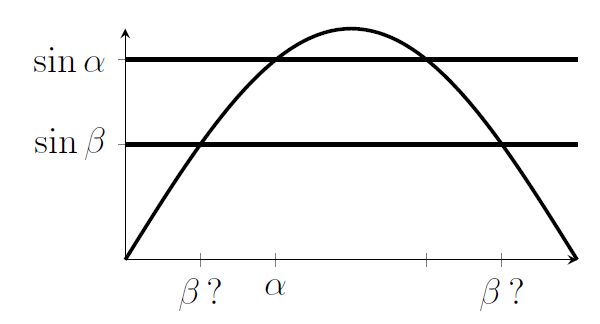
The sine rule gives $\displaystyle \sin\beta = \frac{b\sin\alpha}{a}$. If the denominator is less than the numerator, then this fraction is greater than 1. But the maximum value of $\sin \beta$ is 1, so there are no solutions if $a<b\sin \alpha$.
Then if $a=b\sin\alpha$ the equation is $\sin\beta=1$ which has unique solution $\beta=\frac{\pi}{2}$ in the range $0<\beta<\pi$.
If $a>b\sin\alpha$ then there are two solutions for $\beta$, and one of them is obtuse. If $\alpha$ is also obtuse then this isn't a real triangle (triangles can't have two obtuse angles, or the sum of the angles would exceed $180^\circ$).
Let's consider the case where $a\geq b$; we would have $\sin\beta =\frac{b\sin\alpha}{a}\leq \sin \alpha$. The solutions are an acute angle with $\beta\leq \alpha$, and an obtuse angle with $\beta \geq \pi-\alpha$. That obtuse angle is too large, once you realise that $\alpha + \beta$ would already exceed $\pi$.
The cosine rule is $a^2=b^2+c^2-2bc\cos \alpha$.
Since $-1\leq \cos \alpha\leq 1$, we have $b^2-2bc+c^2\leq b^2+c^2-2bc\cos \alpha\leq b^2+2bc+c^2$.
So $(b-c)^2\leq a^2 \leq (b+c)^2$. Since $a>0$ and $(b+c)>0$, it follows that $a\leq b+c$.
In fact, we can't actually have $a=b+c$ because that would be a triangle with a $180^\circ$ angle. So $a<b+c$.
- If we write down the cosine rule for each of the angles, we get \begin{alignat*}{12} 8^2&=&13^2&+&15^2&-&2&\times& 13 &\times& 15 &\times& \cos \alpha\\ 13^2&=&15^2&+&8^2&-&2&\times& 15 &\times& 8 &\times& \cos \beta\\ 15^2&=&8^2&+&13^2&-&2&\times& 8 &\times& 13 &\times& \cos \gamma \end{alignat*} and these rearrange to \begin{equation*} \cos \alpha =\frac{11}{13},\quad \cos \beta=\frac{1}{2},\quad \cos \gamma =\frac{1}{26} \end{equation*} from which we see that $\beta=60^\circ$.
TMUA Questions
TMUA 2020 Paper 1 Question 12
- I wanted to start by drawing a sketch, but of course that's the whole question. If I could draw an accurate enough sketch, then I could just count the solutions!
Instead, I sketched $3\cos x$ and $\sqrt{x}$ separately.
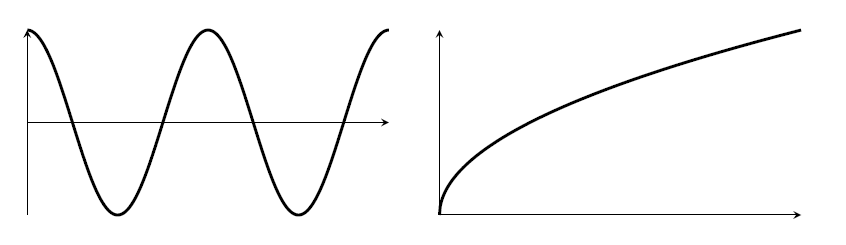
- I think that, eventually, $\sqrt{x}$ will be so large that we won't get any more solutions after that point. I can safely say that there will be no solutions once $\sqrt{x}>3$, which is when $x>9$. That's about $3\pi$, I reckon, looking back at my sketch for $3\cos x$ to compare, so quite early on.
- Looking back at the $3\cos x$ graph reminded me that $\cos x$ is sometimes negative. We will only get a solution if $\cos x$ is positive. So perhaps we will have a solution between $0$ and $\frac{\pi}{2}$, and then another one between $\frac{3\pi}{2}$ and $\frac{5\pi}{2}$?
- Time to draw the combined sketch. I'm happy with the first part of my sketch, where $\cos x$ decreases to zero while $\sqrt{x}$ increases. They must cross somewhere in between.
- For the part near $x=2\pi$, I realised that I'll probably get (at least?) two solutions in the range $\frac{3\pi}{2} < x < \frac{5\pi}{2}$, not just one. That's because I checked the values of each function at $x=\frac{3\pi}{2}$ and $x=2\pi$ and $x=\frac{5\pi}{2}$.
Each of these changes of lead gives at least one solution where the curves cross. I suppose there could be some funny business, like extra crossing points or a point of tangency. That doesn't seem very likely to me, so I think we'll just have two solutions near $x=2\pi$. Then by the time we get to $3\pi$, no more solutions.
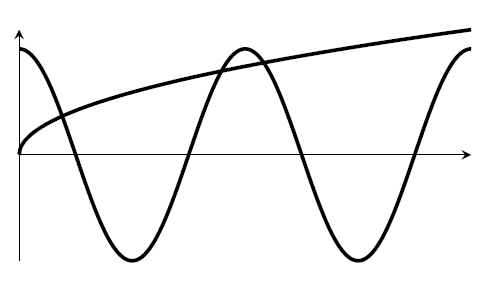
- So I have three solutions overall.
- The answer is D.
Extension
- Use a calculator or Desmos to investigate the case with $\frac{5}{2}\cos x$ instead of $3\cos x$.
- If I were using this as the start of an interview question, then next I would ask you about $3\cos x =x^{-1}$. This has infinitely many solutions, but perhaps you can tell me the approximate values for some of them?
TMUA 2021 Paper 1 Question 6
- I don't like the mix of $\sin x$ and $\cos x$ in this question, so I'm going to immediately rewrite the $\sin^2 x$ as $1-\cos^2x$.
- I'm also going to write $u=\cos x$. The fraction is now \[ \frac{u+3}{6+5u+u^2}. \]
- I have no idea how to find the maximum or minimum of this expression, but just in case it's helpful, I could factorise the denominator.
- The denominator factorises to $(u+3)(u+2)$.
- So the fraction simplifies to $\dfrac{1}{u+2}$. That's much better!
- Now I have to remember that $u=\cos x$, and I have to be a bit careful. The range of $\cos x$ is from $-1$ to $1$. But where will the maximum and minimum of $\dfrac{1}{u+2}$ be?.
- If it helps, I could sketch a graph of $\dfrac{1}{u+2}$ against $u$. It's a translation of the standard $y=\dfrac{1}{x}$ graph two units to the left, and it has an asymptote at $u=-2$.
- So $\dfrac{1}{u+2}$ is a decreasing function as $u$ varies from $-1$ to 1.
- So the maximum of $\dfrac{1}{u+2}$ for $-1\leq u \leq 1$ comes at $u=-1$ and has value $1$, and the minimum of $\dfrac{1}{u+2}$ comes at $u=1$ and has value $\dfrac{1}{3}$.
- The positive difference between those numbers is $\dfrac{2}{3}$.
- The answer is D.
Extension
If I were using this as the start of an interview question, I would ask you to sketch the function.
I'm perhaps working towards asking you about a more difficult function like \[\mathrm{f}(x)=\frac{2\cos x+5}{7+5\cos x -\sin^2 x}.\] Can you find the maximum and minimum values of that function?
[Hint: what have I added?]
TMUA 2021 Paper 1 Question 19
- This question is essentially just a very complicated composite function, and my plan is to work backwards to undo this function, step-by-step.
- Given $\displaystyle \sin^2\!\left(4^{\cos\theta} \times 60^\circ\right) = \frac{3}{4}$ we can write $$ \sin \!\left(4^{\cos\theta} \times 60^\circ\right) = \frac{\sqrt{3}}{2} \quad \textbf{or}\quad \sin\!\left(4^{\cos\theta} \times 60^\circ\right) = -\frac{\sqrt{3}}{2}. $$
- I know when $\sin$ takes the values $\pm\dfrac{\sqrt{3}}{2}$. Lots of times, in fact! Do I have to list negative solutions? I know that $4^{\cos\theta}$ will be positive, so I don't think that I need to. So my two cases are now many cases; $$ 4^{\cos\theta} \times 60^\circ = 60^\circ \text{ or } 120^\circ \text{ or...} \qquad \textbf{or}\qquad 4^{\cos\theta} \times 60^\circ= 240^\circ \text{ or } 300^\circ \text{ or...} $$
- On the left, I can see that these correspond to $4^{\cos\theta}=1$ or $2$ or... . I reckon that the next one would be $7$, which is out of range because $4^{\cos\theta}$ is at most 4.
- On the right, I can see that these correspond to $4^{\cos \theta}=4$ or $6$ or... . I'm only really interested in the first of those.
- So now I must solve $4^{\cos \theta}=1$ or $2$ or $4$. That happens when $\cos\theta$ is $0$ or $\frac{1}{2}$ or $1$.
- A sketch of $\cos\theta$ helps me to remember that this happens when $\theta=0$ or $\theta=30^\circ$ or $\theta=90^\circ$ or $\theta=270^\circ$ or a couple of values after that, before we get back round to $360^\circ$ and the patten repeats.
- I've stopped there though, because I've secretly been counting! The question wants a range for $x$ such that we have three solutions, notably including the one at $\theta=0$, in the range $0^\circ \leq \theta \leq x$.
- This happens if $x$ is between $90^\circ$ and $270^\circ$.
- The answer is B.
Extension
Check your understanding with this similar question. Show that there are exactly four values of $x$ in the range $0\leq x < 2\pi$ such that \[ \frac{6\times \arctan \left(3^{\cos x}\right)}{\pi} \] is a whole number.
In this question, $\arctan y$ is the value of $x$ in the range $-\frac{\pi}{2}<x<\frac{\pi}{2}$ that has $\tan x = y$.
Note that I'm using radians here, just to mix things up.
TMUA 2021 Paper 2 Question 18
- This looks like the ASA case. Why would this be ambiguous? What else is going on?
- Something I noticed is that we're given $x$ and $y$, not the angles $A$ and $B$. That matters, because for $0<x<1$ there are exactly two angles that have $\sin A =x$. One is obtuse and one is acute, and they sum to $\pi$.
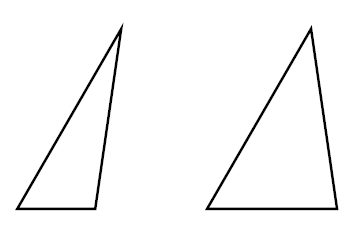
I drew some pictures to try to imagine different possibilities. I've taken the side $AB$ to be horizontal, and I'm drawing lines where we might find $C$. I've got a pair of lines from each point, for the two possibilities for the angle, and I've tried to make the lines from $A$ shallower, to reflect the fact that $\sin A < \sin B$.
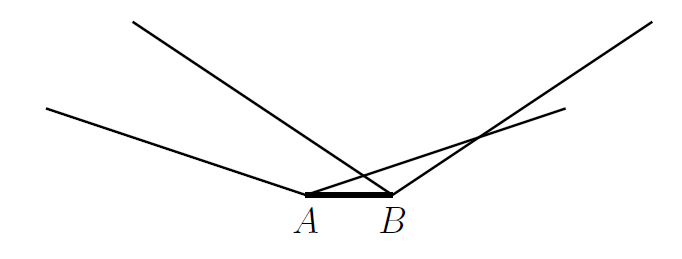
- It took me a surprisingly long time to remember that triangles can't have two obtuse angles. So that's a choice that I'm not allowed to make for angles $A$ and $B$. This is good, because I briefly believed that the answer would be "you always get four triangles" (that would be option A, I suppose).
- If angles $A$ and $B$ are both acute, then I managed to convince myself that there's a unique triangle; once you've fixed the angles, you're in the ASA case, and it's pretty clear that there will be somewhere to put $C$.
- With one obtuse angle, it's not clear that the lines will actually meet; they might diverge.
- This reminds me of the ambiguous case in the revision notes, specifically the part where you think your angles correspond to a real triangle, but then you realise that they already sum to more than $\pi$.
- This happens if I pick the obtuse angle for $A$ and the acute angle for $B$. That's because $x<y$ so $\sin A<\sin B$, which makes $\alpha > \pi - \beta$, and then the angles are too large. On my diagram, the lines going left from $A$ and $B$ don't cross.
- On the other hand, if I pick the obtuse angle for $B$, then this will give a genuine triangle. In my diagram, that's the crossing point on the right where the steep line from $B$ manages to "catch up" with the shallow line from $A$.
- So I've convinced myself that there will be two different triangles that the student could draw, for any choices of $x$ and $y$ that satisfy $0<x<y<1$.
- The answer is C.
Extension
Check your understanding; what if we're told that $\tan A=x$ and $\tan B =y$ instead of $\sin A = x$ and $\sin B=y$?
With that change, what can you say about the angle at $C$?
TMUA 2022 Paper 1 Question 17
- This looks like the SSA case, where (given an acute angle like $30^\circ$), there might be two non-congruent triangles.
Looking at the diagram, if this is a real triangle, then I should be able to drop a perpendicular from the top corner down to the base.
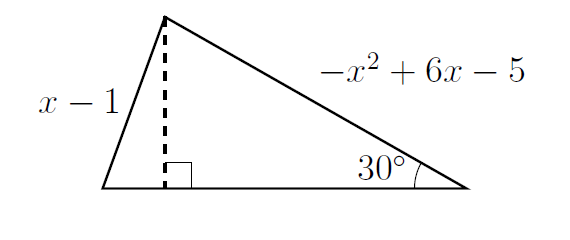
- My idea here is that I can work out the length of the dashed line; it's $\frac{1}{2}\left(-x^2+6x-5\right)$.
- I can also say that $(x-1)$ must be greater than this length, because it's the hypotenuse of a little triangle on the left.
In fact, I can see that I could get to the other non-congruent triangle (with the same two sides and not-included angle) by reflecting that little right-angled triangle over to the other side of the dashed line.
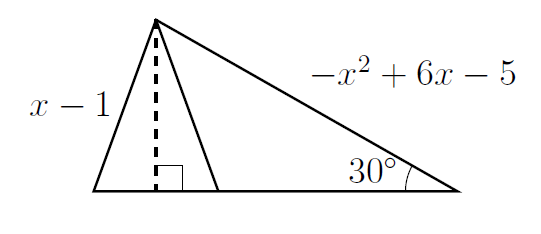
- This could go wrong though, if $(x-1)$ is too big, because then the little triangle won't be so little, and my alternative position for the lower-left corner will end up beyond the lower-right corner of the triangle. That happens if $x-1 > -x^2+6x-5$, thinking about the critical value where the little triangle reflects perfectly onto the side.
- So putting that together, I want $$x-1 > \frac{1}{2}\left(-x^2+6x-5\right)\quad\text{and}\quad x-1 <-x^2+6x-5 $$
- The quadratic factorises as $(x-1)(5-x)$ and then I can cancel the factor of $(x-1)$, assuming that $x>1$ as the side length $(x-1)$ is positive, and I get $1>\frac{1}{2}\left(5-x\right)$ and $1<5-x$.
- That's $3<x<4$.
- The answer is D.
Extension
- Alternatively, we could write down the inequalities in the revision notes. I didn't have this option, because I hadn't written that bit of the revision notes when I did this question! Check that the inequalities in the notes give the same answer.
TMUA 2022 Paper 2 Question 20
- I made a table to track the maximum and minimum values of each function. I've got to be careful because, in general when you have some range like $a<x<b$ and you apply a function $\mathrm{f}$, the maximum output might occur at $a$, or at $b$, or at some in-between point. It depends on whether the function $\mathrm{f}$ is increasing or decreasing or a bit of both.
My table starts like this, describing the minimum and maximum values of $\cos(x)$.
min max $\mathrm{f}_1$ $-1$ $1$ - Then I'm asked to apply sine, because $\mathrm{f}_2(x)=\sin(\mathrm{f}_1(x))$. What happens? The input to the sine could be as large as one radian. Is that a lot? In particular, is that more or less than $\frac{\pi}{2}$? I'm interested because I want to know if $\sin(\mathrm{f}_1(x))$ could be as large as 1.
- We know that $\frac{\pi}{2} > 1$. So the inputs for sine here are pretty small, and $\mathrm{f}_2$ never gets as large as 1. Instead, the maximum is $\sin 1$, whatever that is. This rules out option A. Similarly, a negative value of $\mathrm{f}_1$ gives the minimum of $\mathrm{f}_2$ as $-\sin 1$.
min max $\mathrm{f}_2$ $-\sin 1$ $\sin 1$ - Now we apply cosine to those values. There's a bit of a trap here, because I might try to continue the pattern so far, and just write down $\cos(\sin 1)$ for the maximum. That would forget that cosine achieves the value of 1 when the input is 0. As the range of $\mathrm{f}_2$ includes $0$, we will see that value.
- So the maximum of $\mathrm{f}_3$ is 1. This rules out option B. What's the minimum? Well, $\sin(1)<1<\frac{\pi}{2}$. So when we apply cosine, the minimum value is $\cos(\sin(1))$ (not the maximum!).
min max $\mathrm{f}_3$ $\cos\left(\sin 1\right)$ $1$ - Now it's time to apply sine. The maximum $m_4=\sin(1)=m_2$ which rules out options D and F, and the minimum is $\sin(\cos(\sin 1))$. Note that, unlike the previous case, I'm relatively relaxed here because sine has no turning points in the relevant range.
min max $\mathrm{f}_4$ $\sin\left(\cos\left(\sin 1\right)\right)$ $\sin 1$ - Finally we apply cosine. Looking at the remaining options, it looks like the question is just whether $m_5=1$ or not. We don't have zero in the range of $\mathrm{f}_4$, so I can't see any way for $\mathrm{f}_5$ to give value 1. I think that $m_5<1$, which eliminates option C.
- The answer is E.
Extension
- What happens if the question is in degrees instead?
- What happens if I replace every mention of $\sin u$ in the question with $\sin 2u$, and every mention of $\cos u$ with $\cos 2u$?