

Logarithms Solutions
This resource is part of the 2025 archive of the Oxford MAT Livestream. Click or tap here or on the image below for the new and updated livestream admissions support programme from Oxford Mathematics.

Revision Questions
- $(2^3)^4=2^{12}$. $(2^4)^3=2^{12}$. $2^4 2^3=2^7$. $2^3 2^4=2^7$.
- This is a quadratic for $\frac{1}{x}$ with solutions $\frac{1}{x}=-1$ or $\frac{1}{x}=-3$. So $x=-1$ or $x=-\frac{1}{3}$. Alternatively, we could multiply both sides by $x^2$ and solve the quadratic that we get.
- This is $\log_{10} 12$.
- The quadratic inside the brackets factorises, and this is $\log_3(x+2)+\log_3(x+1)$. Other answers are possible, such as $\log_3 (2(x+2))+\log_3((x+1)/2)$.
- The left-hand side is just $2$ so we want $2=x^3$. So $x=\sqrt[3]{2}$.
- The left-hand side is $1+\log_x 2$ so we want $\log_x 2=2$. So $x^2=2$ and $x=\sqrt{2}$ (not $-\sqrt{2}$ because we're told that $x>0$).
- Take $(x+5)$ to the power of each side to get $6x+22=(x+5)^2$. Expand the square and rearrange for $x^2+4x+3=0$. The solutions are $x=-1$ or $x=-3$. Check these solutions; $\log_4(16)=2$ and $\log_2(4)=2$.
-
- $\ln 1024=\ln\left(2^{10}\right)=10\ln 2=10a$.
- $\ln 40=\ln 8+\ln 5=3a+b$.
- $\ln \sqrt{2/5}=\frac{1}{2}\ln 2/5=\frac{1}{2}\left(a-b\right)$.
- $\ln (1/10)=-\ln 10=-\ln2-\ln 5=-a-b$.
- $\ln 1.024=\ln 1024+\ln 1/1000=10a +3(-a-b)=7a-3b$.
- There are other solutions, partly because $b=a\times\log_2 5$.
- $e^{x+y}+e^{y-x}-e^{x-y}-e^{-x-y}+e^{x+y}-e^{y-x}+e^{x-y}-e^{-x-y}$. That's $2e^{x+y}-2e^{-x-y}$.
$e^{x+y}+e^{y-x}+e^{x-y}+e^{-x-y}+e^{x+y}-e^{y-x}-e^{x-y}+e^{-x-y}$. That's $2e^{x+y}+2e^{-x-y}$. - $2^x=3$ is what it means for $x$ to be $\log_2 3$.
If $0.5^x=3$ then $2^{-x}=3$ so $x=-\log_2 3$. Alternatively, just write down $x=\log_{0.5}3$.
If $4^x=3$ then $2^{2x}=3$ so $x=\frac{1}{2}\log_2 3$. Alternatively, just write down $x=\log_4 3$. - $1^x=1$ is true for all real $x$. $1^x$ is never equal to 3 for real $x$.
- $0^b=0$ for any real $b>0$. $a^0$ is never $0$.
- We always have $a^0=1$ for $a>0$. So $\log_a 1 = 0$. Note that $a^x$ is a strictly increasing function if $a>1$ and strictly decreasing if $a<1$, so if $a^x=1$ then $x$ must be 1.
- We have $\log_{10}x=10^6$, which is a million. So $x$ is ten to the power of a million. That's got a million zeros at the end.
- We have $\displaystyle \log_a \left(\frac{x}{y}\right)=\log_a \left(xy^{-1}\right)=\log_a x +\log_a y^{-1}$ using the product rule, and then $\log_a y^{-1}=- \log_a y$ using the power rule.
- Multiply both sides by $e^x$ and rearrange to get $e^{2x}-4e^x+1=0$. This is a quadratic for $e^x$. Solve it for $e^x=2\pm \sqrt{3}$. So $x=\ln (2\pm \sqrt{3})$.
Following the previous working, we can see that we'll get two roots for $e^x$ if $c^2-4>0$. But we need these to be positive roots, so we need $c>2$. If $c=2$ there's a repeated root. If $c<2$ there are no roots. - Move both terms onto the left-hand side and use the fact that $(N+\sqrt{N^2-1})(N-\sqrt{N^2-1})=N^2-(N^2-1)=1$; that's the difference of two squares. Remember that $\ln 1 =0$.
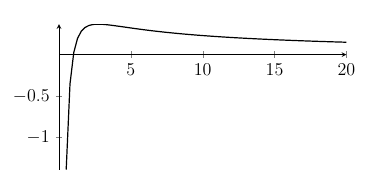
As a result, our solutions to the previous question, $\ln (2\pm \sqrt{3})$, are actually $\pm \ln (2+\sqrt{3})$, revealing a lovely symmetry. But you could have spotted that from the equation, of course! - We have $\ln(x^y)=\ln(y^x)$ which we can simplify down to $y\ln x=x\ln y$. Now rearrange to get $\displaystyle \frac{\ln x}{x}=\frac{\ln y}{y}$. You might choose to put this fraction the other way up, or to square both sides or something, so your $f(x)$ might not be the same as mine. Here's a sketch of $\displaystyle y=\frac{\ln(x)}{x}$.
This is $(a^{\log_a b})^k=b^k$.
We can use a similar bit of algebra with $k=\log_b c$.
$$a^x=a^{\log_a b \log_b c}=\left(a^{\log_a b}\right)^{\log_b c}=\left(b\right)^{\log_b c}=c.$$
So $a^x=c$ and therefore $x=\log_a c$.If we relabel the previous result, we can write $\left(\log_c a\right) \left( \log_a b\right) =\log_c b$. Now divide by $\log_c a$ to get
$$\log_a b = \frac{\log_c b}{\log_c a}$$
In particular, if we take $c$ to be the number $e$, then we can write that fraction with $\ln$ instead of $\log_e$. This is handy because it shows that we can always write logarithms like $\log_{a} x$ in terms of $\ln$. All other $\log_a x$ graphs are just simple transformations of the $\ln x$ graph.
MAT Questions
MAT 2014 Q1B
- The function $y=x^2-2x+2=(x-1)^2+1$ if we complete the square.
- The minimum occurs when $x=1$ and the value at that minimum is $y=1$.
- Consider now the function $y=\log_{10}(f(x))$ where $f(x)$ is the quadratic above. This graph has a local minimum at $x=1$, and the value there will be $\log_{10}1=0$. Only one of the graphs looks like that.
- The answer is (e).
MAT 2015 Q1H
- We can start by using the fact that if $\log_b a = c$ then $a=b^c$.
- Here $\left(4-5x^2-6x^3\right)=\left(x^2+2\right)^2$.
- That polynomial simplifies to $x^4+6x^3+9x^2=0$.
- There's a repeated root at $x=0$, and the polynomial factorises as $x^2(x+3)^2=0$.
- We should check our solutions; $\log_2(4)=2$ and $\log_{11}(4-5\times 9+6\times27)=\log_{11}(121)=2$.
- So there are two distinct solutions.
- The answer is (c).
MAT 2017 Q1I
- The equation simplifies to $$x^2+x\log_a\left(\frac{c}{b}\right)+\log_a \left(\frac{1}{b}\right)\log_a(c)=0.$$
- This quadratic factorises as $$\left(x-\log_a\left(b\right)\right)\left(x+\log_a\left(c\right)\right)=0,$$
where I've used the law of logarithms that $\displaystyle \log_a c -\log_a b =\log_a\left(\frac{c}{b}\right)$. - This quadratic has two distinct roots, unless $-\log_a b = \log_a c$. That happens precisely when $\displaystyle c=\frac{1}{b}$.
- The answer is (d).
MAT 2008 Q1B
Let $x=\log_{10} \pi$. Note that $0<x<1$ because $1<\pi<10$. The four values are
$$
x,\qquad \sqrt{2x}, \qquad x^{-3}\qquad \frac{2}{x}.
$$
Now we want to compare these terms. We have $x<\sqrt{2x}$ if $x^2<2x$ which happens if $x<2$. Also $x<x^{-3}$ because $x<1$. Also $x<2/x$ because $x<\sqrt{2}$.
The answer is (a).
MAT 2008 Q1E
Ignore small powers of $x$ inside each pair of round brackets. We get something like
$$
\left\lbrace \left[ \left(2x^6+\dots \right)^3+\left(3x^8+\dots\right)^4\right]^5+\left[ \left( 3x^5+\dots \right)^5 + \left(x^7+\dots\right)^4\right]^6 \right\rbrace ^3
$$
Now apply the powers on the round brackets and compare terms again
$$
\left\lbrace \left[ 2^3x^{18} +3^4x^{32}+\dots\right]^5+\left[ 3^5x^{25} + x^{28}+\dots\right]^6 \right\rbrace ^3
$$
Take the largest power inside each square bracket and apply the power on that bracket
$$
\left\lbrace 3^{20}x^{160}+ x^{168}+\dots\right\rbrace ^3
$$
Take the largest power inside the curly brackets and apply the power on that bracket
$$
x^{504}+\dots
$$
The answer is (d).
MAT 2010 Q1E
First note that $\displaystyle \log_4 8= \frac{3}{2}$ because $4=2^2$ and $8=2^3$, so $4^{3/2}=8$.
Is $\displaystyle\log_2{3}>\frac{3}{2}$? Only if $\displaystyle3>2^{3/2}$ so only if $9>8$. Yes!
Is $\displaystyle\log_3{2}>\frac{3}{2}$? No, it's less than one.
Is $\displaystyle\log_5{10}>\frac{3}{2}$? Only if $10>5^{3/2}$, so only if $100>125$. No!
So only $\log_2 3$ is larger than $\displaystyle\frac{3}{2}$.
The answer is (a).
MAT 2012 Q1C
Simplify $(\sqrt{3})^3=3\sqrt{3}$.
Simplify $\log_3(9^2)=4$.
Simplify $\displaystyle (3\sin 60^\circ)^2=(3\sqrt{3}/2)^2=\frac{27}{4}$.
Simplify $\log_2(\log_2 8^5)=\log_2(\log_2 2^{15})=\log_2(15)$.
The next thing I notice is that $15<16$ so $\log_2(15)<4$. Aha, that means that it's less than $\log_3(9^2)$.
Then perhaps I could notice that $\frac{27}{4}>4$. So my remaining candidates for the smallest of the numbers are $3\sqrt{3}$ and $\log_2(15)$. But $3\sqrt{3}=\sqrt{27}>4$. So option (d) is the only one that's less than 4.
The answer is (d).
Extension
- We've seen above that for $0<\alpha <1$, the smallest is (a). For $\alpha>1$, it turns out that $\alpha^{-3}$ is the smallest.
- $(8!)^9=(8!)^8\times 8!$ and $(9!)^8=(8!)^8\times 9^8$. Now $9^8$ is clearly larger than $8!$ (each is the product of eight things, and in the case of $9^8$, each of those eight things is larger!). So $(9!)^8>(8!)^9$.