


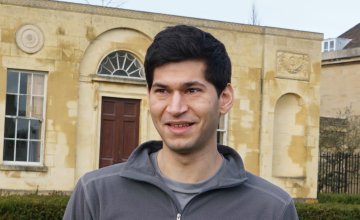
A set of integers greater than 1 is primitive if no number in the set divides another. Erdős proved in 1935 that the series of $1/(n \log n)$ for $n$ running over a primitive set A is universally bounded over all choices of A. In 1988 he conjectured that the universal bound is attained for the set of prime numbers. In this research case study, Oxford's Jared Duker Lichtman describes recent progress towards this problem:
Faster algorithms for Markov equivalence
Hu, Z
Evans, R
Proceedings of the 36th Conference on Uncertainty in Artificial Intelligence, UAI 2020
759-768
(01 Jan 2020)

Alongside the mathematics, the Andrew Wiles Building, home to Oxford Mathematics, has always been a venue for art, whether on canvas, sculpture, photography or even embedded in the maths itself.
However, lockdown has proved especially challenging for the creative arts with venues shut. Many have turned to online exhibitions and we felt that not only should we do the same but by so doing we could stress the connection between art and science and how both are descriptions of our world.
Using information theory to optimise epidemic models for real-time prediction and estimation
Parag, K
Donnelly, C
PLOS Computational Biology
volume 16
issue 7
e1007990
(01 Jul 2020)
doi:10.1371/journal.pcbi.1007990
Suppression of a SARS-CoV-2 outbreak in the Italian municipality of Vo’
Lavezzo, E
Franchin, E
Ciavarella, C
Cuomo-Dannenburg, G
Barzon, L
Del Vecchio, C
Rossi, L
Manganelli, R
Loregian, A
Navarin, N
Abate, D
Sciro, M
Merigliano, S
De Canale, E
Vanuzzo, M
Besutti, V
Saluzzo, F
Onelia, F
Pacenti, M
Parisi, S
Carretta, G
Donato, D
Flor, L
Cocchio, S
Masi, G
Sperduti, A
Cattarino, L
Salvador, R
Nicoletti, M
Caldart, F
Castelli, G
Nieddu, E
Labella, B
Fava, L
Drigo, M
Gaythorpe, K
Brazzale, A
Toppo, S
Trevisan, M
Baldo, V
Donnelly, C
Ferguson, N
Dorigatti, I
Crisanti, A
Nature
volume 584
issue 7821
425-429
(20 Aug 2020)
doi:10.1038/s41586-020-2488-1
Measurements of the Time-Dependent Cosmic-Ray Sun Shadow with Seven
Years of IceCube Data -- Comparison with the Solar Cycle and Magnetic Field
Models
Aartsen, M
Abbasi, R
Ackermann, M
Adams, J
Aguilar, J
Ahlers, M
Ahrens, M
Alispach, C
Amin, N
Andeen, K
Anderson, T
Ansseau, I
Anton, G
Argüelles, C
Auffenberg, J
Axani, S
Bagherpour, H
Bai, X
V, A
Barbano, A
Barwick, S
Bastian, B
Basu, V
Baum, V
Baur, S
Bay, R
Beatty, J
Becker, K
Tjus, J
BenZvi, S
Berley, D
Bernardini, E
Besson, D
Binder, G
Bindig, D
Blaufuss, E
Blot, S
Bohm, C
Böser, S
Botner, O
Böttcher, J
Bourbeau, E
Bourbeau, J
Bradascio, F
Braun, J
Bron, S
Brostean-Kaiser, J
Burgman, A
Buscher, J
Busse, R
Carver, T
Chen, C
Cheung, E
Chirkin, D
Choi, S
Clark, B
Clark, K
Classen, L
Coleman, A
Collin, G
Conrad, J
Coppin, P
Correa, P
Cowen, D
Cross, R
Dave, P
Clercq, C
DeLaunay, J
Dembinski, H
Deoskar, K
Ridder, S
Desai, A
Desiati, P
Vries, K
Wasseige, G
With, M
DeYoung, T
Dharani, S
Diaz, A
Díaz-Vélez, J
Dujmovic, H
Dunkman, M
DuVernois, M
Dvorak, E
Ehrhardt, T
Eller, P
Engel, R
Evenson, P
Fahey, S
Fazely, A
Felde, J
Fichtner, H
Fienberg, A
Filimonov, K
Finley, C
Fox, D
Franckowiak, A
Friedman, E
Fritz, A
Gaisser, T
Gallagher, J
Ganster, E
Garrappa, S
Gerhardt, L
Ghadimi, A
Glauch, T
Glüsenkamp, T
Goldschmidt, A
Gonzalez, J
Goswami, S
Grant, D
Grégoire, T
Griffith, Z
Griswold, S
Günder, M
Gündüz, M
Haack, C
Hallgren, A
Halliday, R
Halve, L
Halzen, F
Hanson, K
Hardin, J
Haungs, A
Hauser, S
Hebecker, D
Heereman, D
Heix, P
Helbing, K
Hellauer, R
Henningsen, F
Hickford, S
Hignight, J
Hill, C
Hill, G
Hoffman, K
Hoffmann, R
Hoinka, T
Hokanson-Fasig, B
Hoshina, K
Huang, F
Huber, M
Huber, T
Hultqvist, K
Hünnefeld, M
Hussain, R
In, S
Iovine, N
Ishihara, A
Jansson, M
Japaridze, G
Jeong, M
Jones, B
Jonske, F
Joppe, R
Kang, D
Kang, W
Kappes, A
Kappesser, D
Karg, T
Karl, M
Karle, A
Katz, U
Kauer, M
Kellermann, M
Kelley, J
Kheirandish, A
Kim, J
Kin, K
Kintscher, T
Kiryluk, J
Kittler, T
Kleimann, J
Klein, S
Koirala, R
Kolanoski, H
Köpke, L
Kopper, C
Kopper, S
Koskinen, D
Koundal, P
Kowalski, M
Krings, K
Krückl, G
Kulacz, N
Kurahashi, N
Kyriacou, A
Lanfranchi, J
Larson, M
Lauber, F
Lazar, J
Leonard, K
Leszczyńska, A
Li, Y
Liu, Q
Lohfink, E
Mariscal, C
Lu, L
Lucarelli, F
Ludwig, A
Lünemann, J
Luszczak, W
Lyu, Y
Ma, W
Madsen, J
Maggi, G
Mahn, K
Makino, Y
Mallik, P
Mancina, S
Mariş, I
Maruyama, R
Mase, K
Maunu, R
McNally, F
Meagher, K
Medici, M
Medina, A
Meier, M
Meighen-Berger, S
Merz, J
Meures, T
Micallef, J
Mockler, D
Momenté, G
Montaruli, T
Moore, R
Morse, R
Moulai, M
Muth, P
Nagai, R
Naumann, U
Neer, G
Nguyen, L
Niederhausen, H
Nisa, M
Nowicki, S
Nygren, D
Pollmann, A
Oehler, M
Olivas, A
O'Murchadha, A
O'Sullivan, E
Pandya, H
Pankova, D
Park, N
Parker, G
Paudel, E
Peiffer, P
Heros, C
Philippen, S
Pieloth, D
Pieper, S
Pinat, E
Pizzuto, A
Plum, M
Popovych, Y
Porcelli, A
Rodriguez, M
Price, P
Przybylski, G
Raab, C
Raissi, A
Rameez, M
Rauch, L
Rawlins, K
Rea, I
Rehman, A
Reimann, R
Relethford, B
Renschler, M
Renzi, G
Resconi, E
Rhode, W
Richman, M
Riedel, B
Robertson, S
Roellinghoff, G
Rongen, M
Rott, C
Ruhe, T
Ryckbosch, D
Cantu, D
Safa, I
Herrera, S
Sandrock, A
Sandroos, J
Santander, M
Sarkar, S
Satalecka, K
Scharf, M
Schaufel, M
Schieler, H
Schlunder, P
Schmidt, T
Schneider, A
Schneider, J
Schröder, F
Schumacher, L
Sclafani, S
Seckel, D
Seunarine, S
Shefali, S
Silva, M
Smithers, B
Snihur, R
Soedingrekso, J
Soldin, D
Song, M
Spiczak, G
Spiering, C
Stachurska, J
Stamatikos, M
Stanev, T
Stein, R
Stettner, J
Steuer, A
Stezelberger, T
Stokstad, R
Strotjohann, N
Stürwald, T
Stuttard, T
Sullivan, G
Taboada, I
Tenholt, F
Ter-Antonyan, S
Terliuk, A
Tilav, S
Tollefson, K
Tomankova, L
Tönnis, C
Toscano, S
Tosi, D
Trettin, A
Tselengidou, M
Tung, C
Turcati, A
Turcotte, R
Turley, C
Ty, B
Unger, E
Elorrieta, M
Usner, M
Vandenbroucke, J
Driessche, W
Eijk, D
Eijndhoven, N
Vannerom, D
Santen, J
Verpoest, S
Vraeghe, M
Walck, C
Wallace, A
Wallraff, M
Watson, T
Weaver, C
Weindl, A
Weiss, M
Weldert, J
Wendt, C
Werthebach, J
Whelan, B
Whitehorn, N
Wiebe, K
Wiebusch, C
Williams, D
Wills, L
Wolf, M
Wood, T
Woschnagg, K
Wrede, G
Wulff, J
Xu, X
Xu, Y
Yanez, J
Yoshida, S
Yuan, T
Zhang, Z
Zöcklein, M
Physical Review D: Particles, Fields, Gravitation and Cosmology
volume 103
issue 4
(08 Feb 2021)
doi:10.1103/PhysRevD.103.042005
Years of IceCube Data -- Comparison with the Solar Cycle and Magnetic Field
Models
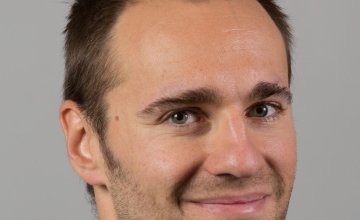
Oxford Mathematician Andrea Mondino has been awarded a Whitehead Prize by the London Mathematical Society (LMS) in recognition of his contributions to geometric analysis in differential and metric settings and in particular for his central part in the development of the theory of metric measure spaces with Ricci curvature lower bounds.
Thu, 02 Jul 2020
16:00 -
17:30
Virtual
John Roe and Course Geometry
Nigel Higson
(Penn State University)
Abstract
Abstract: John Roe was a much admired figure in topology and noncommutative geometry, and the creator of the C*-algebraic approach to coarse geometry. John died in 2018 at the age of 58. My aim in the first part of the lecture will be to explain in very general terms the major themes in John’s work, and illustrate them by presenting one of his best-known results, the partitioned manifold index theorem. After the break I shall describe a later result, about relative eta invariants, that has inspired an area of research that is still very active.
Assumed Knowledge: First part: basic familiarity with C*-algebras, plus a little topology. Second part: basic familiarity with K-theory for C*-algebras.
Further Information
Part of UK virtual operator algebra seminar: https://sites.google.com/view/uk-operator-algebras-seminar/home