

Bounds for the chi-square approximation of Friedman's statistic by Stein's method
Gaunt, R
Reinert, G
Bernoulli - Journal of the Bernoulli Society
volume 29
issue 3
2008-2034
(27 Apr 2023)
doi:10.3150/22-BEJ1530
Half-isolated zeros and zero-density estimates
Maynard, J
Pratt, K
(23 Jun 2022)
https://arxiv.org/abs/2206.11729v2
NEO: Non Equilibrium Sampling on the Orbit of a Deterministic Transform
Thin, A
Janati, Y
Le Corff, S
Ollion, C
Doucet, A
Durmus, A
Moulines, E
Robert, C
Advances in Neural Information Processing Systems
volume 21
17060-17071
(06 Jan 2021)
Diffusion Schrödinger Bridge with Applications to Score-Based Generative Modeling
De Bortoli, V
Thornton, J
Heng, J
Doucet, A
Advances in Neural Information Processing Systems
volume 21
17695-17709
(06 Dec 2021)
Tue, 01 Nov 2022
15:00
15:00
L5
Thickness and relative hyperbolicity for graphs of multicurves
Kate Vokes
Abstract
Various graphs associated to surfaces have proved to be important tools for studying the large scale geometry of mapping class groups of surfaces, among other applications. A seminal paper of Masur and Minsky proved that perhaps the most well known example, the curve graph, is Gromov hyperbolic. However, this is not the case for every naturally defined graph associated to a surface. We will present joint work with Jacob Russell classifying a wide family of graphs associated to surfaces according to whether the graph is Gromov hyperbolic, relatively hyperbolic or not relatively hyperbolic.
Tue, 25 Oct 2022
15:00
15:00
L5
Rational curvature invariants of 2-dimensional complexes
Henry Wilton
Abstract
I will discuss some new invariants of 2-complexes. They are inspired by recent developments in the theory of one-relator groups, but also have the potential to unify the theories of many well-studied families including small-cancellation presentation complexes, CAT(0) 2-complexes and 3-manifold spines, in addition to the motivating examples of one-relator presentation complexes. The fundamental result is that these invariants are the extrema of explicit linear-programming problems, and in particular are rational, computable and realised. The definitions suggest a conjectural “map” of 2-complexes, which I will attempt to describe.
Tue, 18 Oct 2022
15:00
15:00
L5
Random character varieties
Emmanuel Breuillard
Abstract
Consider a random group $\Gamma$ with $k$ generators and $r$ random relators of large length $N$. We study the geometry of the character variety of $\Gamma$ with values in $\SL(2,\C)$ or more generally any semisimple Lie group $G$. This is the moduli space of group homomorphisms from $\Gamma$ to $G$ up to conjugation. We are in particular able to determine its dimension, number of components and Galois group, with an excellent control on the probability of exceptions. The proofs use effective Chebotarev type theorems as well as new spectral gap bounds for Cayley graphs of finite simple groups. They are also conditional on GRH. Joint work with Peter Varju and Oren Becker.
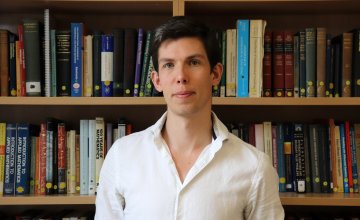
The Fields Medal is widely regarded as the highest honour a young mathematician can attain and is especially hard to win because the medals are only awarded every four years to mathematicians under the age of forty. This year Oxford Mathematician James Maynard is one of four recipients for his "contributions to analytic number theory, which have led to major advances in the understanding of the structure of prime numbers and in Diophantine approximation."
Flows of G<inf>2</inf>-structures on contact Calabi–Yau 7-manifolds
Lotay, J
Sá Earp, H
Saavedra, J
Annals of Global Analysis and Geometry
volume 62
issue 2
367-389
(01 Sep 2022)
doi:10.1007/s10455-022-09854-0