Centre for Topological Data Analysis
The Centre for Topological Data Analysis (TDA), originally established through an EPSRC-funded programme, conducted research at the intersection of topology, geometry, statistics and data science. That programme demonstrated how deep mathematical ideas can reveal hidden structure in complex datasets—from biological systems and materials science to image analysis and network data.
Today, the Centre now operates as an international centre-to-centre collaboration, connecting researchers at the University of Oxford with partners at leading research institutes in Germany, including the Max Planck Institute for Mathematics in the Sciences (Leipzig) and the Max Planck Institute of Molecular Cell Biology and Genetics (Dresden).
This partnership expands the scope of the original centre by bringing together expertise in:
- algebraic and geometric topology
- computational geometry
- machine learning and data science
- experimental and systems biology
By linking mathematics with cutting-edge experimental datasets, the collaboration creates a powerful feedback loop between mathematics and complex biological systems.
People
Core-Team
Post-docs Research Associates & Affiliates
- Dr. Elena Collacciani
- Dr Gillian Grindstaff
- Dr Lida Kanari
- Dr Vukasin Stojisavljevic
- Dr Lukas Waas
- Dr Arne Wolf
Postgraduate Student
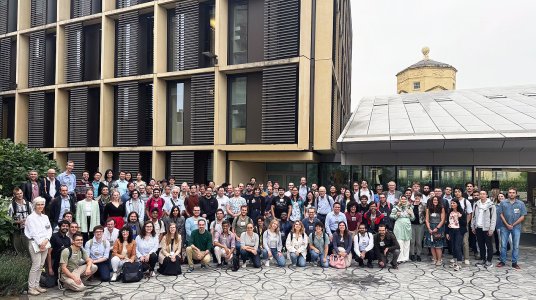
Get Involved
The Centre plays a major role in building the international TDA community. Through workshops, conferences, training schools and collaborative research visits, we bring together mathematicians, scientists and data practitioners from across disciplines.
With the expanded centre-to-centre programme, there are now more opportunities than ever to get involved—from early-career researchers and students to scientists interested in applying topological ideas to their own data.
Applied Topology Seminar
Fri 13 Mar 2026 – 13:15 (L6)
Persistent Cycle Representatives and Generalized Persistence Landscapes in Codimension 1
Leon Renkin (Max Planck Institute of Molecular Cell Biology and Genetics)
Fri 06 Mar 2026 – 13:15 (L6)
Geometric and topological potentials driving self-assembly
Ivan Spirandelli (University of Potsdam)
Fri 27 Feb 2026 – 13:00 (L6)
On the additive image of persistent homology
Ulrich Bauer (Technical University Munich)
Fri 20 Feb 2026 – 13:00 (L6)
From Frames to Features: Fast Zigzag Persistence for Binary Videos
David Lanners (Durham University)
Fri 13 Feb 2026 – 13:00 (L6)
Metrics and stable invariants in persistence
Andrea Guidolin (University of Southampton)
Fri 06 Feb 2026 – 13:00 (L6)
Computing Diffusion Geometry
Iolo Jones (University of Oxford)
Fri 23 Jan 2026 – 13:00 (L6)
Latschev’s theorem in persistent homotopy theory
Lukas Waas (University of Oxford)
Fri 05 Dec 2025 – 13:00 (L6)
Dowker duality: new proofs and generalizations
Iris Yoon (Swarthmore College)
Fri 28 Nov 2025 – 13:00 (L6)
Intrinsic bottleneck distance in merge tree space
Gillian Grindstaff (University of Oxford)
Fri 14 Nov 2025 – 13:00 (L6)
Towards Finite Element Tensor Calculus
Kaibo Hu (University of Oxford)
Fri 31 Oct 2025 – 13:00 (L6)
Categorical fragmentation and filtered topology
John Miller (Université de Montréal)
Fri 24 Oct 2025 – 13:00 (L6)
Generalized Persistent Laplacians and Their Spectral Properties
Arne Wolf (Imperial College London)
Fri 17 Oct 2025 – 13:00 (L6)
Zero sets from the viewpoint of topological persistence
Vukašin Stojisavljević (University of Oxford)
Fri 20 Jun 2025 – 13:00 (L5)
Latent Space Topology Evolution in Multilayer Perceptrons
Eduardo Paluzo Hidalgo (University of Seville)
Fri 13 Jun 2025 – 13:00 (L5)
The Likelihood Correspondence
Hal Schenck (Auburn University)
Fri 06 Jun 2025 – 13:00 (L5)
Topologically Good Cover from Gradient Descent
Uzu Lim (Queen Mary University London)
Fri 30 May 2025 – 13:00 (L5)
A Unified Theory of Topological and Classical Integral Transforms
Vadim Lebovici
Fri 23 May 2025 – 13:00 (L5)
Stratified Learning, Cell Biophysics, and Material Structures
Yossi Bokor Bleile (IST Austria)
Fri 16 May 2025 – 13:00 (L6)
Certifying Robustness via Topological Representations
Andrea Guidolin (University of Southampton)
Fri 02 May 2025 – 13:00 (L5)
An Algebraic Derivation of Morse Complexes for Poset-Graded Chain Complexes
Ka Man Yim (Cardiff University)
Fri 14 Mar 2025 – 15:00 (L4)
A Statistical Perspective on Multiparameter Persistent Homology
Mathieu Carrière (Inria Côte d’Azur)
Fri 07 Mar 2025 – 15:00 (L4)
Central Limit Theorems and the Smoothed Bootstrap in TDA
Johannes Krebs (KU Eichstätt-Ingolstadt)
Fri 28 Feb 2025 – 15:00 (L4)
Optimal Partial Transport and Alexandrov Spaces
Mauricio Che (University of Vienna)
Fri 21 Feb 2025 – 15:00 (L4)
Monodromy in Bi-parameter Persistence Modules
Sara Scaramuccia (University of Rome Tor Vergata)
Fri 14 Feb 2025 – 15:00 (L4)
Distance-from-Flat Persistent Homology Transforms
Nina Otter (Inria Saclay) — Abstract →


Research
Hypergraphs and simplicial complexes in focus: A roadmap for future research in higher-order interactions
Abiad, Arenas, Backhausz, Balogh, Banerji, Barbarossa et al.
Journal of Physics: Complexity (2026)
https://doi.org/10.1088/2632-072X/ad2f2e
Topological classification of tumour-immune interactions and dynamics
Yang, Fang, Dhesi, Yoon, Bull, Byrne, Harrington et al.
Journal of Mathematical Biology (2025)
https://doi.org/10.1007/s00285-025-02090-1
Grounded persistent path homology: A stable, topological descriptor for weighted digraphs
Chaplin, Harrington, Tillmann
Foundations of Computational Mathematics (2025)
https://doi.org/10.1007/s10208-024-09639-5
Persistent homology classifies parameter dependence of patterns in Turing systems
Spector, Harrington, Gaffney
Bulletin of Mathematical Biology (2025)
https://doi.org/10.1007/s11538-024-01337-7
Mouse liver assembloids model periportal architecture and biliary fibrosis
Dowbaj, Sljukic, Niksic, Landerer, Delpierre, Yang et al.
Nature (2025)
https://doi.org/10.1038/s41586-025-08817-8
Absolute concentration robustness: Algebra and geometry
Puente, Gross, Harrington, Johnston, Meshkat, Millán et al.
Journal of Symbolic Computation (2024)
https://doi.org/10.1016/j.jsc.2024.102398
Multiscale topology characterizes dynamic tumor vascular networks
Stolz, Kaeppler, Markelc, Braun, Lipsmeier, Muschel, Byrne, Harrington
Science Advances (2022)
https://doi.org/10.1126/sciadv.abm2456
Multiparameter persistent homology landscapes identify immune cell spatial patterns in tumors
Vipond, Bull, Macklin, Tillmann, Pugh, Byrne, Harrington
PNAS (2021)
https://doi.org/10.1073/pnas.2102166118
Geometric anomaly detection in data
Stolz, Tanner, Harrington, Nanda
PNAS (2020)
https://doi.org/10.1073/pnas.2001741117
Stratifying multiparameter persistent homology
Harrington, Otter, Schenck, Tillmann
SIAM Journal on Applied Algebra and Geometry (2019)
https://doi.org/10.1137/18M1224350
Joining and decomposing reaction networks
Gross, Harrington, Meshkat, Shiu
arXiv (2019)
https://arxiv.org/abs/1810.05575