Patrick Farrell and Heather Harrington made SIAM Fellows

Photos

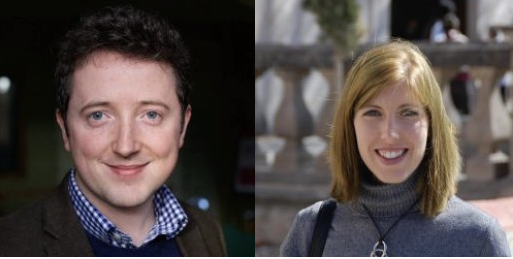
Oxford Mathematicians Patrick Farrell and Heather Harrington have been made Fellows of Society for Industrial and Applied Mathematics (SIAM).

Patrick is made fellow for his contributions to algorithms and software for the numerical solution of partial differential equations. Patrick is a Professor in the Numerical Analysis group in Oxford and a Tutorial Fellow at Oriel College. For 2025 and 2026 he is also the Donatio Universitatis Carolinæ Chair at the Faculty of Mathematics and Physics at Charles University in Prague.

Heather is recognised for her outstanding contributions to the development of new topological and algebraic methods and their applications to mathematical biology. Heather is Professor of Mathematics in Oxford, a fellow of St John's College and director at the Max Planck Institute of Molecular Cell Biology and Genetics (MPI-CBG) and the Center for Systems Biology Dresden (CSBD).

Posted on 31 Mar 2026, 10:06pm. Please contact us with feedback and comments about this page.

New centre to create computer models of lungs, liver, kidneys and cartilage

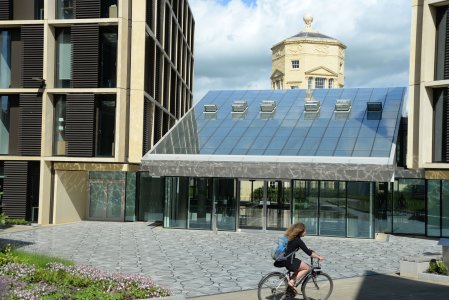
Image of Andrew Wiles Building

The Modelling-Informed Medicine Centre (MiMeC), founded by biopharma company GSK together with the University of Oxford and Imperial College London, will provide a new UK hub for research in the rapidly growing field of data-driven mechanistic modelling.

The centre will create computer models or ‘digital twins’ of organs and diseases to better understand how diseases of the lungs, liver, kidneys and cartilage progress, to discover and develop drugs more quickly, and to target medicines more precisely. The centre is backed by £11 million funding from GSK and multidisciplinary expertise spanning mathematics, data science, and experimentation from the founding partners.

The partners aim to support the life sciences community by bringing together advances across multiple disciplines in the field and training a new generation of research and development specialists who understand best practice in this emerging area of biomedical research. It will share its models on an open-source basis and build collaborations with further partners.

GSK plans to use the research to incorporate computational models of organs into its drug development pipeline within five years, aided by industrial placements it will provide to researchers from the centre.

The programme is led by Professor Helen Byrne and Professor Philip Maini in Oxford Mathematics, Professor Steven Niederer at Imperial College London, and Dr Anna Sher at GSK.

Designing effective treatments

The collaboration will harness advanced mathematical modelling to de-risk and accelerate the discovery and development of new medicines and vaccines. By enhancing our understanding of the underlying pathophysiological mechanisms of disease, the partnership aims to support the wider adoption of model-informed approaches across the drug development pipeline.

In Oxford, the programme will focus on the development of core mathematical and computational biology models for cartilage and lung diseases. The team will develop and apply mechanistic models to advance understanding of disease processes and inform the design of more effective treatments.

The research will focus on the construction of mechanistic mathematical models grounded in physics, physiology and pharmacology to elucidate disease mechanisms, and will include multi-scale models that integrate molecular, cellular and organ-level processes with whole-body physiology.

The Oxford teams will also develop and employ digital twins and virtual patients to simulate treatment responses, optimise dosing strategies, and design in-silico clinical trials. In addition, they will contribute open-source tools, standards for reproducibility, and case studies that showcase the impact of model-informed drug and vaccine development.

Professor Jon Chapman, Head of Oxford's Mathematical Institute said: 'this exciting new partnership recognises the pioneering role that our Wolfson Centre for Mathematical Biology has played - and continues to play - in applying mathematics to understand diseases and their response to treatment.'

Professor Helen Byrne said: 'we look forward to working with GSK and Imperial to train the next generation of leaders in mechanistic modelling for careers across industry and academia.'

Building digital twins of organs

At Imperial, Professor Niederer and team will build patient-specific models of organs using artificial intelligence and biological datasets, mathematically representing millions of cells in organs such as the lungs, and the mechanistic (or cause-and-effect) relationships they hold to one another, by modelling a proportion of cells found in the real organ.

Using the models, researchers could perform a simple in vitro experiment into the effect of a drug on a single lung cell and then use the model to simulate how this would translate into larger effects such as changes in the behaviour of the airways.

Eventually, the approach could allow clinicians to use digital twins of specific patients to tailor their treatments in real time, an approach that Professor Niederer’s group is already testing with cardiac patients.

Professor Steven Niederer from the National Heart and Lung Institute at Imperial College London said: 'We have seen maths used for modelling aeroplanes and cars - and increasingly there is a realisation that this has benefits in biology, where you can perform virtual experiments in models of humans at great speed and a fraction of the usual cost.'

Boosting the UK life science industry

MiMeC will focus on embedding a ‘mathematical modelling-first’ mindset towards the development of new therapies.

Dr Anna Sher, MiMeC Co-Director and Quantitative Systems Pharmacology lead in the Respiratory, Immunology and Inflammation Research Unit at GSK, said: 'by cycling between computer modelling, learning from the results, making predictions and then testing them, we can make faster, better decisions in developing new medicines. The tools and models developed through MiMeC strengthen GSK’s ability to generate virtual patients and digital twins to run computer based (in silico) clinical trials, analyse different data types, and test scientific ideas more efficiently.'

Bringing the mechanistic modelling mindset to the forefront of quantitative medicine has the potential to help supercharge the UK life science industry.


Posted on 19 Mar 2026, 9:12pm. Please contact us with feedback and comments about this page.

Torin Fastnedge wins Gold Medal at STEM for Britain 2026

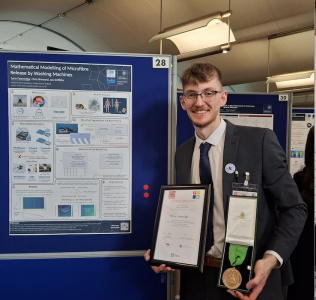
Photo of Torin with the medal by his poster

Oxford Mathematician Torin Fastnedge has won the Gold Medal for Mathematical Sciences at the 2026 STEM for BRITAIN poster competition held in the House of Commons on March 17th. Torin was among 20 researchers in mathematics presenting their work to politicians and a panel of expert judges.

Torin's poster was titled 'Mathematical Modelling of Microfibre Release by Washing Machines', based on research with fellow Oxford Mathematicians Chris Breward and Ian Griffiths. Microplastic fibres shed from our clothes account for around 35% of all ocean microplastics and are subsequently ingested and inhaled by both humans and animals, which may cause adverse health effects. Torin uses mathematical modelling and asymptotic techniques to simplify the complex geometry of the proposed filter, enabling more efficient future optimisation by removing the need for unnecessary numerical simulations and physical experiments.

STEM for BRITAIN is a major scientific poster competition and exhibition which has been held in Parliament since 1997, and is organised by the Parliamentary & Scientific Committee. It aims to give members of both Houses of Parliament an insight into the outstanding research work being undertaken in UK universities by early-career researchers.

Posted on 18 Mar 2026, 11:18am. Please contact us with feedback and comments about this page.

Primes and Resonance: Sophie Germain’s 250th Birthday

Image of So

1 April 2026 marks the 250th birthday of Sophie Germain, who is remembered for major contributions to mathematics, ranging from advances in number theory related to Fermat’s Last Theorem to foundational results in elasticity theory. She was also the first woman to win a major competitive research prize in mathematics. We will celebrate her life and work through four talks for a general audience, given by Lukas Brantner, Ana Caraiani, James Maynard (Oxford Mathematics Public Lecture)  and Laura Monk, alongside a demonstration and a panel discussion.

Please register here at  if you would like to attend this event, which will take place at The Royal Institution, 21 Albemarle Street, London on Wednesday 1 April 2026, from 2.00–7.00 pm.

All lectures will also be made available on YouTube by Wednesday 29 April, and links will be posted on the same website. 

We are grateful to the International Centre for the Mathematical Sciences (ICMS) and Oxford Mathematics for kindly supporting this event, and to XTX Markets for generously supporting the Oxford Mathematics Public Lecture.

Posted on 11 Mar 2026, 1:41pm. Please contact us with feedback and comments about this page.

Computers, Geometry and Einstein

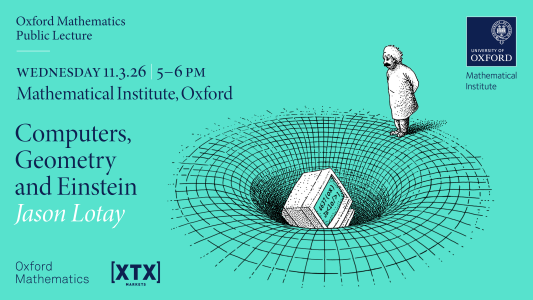
Banner for event

Computers have long been useful for studying mathematical problems. But recently computer techniques have been used to prove new theorems in geometry, specifically related to the study of gravity through Einstein's theory of General Relativity. This Oxford Mathematics Public Lecture will describe these developments and what they might mean for the future.

Wednesday 11 March 2026, 5.00-6.00 pm, Andrew Wiles Building, Mathematical Institute, Oxford.

Jason Lotay is Professor of Mathematics in the Mathematical Institute at the University of Oxford, and one of the inaugural Fellows of the Academy of Mathematical Sciences.

Please email @email to register to attend in person.

The lecture will be broadcast on the Oxford Mathematics YouTube Channel on Wednesday 25 March at 5-6 pm and any time after (no need to register for the online version).

The Oxford Mathematics Public Lectures are generously supported by XTX Markets.

Posted on 2 Mar 2026, 12:12pm. Please contact us with feedback and comments about this page.

Oxford × QRT Labs: investing in the next generation of scientific leaders through a unique multi-university partnership

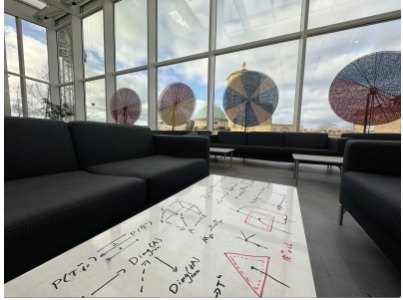
Common Room with writing on white tables

The University of Oxford has launched Oxford × QRT Labs as part of a major new long-term philanthropic partnership with Qube Research & Technologies (QRT), alongside Imperial College London and the University of Cambridge. The initiative forms part of a major investment by QRT across higher education, designed to support fundamental, multidisciplinary research and the next generation of scientific leaders. Oxford Mathematics is a significant part of the partnership.

Oxford x QRT Labs represents a significant investment in people - supporting students and early-career researchers working across mathematics, statistics, computer science and engineering. Through this multi-university partnership, QRT will directly fund more than 70 early-career researchers, including doctoral (PhD/DPhil) students and postdoctoral researchers and research fellows, helping to strengthen the pipeline of future scientific leaders.

Research supported through Oxford × QRT Labs will span both foundational questions and real-world challenges, reflecting Oxford’s long-standing commitment to excellence across disciplines. By giving researchers the space to explore complex problems - particularly those involving data, uncertainty and computation - the initiative will help lay the groundwork for future advances with broad societal relevance.

Alongside Oxford, Imperial College London and the University of Cambridge are each establishing dedicated QRT Labs centres within their institutions, supported by Qube Research & Technologies. Across the three universities, QRT Labs will operate as a coordinated programme, with shared scientific activities including seminars, workshops and events designed to encourage sustained collaboration and exchange, while preserving academic independence within each institution.

Posted on 19 Feb 2026, 8:59pm. Please contact us with feedback and comments about this page.

Rhythmicity and Coordination: The Importance of Circadian and Seasonal Biology

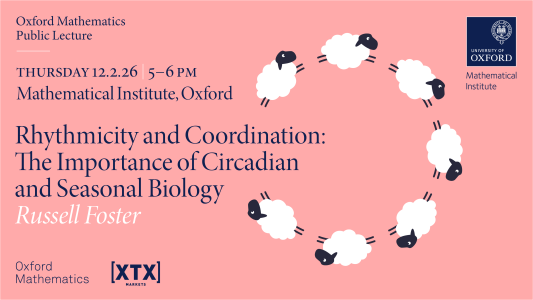
Banner with sheep running round in a circle

Oxford Mathematics Public Lecture, Thursday 12 February, 5 pm, Mathematical Institute, Oxford

Biology is not constant but highly rhythmic. This includes the fast rhythms of action potentials in the nervous system and the pulsatile release of hormones. At a longer timescale are the daily (circadian) rhythms and annual rhythms observed across much of the biological world. This talk will consider the mechanisms and importance of circadian rhythms to human health and the role of seasonal timing in reproduction and other phenomena in birds, mammals and humans. In biology, like the rest of science, timing is everything.

Russell Foster is Professor of Circadian Neuroscience and the Head of the Nuffield Laboratory of Ophthalmology in Oxford. He has featured widely in print and broadcast media on the subject of sleep and circadian rhythms and is the author of several popular books on the subject.

Please email @email to register to attend in person.

The lecture will be broadcast on the Oxford Mathematics YouTube Channel on Thursday 5 March at 5-6 pm and any time after (no need to register for the online version).

The Oxford Mathematics Public Lectures are generously supported by XTX Markets.

Posted on 3 Feb 2026, 12:20pm. Please contact us with feedback and comments about this page.

First Fellows of the Academy for the Mathematical Sciences announced

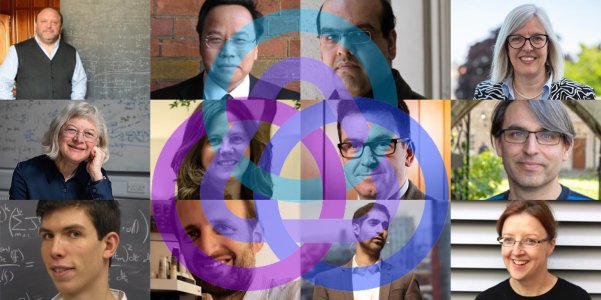
Photos of the 12

The Academy for the Mathematical Sciences has announced its first cohort of fellows, 100 in total from across academia and teaching, science communication and business. Twelve of those fellows are from Oxford, spread across four departments, reflecting the reach and importance of mathematics. 

From Oxford Mathematics, work in partial differential equations is represented by Jose Carrillo and Gui-Qiang Chen, mathematical finance by Rama Cont, geometry by Jason Lotay, analytic number theory by James Maynard, computational mathematics by Christoph Reisinger, and mathematical modelling in medicine by Sarah Waters.

From the Department of Statistics, Christl Donnelly's work in analysing infectious diseases is recognised; while from Computer Science Leslie Goldberg's work in randomised algorithms sees her elected fellow. Deirdre Hollingsworth, Professor of Infectious Disease Epidemiology in Nuffield Department of Medicine is also made a fellow. 

In addition, entrepreneur Zubin Siganporia, a visiting fellow in Oxford Mathematics. is made a fellow of the Academy as is Robert Leese, Chief Technical Officer of the Smith Institute, and a Fellow of St Catherine’s College, Oxford University.

Congratulations to all.  The Fellows will contribute to projects of national importance - such as strengthening maths education in the UK, supporting responsible AI, addressing the UK’s leaky mathematical talent pipeline, and leveraging the mathematical sciences to tackle climate change - for the benefit of the whole UK. Alison Etheridge, founding President of the Academy and Professor of Probability in Oxford’s Department of Statistics, said: ‘I’m delighted to welcome our inaugural Fellows - individuals of exceptional distinction who collectively advance the mathematical sciences through discovery, leadership, education and real-world application.’

The Academy for the Mathematical Sciences, founded in 2023, provides an authoritative, persuasive, and influential voice for the whole discipline. It brings together those in academia, education, business, industry, and government from across all four nations, providing crucial connectivity for harnessing the mathematical sciences to enhance economic productivity, improve lives, and support societal wellbeing.

Image (from left to right from top left): Jose Carrillo, Gui-Qiang Chen, Rama Cont, Christl Donnelly, Leslie Goldberg, Deirdre Hollingsworth, Robert Lesse, Jason Lotay, James Maynard, Christoph Reisinger, Zubin Siganporia, and Sarah Waters. All against the backdrop of the Academy logo.

Full list of Academy Fellows

Posted on 29 Jan 2026, 12:02am. Please contact us with feedback and comments about this page.

How Costly is Your Brain's Activity Pattern? - Dani Bassett

Banner for event. Abstract brain image and details.

Neural systems in general - and the human brain in particular - are organised as networks of interconnected components. Across a range of spatial scales from single cells to macroscopic areas, biological neural networks are neither perfectly ordered nor perfectly random. Their heterogeneous organisation supports - and simultaneously constrains - complex patterns of activity. In this Public Lecture Dani will demonstrate how the principle of network economy can inform our study of neural system function in health and disease and provide a useful lens on neural computation.

Dani Bassett is the J. Peter Skirkanich Professor at the University of Pennsylvania. In 2016, Dani was named one of the ten most brilliant scientists of the year by Popular Science magazine.

Thursday 22 January 2026, 5.00-6.00 pm, Andrew Wiles Building, Mathematical Institute, Oxford.  Please email @email to register to attend in person.

The lecture will be broadcast on the Oxford Mathematics YouTube Channel on Wednesday 11 February at 5-6 pm and any time after (no need to register for the online version).

The Oxford Mathematics Public Lectures are generously supported by XTX Markets.

Posted on 16 Jan 2026, 11:38am. Please contact us with feedback and comments about this page.

Short stories - our latest

Chiara

From a mathematical puzzle from the 18th century to the thoughts of our students as they study maths in the era of AI, our short films provide a (short) window on the world of maths and its mathematicians.

You may also learn about cat's eyes, how to make the perfect salad dressing thanks to the latest in Sam Howison's 'Maths in the Kitchen' series and the secrets behind birds flying in formation. Mathematicians are sometimes accused of having an answer for everything. And that is true. Except for lots of the maths.

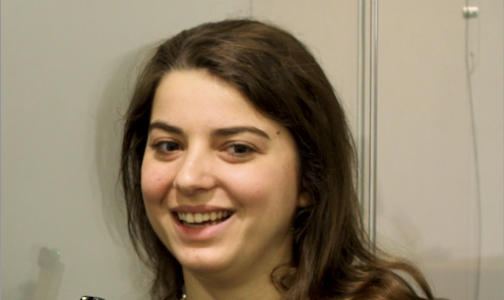
Below, three of our students from the Mirzakhani Society, Zoe, Holly and Chiara (pictured right) take to the microphone (aka a ruler) to answer questions on student mathematical life. Smart young brains in action.

Full list of films

Posted on 24 Dec 2025, 11:46am. Please contact us with feedback and comments about this page.