

Efficacy of ChAdOx1 nCoV-19 (AZD1222) Vaccine Against SARS-CoV-2 VOC 202012/01 (B.1.1.7)
Emary, K
Golubchik, T
Aley, P
Ariani, C
Angus, B
Bibi, S
Blane, B
Bonsall, D
Cicconi, P
Charlton, S
Clutterbuck, E
Collins, A
Cox, T
Darton, T
Dold, C
Douglas, A
Duncan, C
Ewer, K
Flaxman, A
Faust, S
Ferreira, D
Feng, S
Finn, A
Folegatti, P
Fuskova, M
Galiza, E
Goodman, A
Green, C
Greenland, M
Hallis, B
Heath, P
Hay, J
Hill, H
Jenkin, D
Kerridge, S
Lazarus, R
Libri, V
Lillie, P
Ludden, C
Marchevsky, N
Minassian, A
McGregor, A
Mujadidi, Y
Phillips, D
Plested, E
Pollock, K
Robinson, H
Smith, A
Song, R
(04 Feb 2021)
doi:10.2139/ssrn.3779160
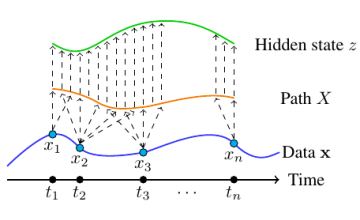
Oxford Mathematician Patrick Kidger writes about combining the mathematics of differential equations with the machine learning of neural networks to produce cutting-edge models for time series.
S-fold magnetic quivers
Bourget, A
Giacomelli, S
Grimminger, J
Hanany, A
Sperling, M
Zhong, Z
JOURNAL OF HIGH ENERGY PHYSICS
volume 2021
issue 2
(05 Feb 2021)
doi:10.1007/JHEP02(2021)054
Using next generation matrices to estimate the proportion of infections that are not detected in an outbreak
Unwin, H
Cori, A
Imai, N
Gaythorpe, K
Bhatia, S
Cattarino, L
Donnelly, C
Ferguson, N
Baguelin, M
2021.02.24.21252339
(26 Feb 2021)
doi:10.1101/2021.02.24.21252339
Reconstructing the degree sequence of a sparse graph from a partial deck
Groenland, C
Johnston, T
Kupavskii, A
Meeks, K
Scott, A
Tan, J
(17 Feb 2021)
doi:10.48550/arxiv.2102.08679
Fri, 12 Mar 2021
14:00 -
15:00
Virtual
Cluster algebras and categorification
Tom Zielinski
(University of Oxford)
Abstract
Introduced by Fomin and Zelevinsky in 2002, cluster algebras have become ubiquitous in algebra, combinatorics and geometry. In this talk, I'll introduce the notion of a cluster algebra and present the approach of Kang-Kashiwara-Kim-Oh to categorify a large class of them arising from quantum groups. Time allowing, I will explain some recent developments related to the coherent Satake category.
Thu, 04 Mar 2021
11:30
Virtual
Non-archimedean analogue of Wilkie's conjecture, and, point counting from Pfaffian over subanalytic to Hensel minimal
Raf Cluckers
(University of Lille)
Abstract
Point counting on definable sets in non-archimedean settings has many faces. For sets living in Q_p^n, one can count actual rational points of bounded height, but for sets in C((t))^n, one rather "counts" the polynomials in t of bounded degree. What if the latter is of infinite cardinality? We treat three settings, each with completely different behaviour for point counting : 1) the setting of subanalytic sets, where we show finiteness of point counting but growth can be aribitrarily fast with the degree in t ; 2) the setting of Pfaffian sets, which is new in the non-archimedean world and for which we show an analogue of Wilkie's conjecture in all dimensions; 3) the Hensel minimal setting, which is most general and where finiteness starts to fail, even for definable transcendental curves! In this infinite case, one bounds the dimension rather than the (infinite) cardinality. This represents joint work with Binyamini, Novikov, with Halupczok, Rideau, Vermeulen, and separate work by Cantoral-Farfan, Nguyen, Vermeulen.
Single-dose administration and the influence of the timing of the booster dose on immunogenicity and efficacy of ChAdOx1 nCoV-19 (AZD1222) vaccine: a pooled analysis of four randomised trials
Voysey, M
Costa Clemens, S
Madhi, S
Folegatti, P
Aley, P
Angus, B
Bibi, S
Cicconi, P
Clutterbuck, E
Dold, C
Emary, K
Ewer, K
Flaxman, A
Feng, S
Green, C
Greenland, M
Jenkin, D
Joe, C
Kerridge, S
Marchevsky, N
Minassian, A
Mujadidi, Y
Phillips, D
Plested, E
Ramasamy, M
Ritchie, A
Robinson, H
Song, R
Snape, M
Douglas, A
Hill, A
Lambe, T
Gilbert, S
Pollard, A
Lancet
volume 397
issue 10277
881-891
(19 Feb 2021)
doi:10.1016/S0140-6736(21)00432-3
How to deal with resistance? This is the headline question these days with regards to COVID vaccines. But it is an important question also in cancer therapy. Over the past century, oncology has come a long way, but all too often cancers still recur due to the emergence of drug-resistant tumour cells. How to tackle these cells is one of the key questions in cancer research. The main strategy so far has been the development of new drugs to which the resistant cells are still sensitive.