

Thu, 17 Oct 2024

12:00 - 13:00
L3

Microswimmer motility and natural robustness in pattern formation: the emergence and explanation of non-standard multiscale phenomena

Mohit Dalwadi
(Mathematical Institute)
Abstract
In this talk I use applied mathematics to understand emergent multiscale phenomena arising in two fundamental problems in fluids and biology.
 
In the first part, I discuss an overarching question in developmental biology: how is it that cells are able to decode spatio-temporally varying signals into functionally robust patterns in the presence of confounding effects caused by unpredictable or heterogeneous environments? This is linked to the general idea first explored by Alan Turing in the 1950s. I present a general theory of pattern formation in the presence of spatio-temporal input variations, and use multiscale mathematics to show how biological systems can generate non-standard dynamic robustness for 'free' over physiologically relevant timescales. This work also has applications in pattern formation more generally.
 
In the second part, I investigate how the rapid motion of 3D microswimmers affects their emergent trajectories in shear flow. This is an active version of the classic fluid mechanics result of Jeffery's orbits for inert spheroids, first explored by George Jeffery in the 1920s. I show that the rapid short-scale motion exhibited by many microswimmers can have a significant effect on longer-scale trajectories, despite the common neglect of this motion in some mathematical models, and how to systematically incorporate this effect into modified versions of Jeffery's original equations.
Improved estimates of COVID-19 correlates of protection, antibody decay and vaccine efficacy waning: a joint modelling approach
Phillips, D Christodoulou, M Feng, S Pollard, A Voysey, M Steinsaltz, D doi:10.1101/2024.07.02.24309776
Whole genome sequencing refines stratification and therapy of patients with clear cell renal cell carcinoma
Culliford, R Lawrence, S Mills, C Tippu, Z Chubb, D Cornish, A Browning, L Kinnersley, B Bentham, R Sud, A Pallikonda, H Frangou, A Gruber, A Litchfield, K Wedge, D Larkin, J Turajlic, S Houlston, R Nature Communications volume 15 issue 1 (15 Jul 2024) doi:10.1038/s41467-024-49692-1
Jointly estimating epidemiological dynamics of Covid-19 from case and wastewater data in Aotearoa New Zealand
Watson, L Plank, M Armstrong, B Chapman, J Hewitt, J Morris, H Orsi, A Bunce, M Donnelly, C Steyn, N communications medicine volume 4 issue 1 (15 Jul 2024) doi:10.1038/s43856-024-00570-3
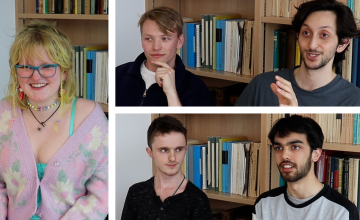
Photo of five students

Our final year students have now left us, in some cases never to return to mathematics, but in others to pursue the subject as researchers, in Oxford and across the globe.

However, before they left we asked some of them them to reflect on what they'd liked and disliked about the mathematics course, which parts of mathematics had really grabbed them, and whether they had any regrets - a fun and instructive exit interview, if you like.

Minimal activation with maximal reach: reachability clouds of bio-inspired slender manipulators
Kaczmarski, B Moulton, D Goriely, A Kuhl, E Extreme Mechanics Letters
Minimal activation with maximal reach: reachability clouds of bio-inspired slender manipulators
Kaczmarski, B Moulton, D Goriely, A Kuhl, E Extreme Mechanics Letters
Fri, 06 Dec 2024

11:00 - 12:00
L5

Spatial mechano-transcriptomics of mouse embryogenesis

Prof Adrien Hallou
(Dept of Physics University of Oxford)
Abstract

Advances in spatial profiling technologies are providing insights into how molecular programs are influenced by local signalling and environmental cues. However, cell fate specification and tissue patterning involve the interplay of biochemical and mechanical feedback. Here, we propose a new computational framework that enables the joint statistical analysis of transcriptional and mechanical signals in the context of spatial transcriptomics. To illustrate the application and utility of the approach, we use spatial transcriptomics data from the developing mouse embryo to infer the forces acting on individual cells, and use these results to identify mechanical, morphometric, and gene expression signatures that are predictive of tissue compartment boundaries. In addition, we use geoadditive structural equation modelling to identify gene modules that predict the mechanical behaviour of cells in an unbiased manner. This computational framework is easily generalized to other spatial profiling contexts, providing a generic scheme for exploring the interplay of biomolecular and mechanical cues in tissues.

Subscribe to